
Introduction
Calls for the establishment of a naval base at Port Stephens were first made in the early 1900’s, with no success. It was not until the immediate years before the First World War that the idea garnered government support.
With the establishment of the Royal Australian Navy on 10 July 1911, the need for adequate naval bases around Australia was examined. The Commonwealth Government had also obtained two British built submarines [AE1 and the AE2] in May 1914, and there was a need to build suitable docking and maintenance facilities for them. There was also the longer term need to expand the location of naval support infrastructure away from Sydney.
With these factors in mind, the Commonwealth Government acquired a large portion of land in the Salamander Bay district in 1916. It then commenced preparatory work for the construction for a of a naval submarine facility there.
Several factors were to eventually stall the development of naval facilities at Port Stephens. The need for a submarine base became less urgent when both submarines had been destroyed in combat by 1915. At the same time as the preparatory work at Salamander Bay was being undertaken, the Commonwealth Government was also developing a naval base at Flinders in Victoria. This was to become the favoured facility to which the government allocated the most funds at the expense of Salamander Bay.
By 1917 all preparatory work at the Port Stephens naval base had been suspended and was never re-commenced. The Commonwealth Government held on to its defence land at Port Stephens for over thirty years in case it was every needed again for defence purposes. Finally, on 1 January 1955, the land was sold to the Port Stephens Council for development purposes.
The story of the proposed naval base at Port Stephens is intuitive as it gives an insight into the Commonwealth Government’s defence strategy and planning in the years leading up to and during The First World War and beyond.
Calls for a Naval Base at Port Stephens – 1907
One of the first calls for the fortification of Port Stephens and the establishment of an associated naval base was made Mr. E. J. Paton who provided a lecture to the Karuah Progress Association on the topic of the “Future of Port Stephens.”
The Maitland Mercury, of 23 October 1907 reported:
‘To fortify Newcastle and leave Port Stephens in its present condition was to court defeat. The day was not far distant when Port Stephens, from its geographical position and natural facilities, might become a strong naval station. …… Port Stephens, the speaker concluded, may be comparatively little known or valued, but the day is not far distant when, as a port for deep-sea commerce and a naval base, it will force itself on the attention of the powers that be, and its value as a national possession will be realised.’
Calls for a Naval Base – 1909
The Maitland Mercury, of 27 August 1909, reported:
‘Mr. R. A. Price, M.L.A., has received the following letter from the Commonwealth Defence Department : Dear Sir, — With further reference to your letter of the 7th ultimo, covering a resolution passed at a public meeting at Nelson Bay, urging the advantages of Port Stephens as a naval training station I am directed to inform you that this is a matter for future consideration, as the Australian Navy is not sufficiently advanced to require bases. Furthermore, the proximity of Sydney to Port Stephens has an important bearing on the question. Regarding the training of the sons of fishermen and seacoast settlers, this could be arranged if the future naval scheme admits.’
Speculation Mounts About the Base – 1910
The Daily Telegraph, of 31 August 1910 reported on the visit of Vice-Admiral Sir Richard Poore to Port Stephens:
‘Considerable interest was manifested in the recent visit of Vice Admiral Sir Richard Poore, the Commander-in-Chief of the Australian Squadron, to Port Stephens. The Admiral landed there from H.M.S. Pegasus. The object of this visit, it is rumoured, was to make a personal inspection of the port, with a view of establishing a naval station there. It is also said that a suggestion was made that Broughton Island, about seven miles distant from Port Stephens, might be used as a submarine base.’
Visit by Admiral Reginald Henderson – 1910
The Sunday Times of 6 November 1910, page 7, reported on the visit by Admiral Reginald Henderson. He was commissioned by the Commonwealth Government to make recommendations on the future development of the Navy and its associated support facilities:
‘Our Newcastle correspondent wired last night: — Admiral Henderson visited Port Stephens today, and on Monday next will return to Newcastle for the purpose of making a further inspection of the harbor.’
Visit of Naval Experts – 1911
The Sydney Morning Herald of 22 July 1911, page 11, reported on a visit of Captain Bertram Chambers and other naval personnel to Port Stephens:
‘ “Port Stephens is really a magnificent harbour. I think it is very nearly a perfect naval base. I am immensely impressed with it. I have not the slightest doubt that some of the naval works will be established here, though I am not at liberty to say what.” These are the words of Captain Bertram Chambers, R.N., Director of the Naval College and second member of the Naval Board, spoken after a thorough investigation of the Cinderella port. Accompanied by Engineer Captain Clarkson and Commander Brownlow, District Naval Commandant for New South Wales, the director left Newcastle yesterday morning by launch, and after a 30-hours inspection endorsed the notion of Admiral Henderson, who chose Port Stephens as a naval base, and the decision of the Decentralisation Commission, who chose it as a deep-sea port. ……
A steamer flying the Australian flag and crowded with the O.C. [Officer Commanding] Artillery and his officers, steamed up from Newcastle passed the Bight, swung in towards Tomaree Head, leaving Yacaaba Head to northward and entered Port Stephens. Later on a launch followed suit, having on board the District Naval Commandant and a group of naval officers. This craft skimmed lightly over the placid waters to Salamander Bay. On the land side the ubiquitous automobile added its quota in the shape of the Inspector-General the Chief of Ordnance, and other officers. Back at Newcastle was the Minister for Home Affairs; with him the Under-secretary Colonel Miller, who knows Port Stephens as well almost as Port Phillip. The Minister pointed to a document dated10/3/11, asking the State authorities to reserve an area of land at Port Stephens for naval purposes. The State authorities evidently ignored the Cinderella port, for a “chaser” or “reminder” followed on 10/6/11. Possibly this will bear fruit.
Meanwhile Federal officers, military officers, and naval officers, feasting their eyes upon the silent port as upon some terra incognita, asked themselves the question: “Why this inexplicable neglect?” …….
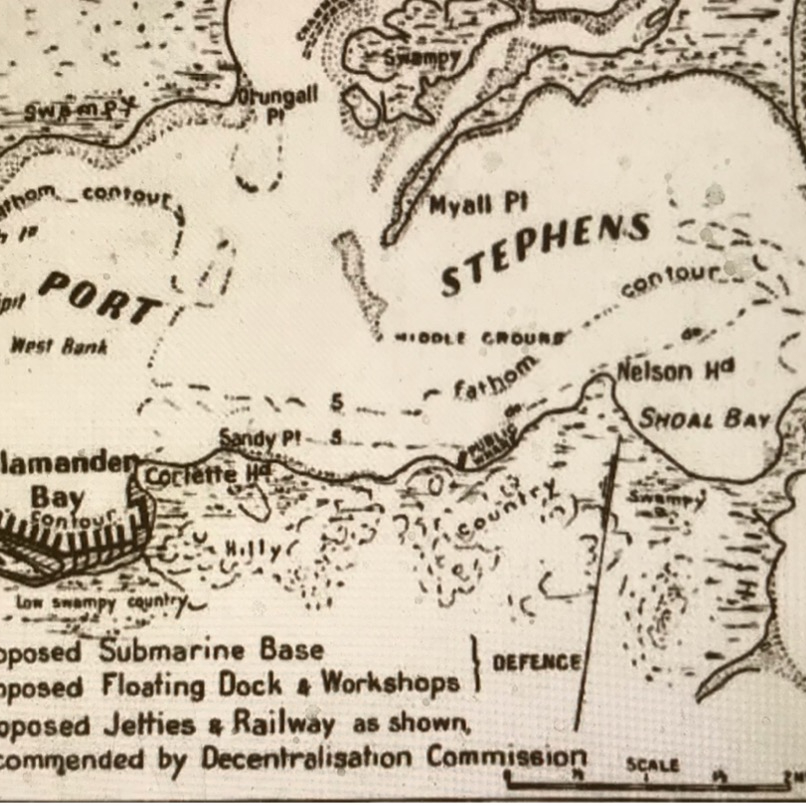
Admiral Henderson in his voluminous and comprehensive report on the formation of an Australian navy [publicly released in 1911] selected Port Stephens as the submarine base for the submarine flotilla of the eastern division of the navy. It was to be the first base to be developed. After commenting on the excellence of the harbour the Admiral said that it should be surveyed and examined thoroughly with a view to possible requirements of future naval expansion. Of the 52 vessels of the navy three—submarines— were to be stationed at Port Stephens.
In the list of urgent works the naval expert advised—
(a) Survey and examine thoroughly the harbour and the reserve land on the south side of Salamander Bay.
(b) Establish submarine base.
(c) Provide floating dock and workshops.
This is, of course, a federal matter. The application of Mr. O’Malley and the presence here of the naval experts prove that the initial steps at any rate are being taken.’
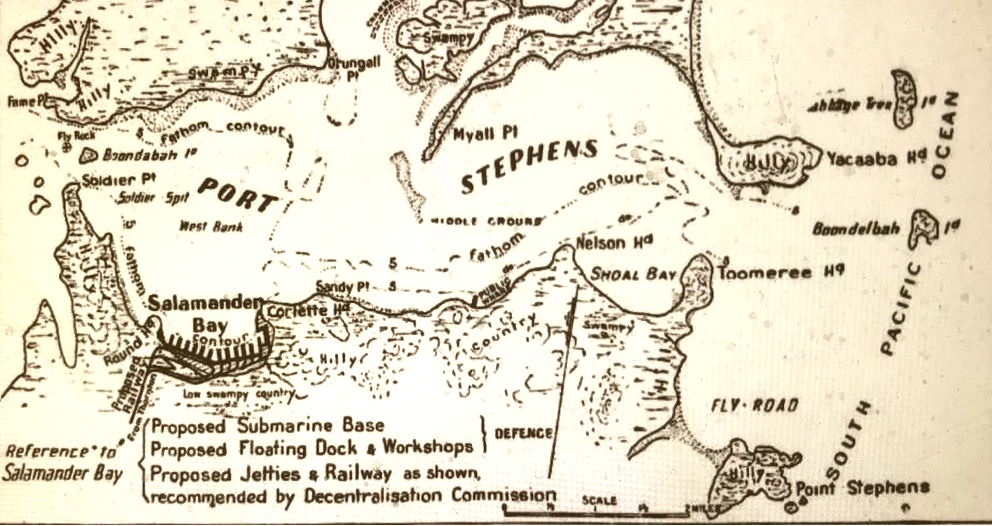
Diagram of the recommended naval works at Salamander Bay proposed by Admiral Henderson, as published in the Sydney Morning Herald of 22 July 1911.
Survey of Salamander Bay – 1912
The Evening News, of 7 August 1912, reported:
‘The steamer ‘Karuah’, .. on the last trip to the picturesque northern port had on board a portable cottage —a comfortable dwelling made in Sydney. Inquiries as to the destination of this abiding place revealed the fact that the Federal Government has sent an officer of the Defence Department (naval branch) to Port Stephens for the purpose of laying out a base for the Australian navy.
The spot selected, according to all accounts, is Salamander Bay, a fine stretch of water, between four and five miles from the entrance to Port Stephens, and a place calculated to suit the requirements of the Navy Board in every respect. This bay is sheltered from all wind and weather; also it is practically out of sight from the headlands forming the entrance to Port Stephens. In official circles it has been known for some time that the Navy Board had its eye on Port Stephens, and has got in first, so far as securing Salamander Bay is concerned. ……
The surveyor now on the spot is likely to spend about nine or twelve months over the work, and as a fleet of 16 ships can find safe anchorage, it is understood that the base is to be more than one in name only. The Defence Department has now taken up areas in two of the most important bays on the N.S.W. coast—Port Stephens and Jervis Bay. The distance from Sydney is pretty much the same, the northern port is 82 miles, and Jervis Bay 87 miles.’
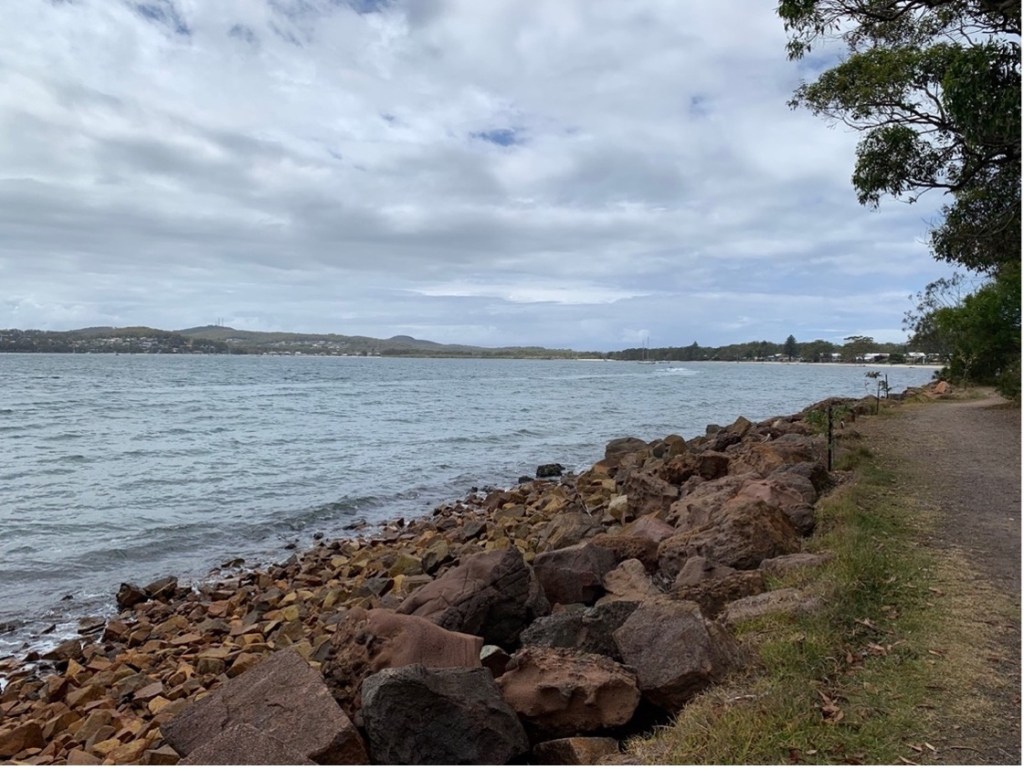
Salamander Bay [Author photo, January 2023]
The Raymond Terrace Examiner and Lower Hunter and Port Stephens Advertiser of 9 August 1912, page 3, further reported:
‘When Admiral Sir Reginald Henderson was visiting this country about 18 months ago, at the invitation of the Commonwealth Government, he presented a report to the Federal authorities with regard to the establishment of an Australian navy. In that report he strongly recommended Port Stephens as a naval base. As a consequence, the authorities at the Federal naval construction branch office, Melbourne, about six weeks ago sent a naval civil engineer, Mr. E. Bale, to Port Stephens, with the object of thoroughly surveying the harbor. Mr. Bale has established his camp at Corlette Head, which runs out from Salamander Bay. This latter stretch of water, which is about four miles from the entrance of Port Stephens, has, up to the present, occupied the whole of Mr. Bale’s attention.
The surveyor will, in all probability, spend 12 months on the work. In the meantime, all his reports have been sent on to headquarters at Melbourne: but so far no facts pertaining to the progress made, or to the suitability of the position as a naval base, have been disclosed. Referring on Wednesday night to the statements from Sydney that Salamander Bay had been selected as the site of the torpedo boat and submarine base on the northern coast of New South Wales, the Minister for Defence said that the naval civil engineer selected to superintend the Port Stephens works had been sent to the bay as the base for his survey work. Asked whether he had decided on the distribution of £90,000 available on the Works Estimates for the naval base works, Senator Pearce added that the Government would proceed this financial year with the works at the three sites for bases, namely, Westenport (Flinders naval base), Port Stephens, and Cockburn Sound.’
Survey Work Finalised – 1913
The Sun of 24 September 1913, page 12, reported:
‘If Captain C. F. Henderson. R.N., wore a wide-brim sombrero and a red sash with big brass earrings in his ears he might have been mistaken for a pirate chief last week. And if Dr. Brennand and Messrs. W. R. Swan, and E. Bale wore cutlasses and top boots as part of their customary dress they might have been mistaken for part of his crew helping him look for buried treasure on a Treasure Island. The party spent last week at Salamander Bay, on the southern shore of Port Stephens, and their resemblance to pirates lay in the fact that they carried a large chart about with them in many expeditions about the foreshores, and into the bush behind and every now and then examined it intently. Had they worn romantic clothes one would have been sure that they were trying to locate the spot where the booty had been buried.
In reality, the party was looking for a place where much treasure may be buried; it was considering the choice of a site for the first Australian Naval Submarine Base. Captain Henderson is senior naval officer of New South Wales, Dr. Brennand is principal medical officer, Mr. Swan is from the Navy Office, Melbourne, and Mr. Bale is naval civil engineer for New South Wales. Captain Henderson had been called upon to make a report as to the suitability of a site at Salamander Bay for the establishment of a submarine base. The other members of the party were experts assisting Captain Henderson. When Admiral Henderson— he is not a relative of the captain— made his report on Australian naval defence two years ago, he picked on Port Stephens as offering facilities for the establishment, in the first instance, of a submarine base. He wrote:— “Port Stephens is a very good harbor. My proposals only suggest its use as a Submarine Base for the present, but it should be surveyed and examined thoroughly, and land reserved with a view to possible requirements of future naval expansion.”
For many months the preliminary work of establishing the base has been in progress. It has consisted of making surveys, preparing charts, taking soundings of the bay and the entrance passage from Port Stephens Heads, five miles away, and of building a small wharf and accommodation house for the surveyors. That work has been in charge of Mr. Bale. Now the preliminary work is finished and the definite step of establishing the base has to be faced. Australian submarines are afloat in England and will be here before many months have passed. They will require a water-side house and a water-ground to play in and practice their deadly little trade. That is why the authorities have sent their experts to Port Stephens to make a last report before the work is begun, when withdrawal from the commitment would become impossible.
The general requirements which Admiral Henderson laid down for a submarine base were”— (a) A graving dock, floating dock, or slip capable of receiving one submarine at a time, possessing facilities for rapid docking, cleaning, and undocking. (b) Small workshops. (c) Enclosed wharfage accommodation for four boats, with facilities for adjusting gyroscopes. If desirable a suitable hulk might be used, but the structure must not be coppered. Good sleeping and other accommodation is required for all officers and men, either on shore or on the hulk. (d) Storage for adequate reserves of oil fuel.
In addition to these requirements Admiral Henderson recommended that the following special work should be carried out at Port Stephens: — (a) Survey and examine thoroughly the harbor, and reserve land on south side of Salamander Bay. (b) Establish submarine base. (c) Provide floating dock and workshops. The erection of a medium-power wireless station at Port Stephens to maintain ship-to-shore communication with the fleet was also recommended by the Admiral as a necessary work in the future. Captain Henderson would not give any opinion as to the proposed site for the submarine base. What he thought of it would be placed in his report. He would say, however, that he considered Port Stephens an excellent harbor and suitable for naval purposes. Dr. Brennand who visited the site to report as to its fitness, from the point of view of sanitation, said it was a delightful place. It was not only quite healthy, but even seemed to him to be a place where convalescent persons might go to get back their health.
The site of the base includes Corlette Head, which is the southern point of Salamander Bay, and parts of two sandy beaches on the east and west. It is surrounded by water on three sides, with hilly scrub country at the back, protecting it from the southerly winds. A deep-water channel, varying from 1800 to 2700 feet wide and carrying from 35 to nearly 100 feet of water, leads from the entrance to the port to Salamander Bay. This channel has been frequently used by warships, and on several occasions steamers of 10,000 tons have come into the bay to load timber. Corlette Head consists of high, rocky ground, somewhat like the north end of Garden Island. Between the east and west beaches is flat country, intersected by marshy creeks. Permanent water is obtained anywhere by sinking five or six feet. At 50 feet depth there is a solid sandstone formation. The present site consists of about 40 acres, but the adjoining land along Salamander Bay belongs to the crown, though some blocks to the west and south have been alienated. It is suggested that this Government land should be set apart as a naval reserve to be used for the “future expansion”, referred to by Admiral Henderson, and possibly, described in his confidential report, which has not been made public. The whole area would give the naval authorities a site which, one expert declares, “could be turned into a Garden Island, a Cockatoo Island, and a Botanical Gardens.” ‘
Naval Visit to Port Stephens – 1913
The Newcastle Morning Herald and Miners’ Advocate of 6 December 1913, page 6, reported:
‘Sir Maurice Fitzmaurice, C.E., accompanied by Rear-Admiral Sir William Cresswell, and Mr. H. Fanston, Director of Naval Works, will leave Sydney on Sunday evening to visit the site of the naval base at Port Stephens.’
Naval Base Receives Favourable Report – 1914
The Raymond Terrace Examiner and Lower Hunter and Port Stephens Advertiser of 20 February 1914, page 3, reported:
‘Sir Maurice Fitzmaurice who was commissioned by the Federal Government to report on the naval bases required for the defence of Australia, has the following to say about Port Stephens.— “I found that, as proposed by Admiral Sir Reginald Henderson, Salamander Bay was a particularly suitable place for a submarine base. The protective sea works necessary would not be of a serious nature, as the bay is naturally a well sheltered one from the heaviest winds, and the dredging required would not be great. From personal investigations and from information obtained, I am satisfied there is no difficulty in entering or leaving Port Stephens if the channels are better marked than at present.
An investigation will be necessary as regards the permanent water supply and the opening up of a quarry. It will not be possible to estimate what the cost of the necessary works will be until further information is obtained on these and some other points. “I am also of the opinion that it would be advisable to make an accurate survey of, and keep under close observation, the narrow neck of land connecting the North Head at the entrance to Port Stephens with the mainland. If this neck of land were breached at any time it would have a serious effect on the deep-water channels within the entrance. If after careful inspection, there appears to be any chance of serious damage at this place some small works should be undertaken for its protection.” ‘
Minister for Defence Visits Port Stephens – 1915
The Bathurst Times of 16 January 1915, page 5, reported:
‘Senator Pearce, Minister for Defence, visited Port Stephens this morning and inspected the proposed naval base.’
Possibility of Chief Naval Base to be Established – 1915
The Farmer and Settler of 16 April 1915, page 2, reported:
‘Rear-Admiral Sir William Cresswell, first member of the Commonwealth Naval Board, gave evidence on Wednesday before the Commonwealth Parliamentary Standing Committee on Public Works on the question of the naval base at Western Port Victoria. In reply to questions by the chairman, witness said that Port Stephens was an excellent place for a destroyer and torpedo base, and the idea at the back of his head was that Port Stephens would ultimately become the chief naval base.’
Further Survey Work Proposed – 1915
The Sydney Stock and Station Journal of 18 May 1915, page 4, reported:
‘It is the intention of the Federal Government, so the assistant Defence Minister told Mr. Charlton in reply to an inquiry in the House of Representatives on Friday to send to make surveys and take soundings with a view to the utilisation of the port on a naval base as recommended by Admiral Henderson and other naval experts. There is a sum of £5000 on the Estimates for the purpose. Mr. Poynton inquired whether the Government was proposing to do anything of a similar kind at Port Lincoln, South Australia. The Minister replied in the negative.’
Newcastle Unemployed Employed at Base Works – 1916
The Maitland Daily Mercury of 13 April 1916, page 4, reported:
‘The Commonwealth Government is pushing ahead with preliminary work in connection with the creation of a naval base at Port Stephens and surveying and clearing operations are in progress. Mr. Walkenden, officer in charge, visited Newcastle on Tuesday, and was interviewed by Mr. A. Lewis, treasurer of the Colliery Employees’ Federation, in regard to the placing of members of that organisation who are suffering from slack employment owing to the dullness in the coal trade.
Mr. Walkenden pointed out that men at present on the work were engaged clearing away scrub and timber to allow tents being pitched and a camp being formed, this being a necessary preliminary to the employment of the large number of men who will be required. This work, it is anticipated, will be sufficiently advanced to allow of the employment of a great many men in a couple of weeks. A further conference on the matter is to take place in Newcastle today. A very large number of members have registered at the office of the federation for work at the naval base. For the most part, they are married men with families, very little cognisance having so far been taken of single men, and many of the applicants are said to be in distress owing to prolonged unemployment.’
The Maitland Daily Mercury of 19 April 1916, page 3, further reported:
‘The preliminary work in connection with the employment of a large number of men on the development of the naval base at Port Stephens is so near completion that the authorities will be ready to engage men immediately after the Easter holidays. The executive officers of the Colliery Employees’ Federation have been actively seeking the placement of unemployed members on the work.
Messrs, J. M. Baddeley (the president), and W. Brennan (secretary) visited Port Stephens on Sunday, and as the outcome of negotiations with Ministers and with Mr. Walkendon, the director of the works, they have secured employment for 250 members of the federation. One hundred and fifty men — comprising 125 members of the federation, and 25 members of the Coal Trimmers’ Union— are to proceed to Port Stephens on Tuesday evening next, and batches of 25 per week are to be sent up subsequently.’
Work Appreciated by Colliery Employees – 1916
The Maitland Daily Mercury of 13 May 1916, page 4, reported:
‘Good progress is being made with the preparatory work in connection with the naval base at Port Stephens. In the prevailing slackness in the coal trade, the work has proved a great relief to colliery employees, and is attracting them front all parts of the Newcastle and Maitland districts. The change of work is, in fact, being appreciated by them, according to reliable accounts.’
Commonwealth Government Acquires Land for Base – 1916
Under the provisions of the Lands Acquisition Act 1906, the following notice and diagram were published in the Commonwealth of Australia Gazette of 25 May 1916 (No.64), page 1198, notifying the acquisition of the following land for defence purposes at Port Stephens ……..
‘All that piece or parcel of land at Port Stephens, being part of parish of Tomaree, ……. as shown hachured on plan hereunder: Commencing at a point being the intersection of the western boundary of portion 49, parish of Tomaree, with the high-water mark of Port Stephens ; thence southerly by part of that western boundary to a point being a north eastern corner of portion 27 ; thence westerly by the northernmost boundary of portion 27 to the north-western corner thereof; thence southerly by the western boundary of portion 27 before mentioned and its further production southerly to its intersection with the production easterly of the southern boundary of portion 20, parish of Tomaree; thence westerly by the last-mentioned production and the southern boundary of portion 20 to a point on the high-water mark of Port Stephens ; thence northerly by that high-water mark to Carumba or Mud Point; thence southerly, easterly, and northerly by the high water mark of Cromarty’s Bay; thence northerly by the high-water mark of Port Stephens to Soldier’s Point; thence southerly by the high-water mark of Port Stephens to Wanda Wanda or Round Head ; thence easterly and northerly by the high-water mark of Salamander Bay to Corlette Point; thence easterly by the high-water mark of Port Stephens to Sandy Point; and thence further easterly by that high-water mark to the commencing point, saving and excepting out of and from the land above described portion 17, parish of Tomaree, already the property of the Commonwealth.’
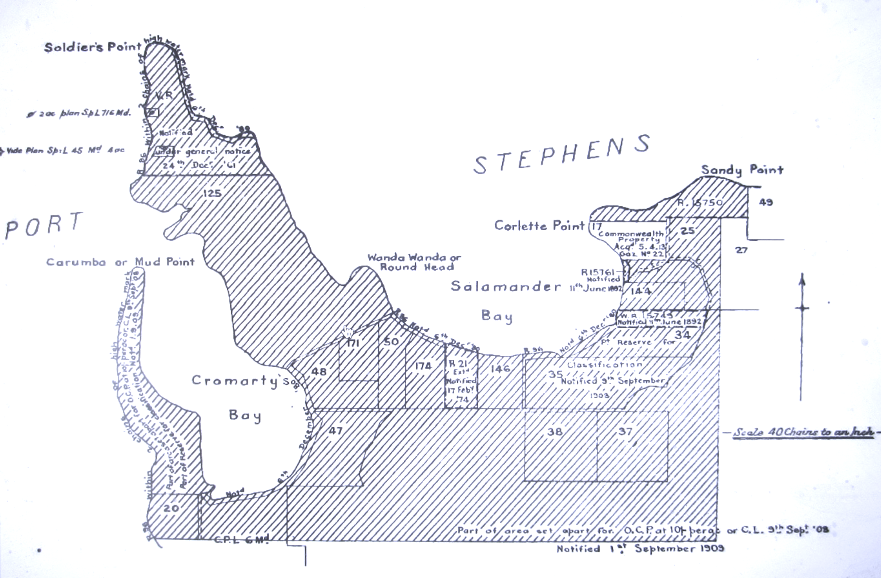
Diagram of land acquired for defence purposes at Port Stephens as published in the Commonwealth of Australia Gazette.
While the Commonwealth Government reserved the land for defence purposes at Port Stephens in May 1916, it was not until April 1918 that the Government allocated £25,000 for the purchase of the required land.
The Raymond Terrace Examiner and Lower Hunter and Port Stephens Advertiser of 9 June 1916, page 3, reported on the land acquisition:
‘The Commonwealth Government have for defence purposes resumed a large tract of country on the foreshores of Port Stephens, and the loss to this council in rates occasioned by such resumption will amount approximately to £30.’
Accident at the Naval Base – 1916
The Newcastle Argus and District Advertiser of 15 July 1916, page 3, reported on an accident which occurred during the preliminary construction works:
‘On the 22nd of May last, Frederick Odgers and Samuel Wells were thrown to the ground through a planking (3 x 1 in.) breaking, whilst working on scaffolding, at the Naval Base, Port Stephens. The distance the men fell was about 9 feet. Wells escaped without injury, but Odgers cut his arm and hurt his leg. He could not work for some days and was taken to his home at Teralba.
Odgers came back to Port Stephens and worked until the 5th June, when he complained of his leg and had to go home again. He was removed from Teralba on the 14th June to the Wallsend Hospital, where he died on the 19th June. Deceased told Dr. F. G. Shallshear he had ulcers on one leg before the accident. The doctor was inclined to think that the exciting cause was the fall, inasmuch as it caused the veins of the leg to become affected by the ulcers, and so setting up general septicaemia (blood poisoning).
At the inquest held at the Wallsend Court House, on the 7th inst., Coroner Hibble entered up :— Deceased died at the Wallsend Hospital from Septicaemia, such being accelerated through an injury accidentally received at the Naval Base on the 22nd May, through deceased falling from a plank whilst at work there, or, in other words, that death was due to injury accidentally received.’
Preparatory Work Suspended – 1917
The Newcastle Morning Herald and Miners’ Advocate of 14 February 1917, page 5, reported:
‘Casual reference to the work at Port Stephens was made in the Federal Coal Court yesterday. Mr. A. Lewis, treasurer of the Colliery Employees’ Federation, said they had close on 300 men engaged there some time ago, occupied in excavation work, road forming, gutter clearing, drainage, and preparations for wharfage. “How many are there now?” inquired Mr. Justice Edmunds. “Not half a dozen,” replied Mr. Lewis. “I was so assured yesterday by a man who had just returned.” The work was in connection with the Naval Base, and is now entirely suspended.’
Analysis of Rock Extracted at Naval Base – 1918
The Newcastle Morning Herald and Miners’ Advocate of 17 July 1918, page 5, reported:
‘In accordance with instructions, Mr. M. Morrison, Geological Surveyor of the New South Wales Department of Mines, has made an examination of the country along the foreshores of Port Stephens, with the object of locating deposits of rock suit for roadmaking purposes. The officer’s examination was confined to that part of the port easterly from Soldier’s Point, on the southern shore, and Fame Cove, on the northern side. The quarry referred to by the secretary of the Local Government Association as being worked by the naval authorities is situated at Wanda Wanda, or Round Head, on the southern shore, and is within the area that has been acquired by the Commonwealth Government for naval purposes.
The quarry has been opened by cutting away the base of a low hill along the shore line. The face is semi-circular in extent, and varies front five to 15ft in height. The hill rises to a height of about 60ft above sea level, the surface in places being composed of sand. The rock is a dense, hard, quartz felspar porphyry, varying in colour from white to pink, on the weathered faces, to dark grey when unaltered. Slight variations in texture occur in places. It is an igneous rock, with a finely-textured base, through which are scattered crystals of quartz and felspar relatively large, as compared with the basal texture.
Chemically, the rock is almost identical with granite, but differs materially in structure, and has the mechanical advantage of a more intimate blending of the mineral components. Generally, the stone possesses most of the requisites of a good road stone. It is hard, fairly tough; has good binding properties, and low absorption. Its value for road purposes can only be definitely determined by practical tests on the road, as there are no machines in New South Wales with which a series of systematic laboratory tests might be carried out. Although it is perhaps not equal to the Kiama “metal” (basalt) for road-making purposes, Mr. Morrison has no doubt that it is a good road stone.
Owing to the limited rock outcrops, no attempt was made to estimate the quantity of stone available, but there is little doubt that an extensive quarry could be developed. Similar stone to that in the quarry occurs at South Head or Tomaree, Nelson’s Head, near Nelson’s Bay, Soldier’s Point, Middle Island, and Fame Cove. These deposits are undeveloped, and are so situated that the product could be placed on board ships at low cost. The Fame Cove and South Head deposits appear to present the most favourable conditions for starting extensive quarries. The other deposits are each rather limited in extent for the development of really big quarries.’
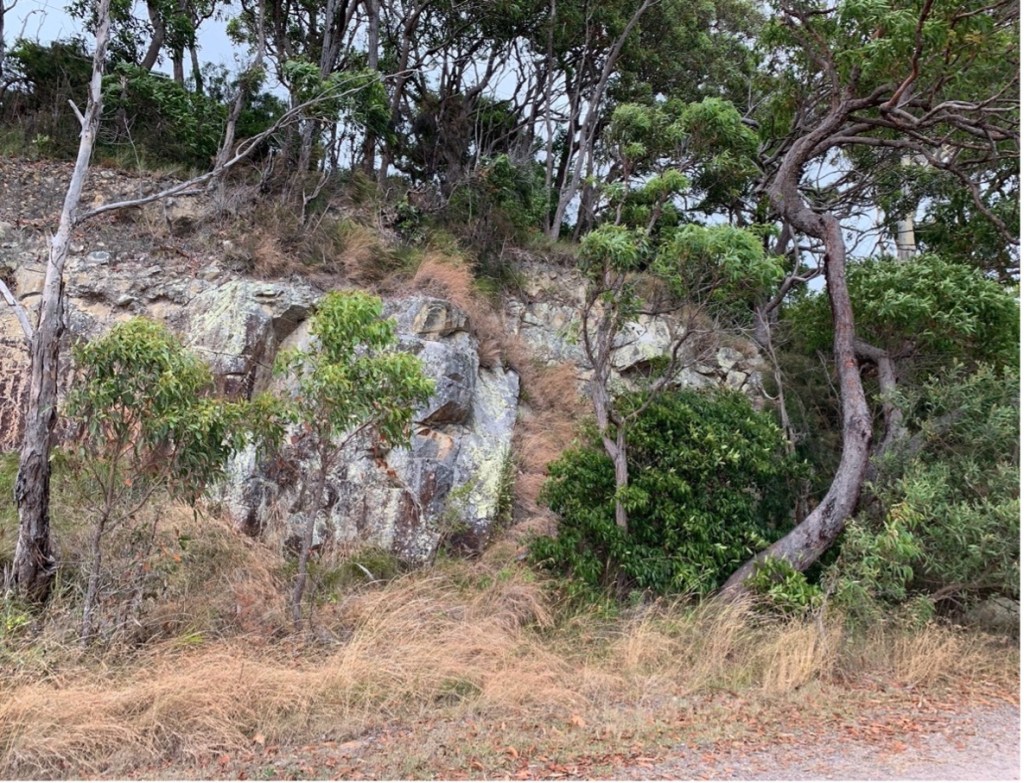
Part of the rock face left after preparatory works at the Salamander Bay Naval Base were completed, and referred to in the above geological report [Author photo, January 2023]
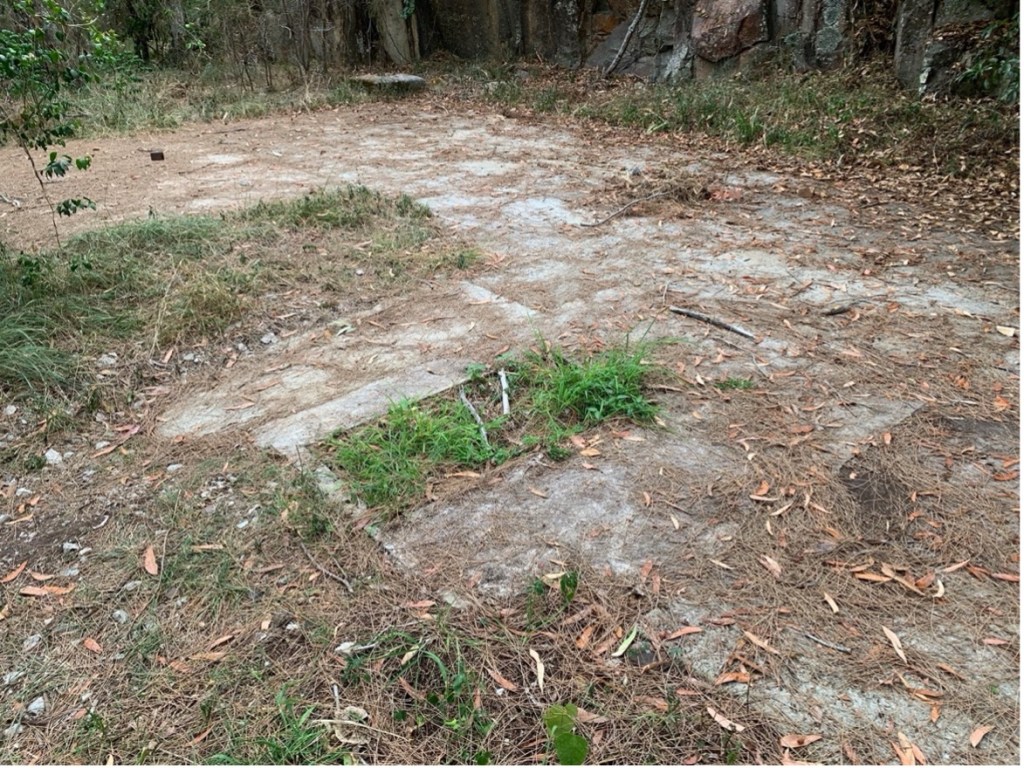
Floor of building in area excavated by unemployed mining employees at Wanda Wanda, Salamander Bay [Author photo, January 2023]
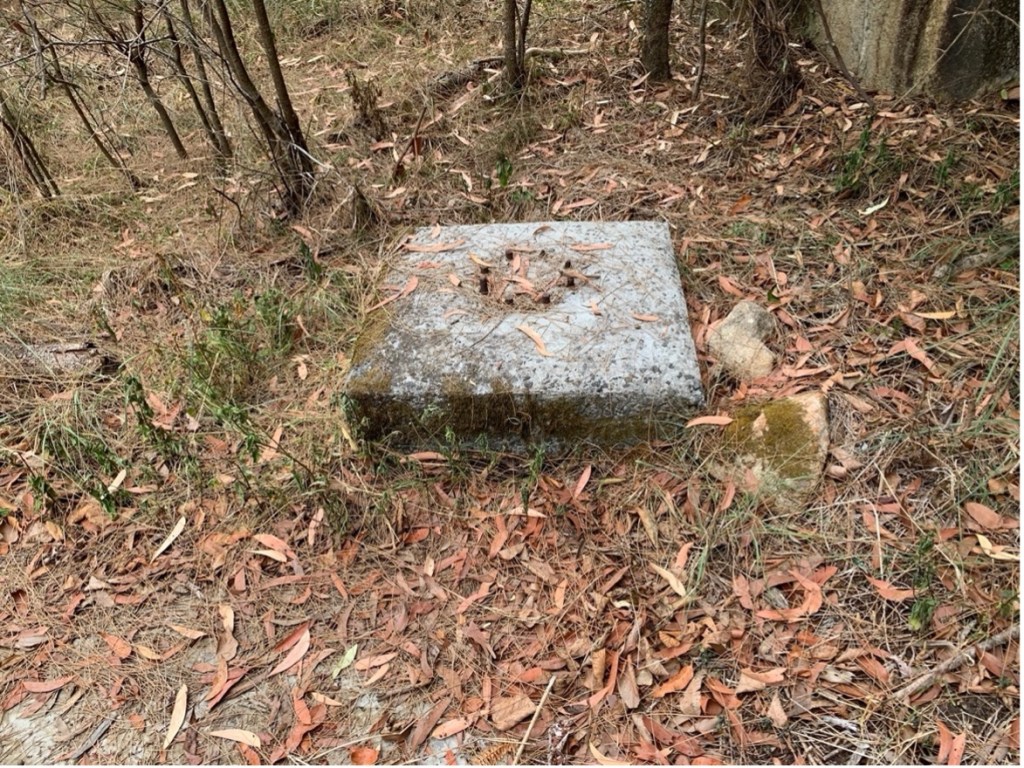
Equipment foundation in area excavated by unemployed mining employees at Wanda Wanda, Salamander Bay [Author photo, January 2023]
Lack of Progress with Navy Base Raised in Parliament – 1918
The Maitland Daily Mercury of 30 October 1918, page 7, reported:
‘Speaking in the House of Representatives on the Naval Defences Vote, on October 23, Lieut.-Col. Abbott (New England), said it was proposed to spend £1,242,000, largely for naval and military defence purposes, and he did not criticise expenditure on such defence works, seeing that we are now in the midst of a war.
He directed attention to the expenditure upon the Flinders — also called Port Western — Naval sub-Base [in Victoria], which, from the point of view of our naval protection, he said was in exactly the same category as the proposed sub-base at Port Stephens, in New South Wales. Already no less than £471,000 had been spent on the Victorian sub-base at Flinders. It was proposed, under this measure, to provide an additional amount of £190,000; and assuming that this vote be passed, and the money spent, there would at the close of this year have been no less than £661,519 expended on the Flinders Naval Base.
In exactly the same category, and intended to serve identically the same naval purpose, the establishment of a Naval sub-base at Port Stephens was recommended by Admiral Henderson. It was recognised by all unbiased authorities that, as a harbour, Port Stephens is equal to, if not better than Port Jackson. There is a depth of 42 feet of water there right up to the foreshore, and 60 feet in the basin, and no dredging would be required there at all. The facilities afforded there are greatly superior to those of Newcastle Harbour. Here they had a natural port recommended by Admiral Henderson as a sub-base, and yet whilst, up to the end of the present financial year, no loss than £661, 519 will have been provided for the Flinders Naval Base, the total amount expended so far at Port Stephens is £41,000.
There was a vote of £25,000 provided, in the schedule for the purchase of land at Port Stephens, and assuming that it was agreed to and expended, there would then have been spent on this sub-base only £66,236. He asked why, if Admiral Henderson’s report is to be relied upon, the Naval Base at Port Stephens is neglected, in order that the money available may be spent upon other sub-bases.
Admiral Henderson, in his report of 1911, suggested, so far as Port Stephens is concerned: — 1. Survey and examine harbour and reserve land on south side of Salamander Bay. 2. Establish submarine base. 3. Provide floating dock and workshops. Very little of that programme has been carried out, and yet if these proposals were good with respect to the Flinders Naval Base they were equally good with respect to Port Stephens. He asked why at that late stage, and after four years of war, it was only now proposed to vote money for the purchase of land provided for in the recommendation made seven years ago by Admiral Henderson.
He recommended, that these works should be gone on with, and his recommendation had been given effect to in the case of the Naval Base at Flinders. If it was good for Flinders, why, had the establishment of a Naval Base at Port Stephens been neglected, and why were the Government today merely asking for money to purchase land there?’
Viscount Jellicoe Visits Port Stephens – 1919
The Sydney Morning Herald of 4 August 1919, page 6, reported:
‘At 7 a.m. on Sunday morning Viscount Jellicoe and party left Newcastle by motor cars for Salt Ash, where they boarded launches and proceeded on an inspection of Port Stephens. The Admiral landed in Salamander Bay, where some pioneering work was previously carried out for the naval authorises. He returned to the launch and visited the imposing entrance to this vast sheet of protected water.
Commodore Dumaresq proceeded to Port Stephens with the two destroyers which had reached Newcastle on Saturday. These both returned to Sydney later on. There were no public functions during Sunday, the Inspection being solely associated, with the Admiral’s mission. The Admiral and his party returned to Newcastle during the afternoon and come on from there to Sydney by train, arriving on Sunday night.’
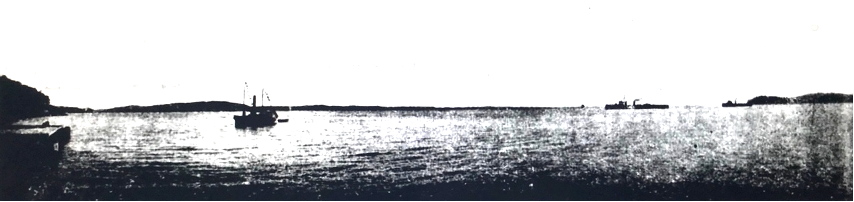
Admiral Lord Jellicoe visiting Port Stephens, on the launch in the foreground [Construction and Local Government Journal, 15 March 1920].
Further Funds Approved for Naval Base – 1919
The Daily Observer of 18 October 1919, page 2, reported:
‘The latest Federal Estimates contain an item of £13,000 for the carrying out of naval base works at Port Stephens. It is understood that in his report Admiral Jellicoe strongly recommended this as the premier naval base of the Commonwealth.
Port Stephens has been a naval base for some years, but beyond the construction of a flimsy jetty for small craft and the erection of a few tin sheds nothing serious has been done. Actually, the port has never been used, owing, probably to the continuous absence of the Commonwealth fleet for the last four and a half years. There is every likelihood now that the port will become a busy centre of naval activity, which may result in the growth of a new city there.’
Navy Base Included on Survey Map – 1920
In 1920, the H.M.S. Fantome [a government survey ship] was in Port Stephens engaged in survey work. A map, which includes the naval base, was published, based on the survey work undertaken by the survey party. A portion of the survey map [as shown below] indicates the locations of the naval wharf, buildings, and access roads.
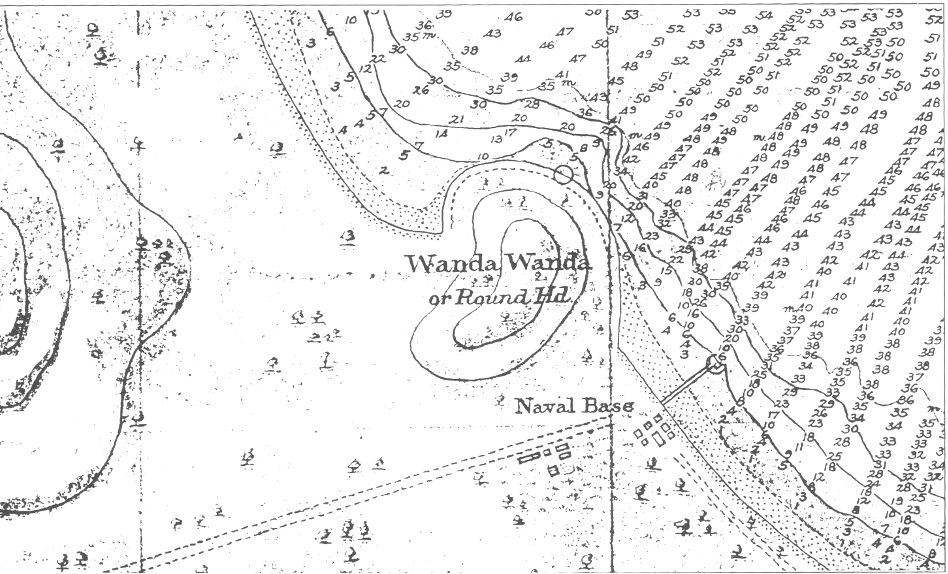
Part of the map based on the survey work of the H.M.S. Fantome, which shows the Salamander Bay naval base.
When the Fantome had completed the marine survey of Port Stephens, rumours incorrectly spread that its survey work may signal the start of new work at the naval base site. The Raymond Terrace Examiner and Lower Hunter and Port Stephens Advertiser of 31/8/1920, reported:
‘It is understood that as a result of the survey recently made by H.M.S. Fantome, a gang of men will shortly be employed at the Naval Base. The work was commenced five or six years ago, but had not proceeded for any length of time before the authorities called a halt in the operations. Since then nothing has been done. Lord Jellicoe had a look at the place twelve months ago, and the warship mentioned has been for some weeks on a surveying mission.’
Naval Base to be demolished – 1922
The Sydney Morning Herald, of 22 November 1922, reported:
‘The naval base at Salamander Bay, Port Stephens, is shortly to be demolished and the extensive plant, buildings, and equipment will be sold by public auction by Messrs Creer and Berkley on Tuesday December 5, and following days. The naval base was established under the Henderson naval defence scheme, but owing to a drastic cut in the defence vote insufficient funds were available to permit of the development or continuance of the base. It was originally intended for a submarine base, but was found impracticable for that purpose. A caretaker has been in charge of the establishment, which is otherwise deserted, except when the Australian fleet pays an occasional visit. …..
Instructions have been given by the works director of New South Wales of the Commonwealth Department of Works and Railways to dispose of the whole plant, stores, furniture, and all buildings at the base.’
Commonwealth Expenditure on Naval Base Revealed – 1922
The Newcastle Sun of 25 November 1922, page 4, reported:
‘The expenditure on works at the Port Stephens naval base up to the date when work was suspended was £35,000. The Secretary to the Navy states that he understands this amount does not include payment for land which may have been reserved or taken over.’
Clearance Sale Advertised – 1922
The Raymond Terrace Examiner and Lower Hunter and Port Stephens Advertiser of 1 December 1922, carried the following advertisement for the clearance sale of items at the former naval base at Salamander Bay:
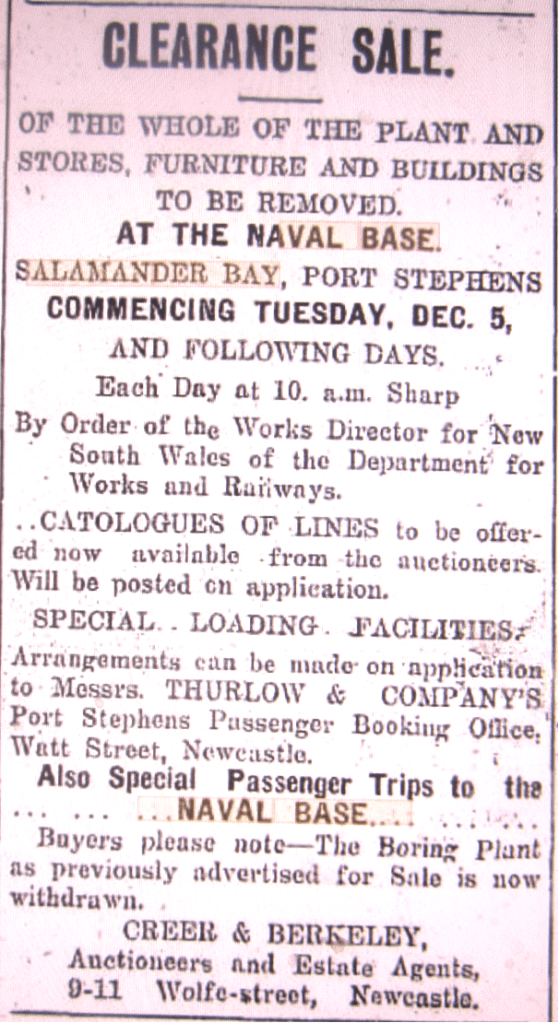
Advertisement for clearance sale in Raymond Terrace Examiner and Lower Hunter and Port Stephens Advertiser of 1 December 1922.
Port Stephens Shire Council Buys Navy Lands – 1954
For over thirty years after the closure of the Salamander Naval base, the surrounding area of land acquired by the Commonwealth Government remained largely undeveloped. This changed in 1954 when it was announced that naval base land would be sold to the Port Stephens Council for development.
The Scone Advocate of 10 September 1954, page 6, reported:
‘Following a Federal Cabinet decision on the matter, Executive Council approval has now been given to the sale of the Naval Base area of Soldiers’ Point to the Port Stevens Shire Council. The sale followed four years of constant effort by the Federal member, Mr. Allen Fairhall, Liberal member for Paterson, to see that the 3000 acres of the Naval Base lands were opened for free hold tenure and development. Mr. Fairhall said Council would purchase the entire property for £50,000, subject to existing tenancies on the basis of an initial low deposit and the balance payable in annual instalments over a period of fifteen years at an interest rate of 4¾ per cent. per annum. He said that in discussions, Council had agreed that special consideration would be given to the cases of people on pensions who held leases in the area and might not find themselves in a position to buy their property.
The question of fixing valuations and the provision of Local Government services will now become one for the Port Stephens Shire Council, whose area surrounds Soldiers’ Point. It may confidently be expected, added Mr. Fairhall, that Soldiers’ Point will go ahead and show some progressive development as a holiday and residential centre on one of the finest inland waterways on the Coast.’
Transfer of the land to Port Stephens Council was effected on 1 January 1955. The area was later subdivided by the Council and sold as residential land.
Concluding Comments
Following the closure of the naval base at Salamander Bay, further efforts were made from time to time to have naval facilities again established within Port Stephens. Naval authorities and politicians continued to be aware of the suitability of Port Stephens for navy purposes, and its advantages continued to be advocated by interested parties. The development of a future naval facility never came to pass.
The Daily Examiner of 19 May 1923, page 4, reported:
‘The Minister for Defence (Mr. E. K. Bowden) stated on Monday that he would require further expert, opinion before seriously considering the suggestion that a naval base should be established at Port Stephens. A naval base was previously established at the northern port, under the Henderson scheme, but it was recently demolished and sold by auction. The site of the base was Salamander Bay. Admiral Jellicoe recommended the establishment of a base at this port.’
The Sydney Morning Herald of 5 May 1939, page 16, reported:
‘Although the development of Port Stephens as a naval base has been considered by the Defence authorities all the funds available are required for other defence works and no work can be undertaken there at present, according to a reply made by the Minister for Defence, Mr. Street, to a question asked in the House of Representatives today by Mr. Watkins (Lab., N.S.W.).
“Consideration has been given to the development of Port Stephens as a naval base and the advantages of the port are well known to naval authorities,” said Mr. Street. “Funds available however are required for naval projects of a more urgent nature, and the present naval development programme does not provide for any work being undertaken there.” ‘
The final military event at the Naval Base was held in March 1922 when the Royal Australian Navy Annual Fleet Regatta was conducted at Port Stephens for the first time. Further information on the Regatta is published at the link on the website.
Researched and compiled by Kevin McGuinness
January 2023

 Port Stephens - a history exploration