
Introduction
Port Stephens has been a destination for recreational and commercial pursuits from the late 1800’s. The main activities in the early years centred around fishing, swimming, boating and camping.
On several occasions over the years, such activities have resulted in some tragic deaths, which attracted much media attention at the time
The stories of two such tragic events are told below. They are a testament to the bravery of those who attempted to save the lives of those in peril.
Sympathy is offered to the descendants of those who have lost their lives in the Port Stephens district over the years from recreational and work-related tragedies.
LANDSIDE AT ONE MILE BEACH – ANNA BAY 1927
On the Easter weekend in April 1927, a record amount of heavy rain fell on Sydney, Newcastle and other coastal areas. Considerable flooding occurred in parts of the affected areas, resulting in disruption to rail and road transport.
The Sydney Mail of 20 April 1927, page 24, reported on the torrential downpours in the following manner:
‘From Thursday morning till Saturday night heavy ram fell over a wide area of the coastal districts. Shipping was brought practically to a standstill, and a considerable disorganisation of railway traffic was caused by numerous landslides and washaways. Many of the low-lying parts of the [Sydney] Metropolitan area, Newcastle, and other localities were flooded.’
At One Mile Beach, near Anna Bay, the rain event caused a tragedy. A large landslide was triggered causing the death of one camper and injuries to others.
This is the story of that tragic event and of the difficulties experienced by authorities to provide assistance to the campers.
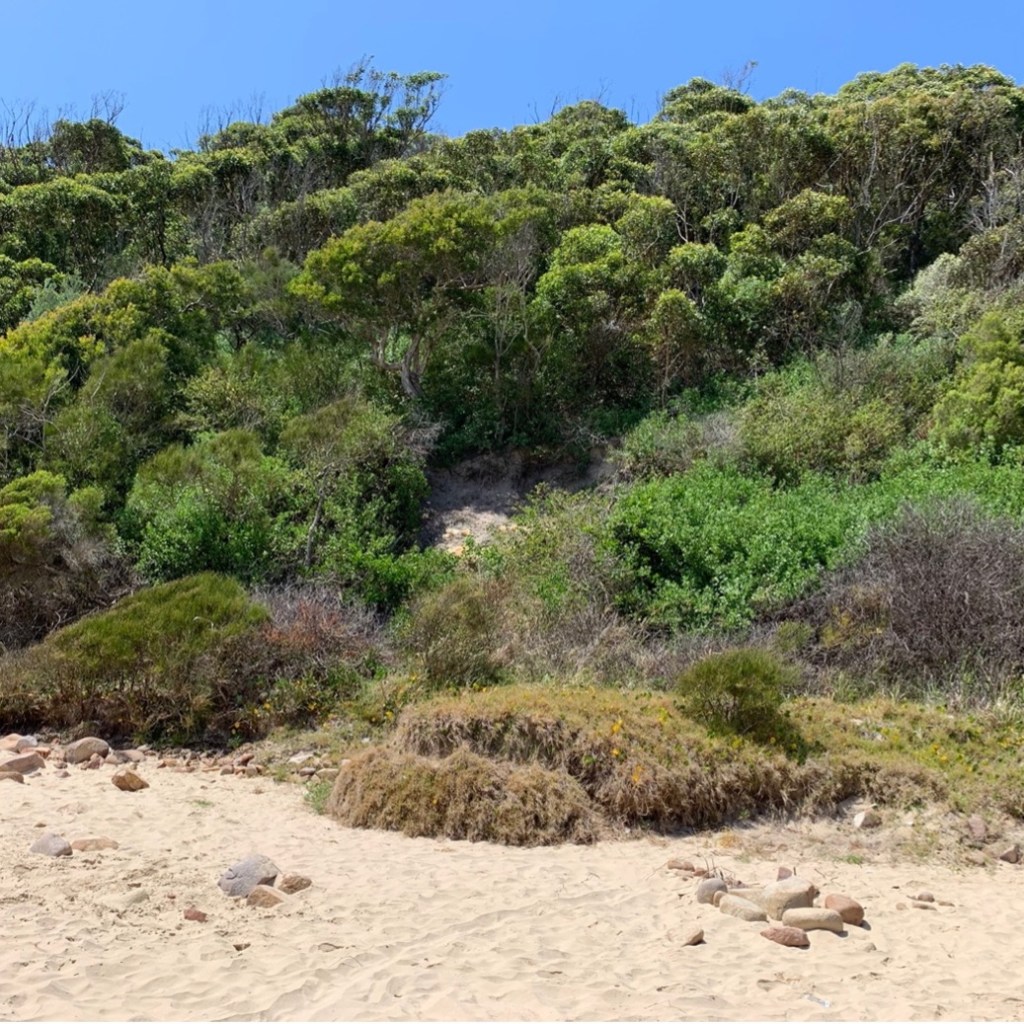
One Mile Beach in the vicinity of the landslide [Author photo, January 2023]
News of the tragedy breaks
The Evening News of 16 April 1927, page 1, reported:
‘One man was killed, and three others were temporarily buried, in a landslide at Anna Bay this morning. This message was received at Newcastle Police station today. Interruptions to the telephonic service have made it impossible so far to obtain the names of the injured, or to ascertain the extent of the disaster. It is believed, however, that the four men were camping under a sand bank, which collapsed before they could escape. Three ambulance cars have been despatched to the scene.’
Further news of the Landslide
The Newcastle Morning Herald and Miners’ Advocate of 18 April 1927, page 6, reported:
‘Coming away from within about 200 feet of the top of a hill 500 feet high, at One-mile Beach, Anna Bay, on Saturday morning, a mass of sand, earth, and stunted trees overwhelmed two tents and nine campers, and buried them in a gully seven feet. One of the men, Harry Davis, …. was killed. The others escaped with minor injuries. It is estimated that the mass that came down weighed about 400 tons.
The party left by motor lorry on Thursday night for One-Mile Beach with tents and fishing gear, intending to stay there over the Easter holidays. It rained incessantly from the time they started, and, they were unable to do any fishing. They decided to return Saturday morning and preparations had been begun for their departure. …… About half-past eight o’clock the landslide occurred, sweeping men and tents into the gully. All, with the exception of Davis, scrambled out with assistance, which was readily forthcoming from other campers in the vicinity. About ten minutes later it was discovered that Davis was missing, and on a search being made his legs were seen protruding above a mass of sand and with his body pinned by a tree. He was soon extricated, but the unfortunate man was beyond aid. He had sustained severe head injuries, and was probably asphyxiated.
A telephone message was sent to the Newcastle Ambulance Transport Brigade, and two cars were despatched to the scene. The road was in a very bad state, and for about three parts of the way the cars were up to their running boards in water. Davis’ body was taken to the Newcastle Hospital, where formal pronouncement of death was made …. [One of the survivors] was admitted [to hospital] suffering from a contusion of the left leg and shock. ….. Mr. J. Dolan, superintendent of the ambulance, also went to the scene of the accident following the other cars. He found that the other members of the party were not seriously hurt. They remained to collect the belongings of themselves and their friends, and returned home by motor lorry.’
The Labor Daily of 18 April 1927, page 7, provided further information on the tragedy:
‘Preceded by a warning roar, about a ton of sand, rocks and scrub plunged down a hillside at One Mile Beach, near Anna Bay, yesterday, overwhelming a camping party of nine miners. ……
The men had been camped in the incessant rain since Thursday, and about 8.30 a.m. determined to go home. They were in the act of packing up when the landslide crushed on the back of their tent, sweeping all before it. [Two of the party] were pinned by the legs, and [another] was almost buried. Their mates and men from the nearby camps rushed to their assistance and worked frantically to release them.
Davis had been in the back of the tent, and despite strenuous efforts it was about 10 minutes before he was freed. He was dead, a big boulder having been resting on his head, which had received severe injuries. The greatest difficulty was experienced by the drivers of the three ambulance waggons in reaching the scene, which was 22 miles from Newcastle. More than two feet of water lay on the road for many miles. It was not till 3 in the afternoon that the injured men arrived at the hospital, where they were seen to be suffering badly from exposure, most of their clothes having been lost. One of the injured men said they heard the row of the falling earth but had no time to get out of the tent.’
The Sydney Mail of 20 April 1927, page 24, published the following photograph of one of the Newcastle ambulance cars returning from Anna Bay, where a tragedy had occurred on Saturday morning, one man being killed and two injured in a landslide which swept down upon a party of nine campers.
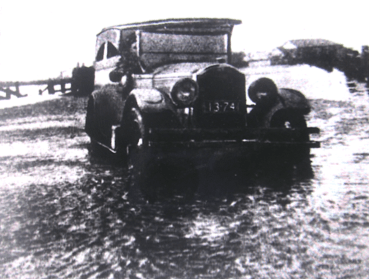
Newcastle Ambulance returning from Anna Bay
Coroner’s Inquest
The Newcastle Morning Herald and Miners’ Advocate of 17 May 1927, page 4, provided a report on the proceedings of the Coroner’s Inquest:
Mr. Hibble, the district coroner, held an inquest at the Newcastle Courthouse, yesterday afternoon, into the circumstances surrounding the death of Henry Davis. Deceased and eight companions were camped at the foot of a hill at One Mile Beach, Anna Bay, at Easter, when a huge landslide came away from a considerable distance up the hill, and completely enveloped the camp. After being forced over a small rise, deceased was deposited in a gully, and covered with the slimy earth. It was about five minutes from the time he disappeared over into the gully, until he was extricated. Sergeant Toohill conducted the inquest on behalf of the police. James Davis, a carpenter, living at Adamstown, said his deceased brother was 37 years old at the time of his death, Deceased was born at Merewether. He was a single man, and a coal miner by occupation. He last saw his brother alive on April 13, when he was in his usual good health,
Robert H. Macintosh, living at Adamstown, said he was one of a party which left Adamstown in a motor lorry to go to Anna Bay. On arrival there the party pitched two tents at the foot of a hill. It commenced to rain very heavily. Deceased was in his tent and he said to Quinton Watt, the driver of the lorry, “You had better go and see if your engine is all right.” Watt went to the lorry, and when returning, called out: “Look out, boys,” and the next he (witness) knew was they were in the midst of a landslide. Deceased was swept away over into the gully nearby, and was completely covered. Witness said he managed to raise his hand and saw Gilpin close by. As soon as he cleared himself, he commenced a search for deceased.
Later, he saw some of the men pulling deceased from out of the sloppy earth. There were thousands of tons of debris in the landslide, including trees and large rocks. David Gilpin, another member of the party, a coal miner, living at Adamstown, said that the party decided on Easter Saturday to strike camp, and return home. He gave corroborative evidence as to hearing Watt calling out. The next he knew he heard a great rushing noise, and felt himself being swept away. Deceased was swept into a gully and it was not for five minutes later that he was extricated.
It was a recognised camping area, and they made a practice of going to this particular spot often. There was nothing to give any cause for apprehension as to any danger, Robert Maxwell, living at Gosford-road Hamilton West, said he visited the particular spot practically every pay weekend, he camped in the second tent. He rang and informed the Ambulance Brigade of the occurrence. The nine members of the party were in some way affected by the landslide. Watt saw the landslide coming and he could not escape. He considered it extremely fortunate, with the tremendous amount of rushing debris, they did not all share deceased’s fate.
Doctor Leslie gave evidence as to inspecting the body of deceased on April 17. There was a severe laceration to the right ear. Death, in his opinion; was due to suffocation. In returning his verdict the coroner said that, on April 16, at Anna Bay, the deceased, Henry Davis, died from the effects of suffocation through being over-whelmed in a landslide. In the circum-stances of the case, as presented to the court, it was really providential that the other members of the camping party escaped in the manner in which they did.’
DROWNING OF TWO FISHERMEN – 1935
In August 1935, two fishermen lost their lives by drowning several kilometres south of the Port Stephens Lighthouse. The tragedy attracted considerable newspaper attention at the time, and the recovery of the two bodies was a tribute to the tenacity of those who went in search of them.
Two fishermen reported missing
The report of the missing fishermen was carried by several newspapers. For instance, the Goulburn Evening Penny Post of 23 August 1935, page 5, reported:
‘It is believed that Ronald Laman, 21, and Oscar Shepherd, 24, were overwhelmed by a bombora and drowned while lifting lobster pots near Rocky Bay, about two miles south of Point Stephens, yesterday morning. A dinghy in which the men had rowed out from Nelson’s Bay, Port Stephens, was washed into Rocky Bay yesterday evening. A broken oar and a man’s hat were found inside the dinghy, which was damaged and full of water. The two young men were not to be seen. As a result of their failure to come back, Shepherd’s brother headed a search party. which discovered the boat. The sea was comparatively calm at Rocky Bay during the day, but local residents state that trouble with the bombora is always likely to be encountered by fishermen.’
One body found recovered from the sea using special apparatus
The Sydney Morning Herald of 27 August 1935, page 9, reported:
‘The body of Oscar Shepherd, 24 was recovered from the sea south of Point Stephens today. Searchers also found a pair of trousers belonging to Ronald Laman, 21, who, last Thursday morning, left Nelson’s Bay with Shepherd in a dinghy, which, later that day, was washed up empty on the coast at Rocky Bay. Shepherd’s body was only partly clothed. It is surmised that the two young men, discovering that their boat had come too near a bombora, tried to get rid of their clothing, with the idea of swimming to shore, but found themselves trapped in a swirl against which they could not fight.
By the use of an apparatus devised by a relative of Laman for seeing under water. Shepherd’s body was found lying on the bed of the sea at a point where the water is about 40 feet deep. The apparatus, according to descriptions from Nelson’s Bay, includes a glass, the bottom of which is submerged to a depth sufficient to obviate the distortions of vision caused by ripples on the surface of the water.’
The Labor Daily of 27 August 1935, page 7, further reported:
‘In an effort to locate the bodies of Oscar Shepherd, 24, of Henry Street, Tighe’s Hill, and Ronald La-man, 21, of Nelson’s Bay, who were the victims of a drowning tragedy off Port Stephens last Thursday, a charge of gelignite was exploded this afternoon and the body of Shepherd was recovered. A pair of trousers which were identified as those worn by Laman, also came to the surface. ……. They did not return, but the skiff and some articles of clothing were recovered by a search party on Friday.’
Aeroplane used for search of second body
The Newcastle Morning Herald and Miners’ Advocate of 28 August 1935, page 6, reported:
‘The search was continued yesterday for the body of Ronald Laman, who was drowned with Oscar Shepherd, of Tighe’s Hill, when their dinghy was caught in a bombora, near Port Stephens, last Thursday. A Newcastle Aero Club machine, piloted by Flight-Lieutenant I. C. C. Thomson, and carrying the Vice-president of the club (Mr. L. Cavalier) flew over the bombora yesterday morning, and a close watch was kept along the foreshores. The pilot and Mr. Cavalier saw what they thought was a body wedged in a rock of the bombora, and when they returned to Newcastle they communicated by telephone to Constable Ovenstone, who has been conducting the search since last Thursday.
Constable Ovenstone went out in a boat, but was unable to see the body. It was difficult, however, to indicate exactly by telephone where it was thought the body was caught, and Flight-Lieutenant Thomson will fly over the spot again today and will drop a message to the search party. Mr. Cavalier said on his return to Newcastle that the constant waves breaking over the spot made it difficult to see clearly, but what they believed to be the body was much whiter than the sand, and appeared to be wedged in a rock.’
Second body found
Ronald Laman’s body was found on a rock on the shore of Bowlers Bay, just south of Port Stephens lighthouse during the early morning of 29 August by fishermen who had been searching for the past week.
The Manning River Times and Advocate for the Northern Coast Districts of New South Wales of 4 September 1935, page 4, reported:
‘Latest reports concerning the drowning of Ronald Laman and Oscar Shepherd at Port Stephens recently indicate that the body of Laman has been recovered. The drowning of the young man Laman is a particularly sad blow to his parents, who reside at Nelson’s Bay. They had three sons, one of whom was reported missing in the Great War and no further tidings were heard of him. Another who was with other boys in the bush had climbed a tree from which he fell, striking a stump in the fall and sustaining such serious injuries that he only lived a few days. Now they have been bereaved by the loss of their other son under tragic circumstances.’
Oscar Shepherd and Ronald Laman buried side by side at Nelson Bay Cemetery
Oscar Shepherd was buried soon after his body was found at the Nelson Bay Cemetery, on 27 August, 1935. His Funeral Notice appeared in the Sydney Morning Herald of 27 August 1935.
Ronald Laman was buried beside Oscar Shepherd on 29 August 1935, at the Nelson Bay Cemetery. The Newcastle Morning Herald and Miners’ Advocate (of 30 August 1935, page 12, reported:
‘Shepherd was buried at Nelson’s Bay a few days ago, and late yesterday afternoon his companion—in life and in death —was lowered into a grave beside him. Rev. W. T. Cross, of Raymond Terrace, read the burial service. Those present included fishermen who had given up thought of self for a week, and who had searched in the day and at night, on the shore and in the sea near the dangerous bombora, first for Shepherd’s body and then for Laman’s. Mr. Cross said it was appropriate that two men who had been such close comrades in life should, when tragedy overtook them, be close together in death.
On behalf of both families, he expressed gratitude for the ceaseless, unselfish endeavours of Constable Ovenstone, of Tea Gardens, and those who had helped him, despite great hardship and the seeming hopelessness of the task, to recover the bodies. It is believed that Laman’s body had been lying among the rocks fairly close to the shore and inaccessible to the searchers because of the dangerous surf. At dark on Wednesday night, searchers saw what they believed to be a body. They went out early yesterday morning, and found it on a rock. It is presumed that it was washed on to the rock at high tide, and left there as the water receded.’
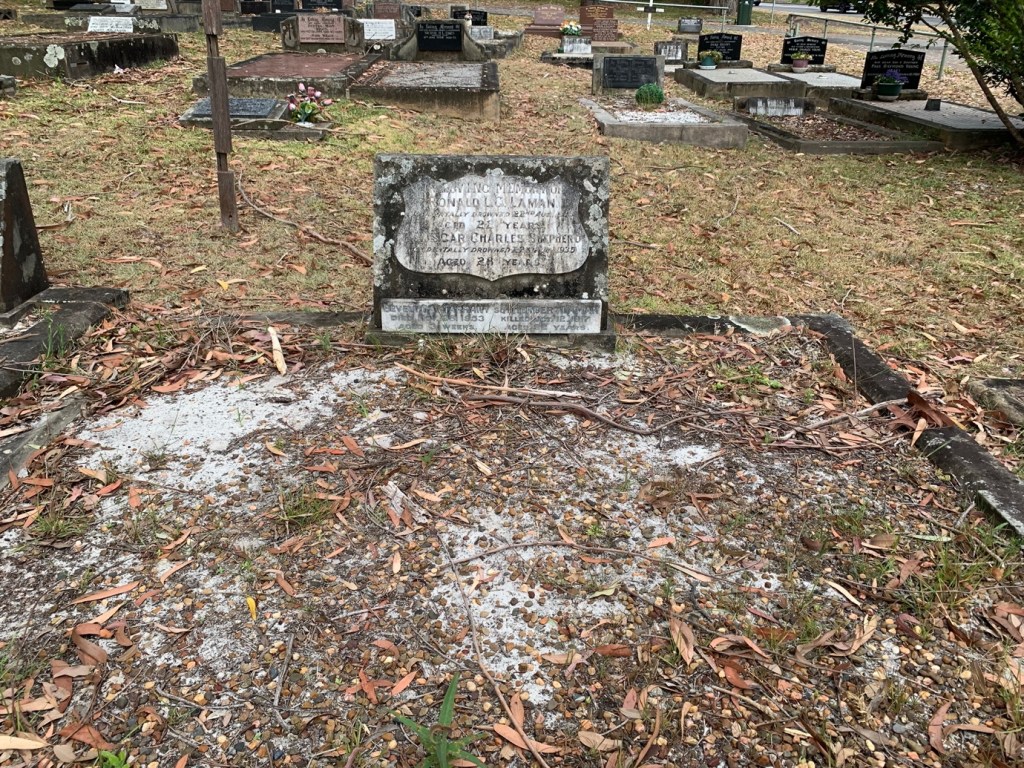
Double grave of Oscar Shepherd and Ronald Laman at Nelson Bay Cemetery [Author photo, January 2023]
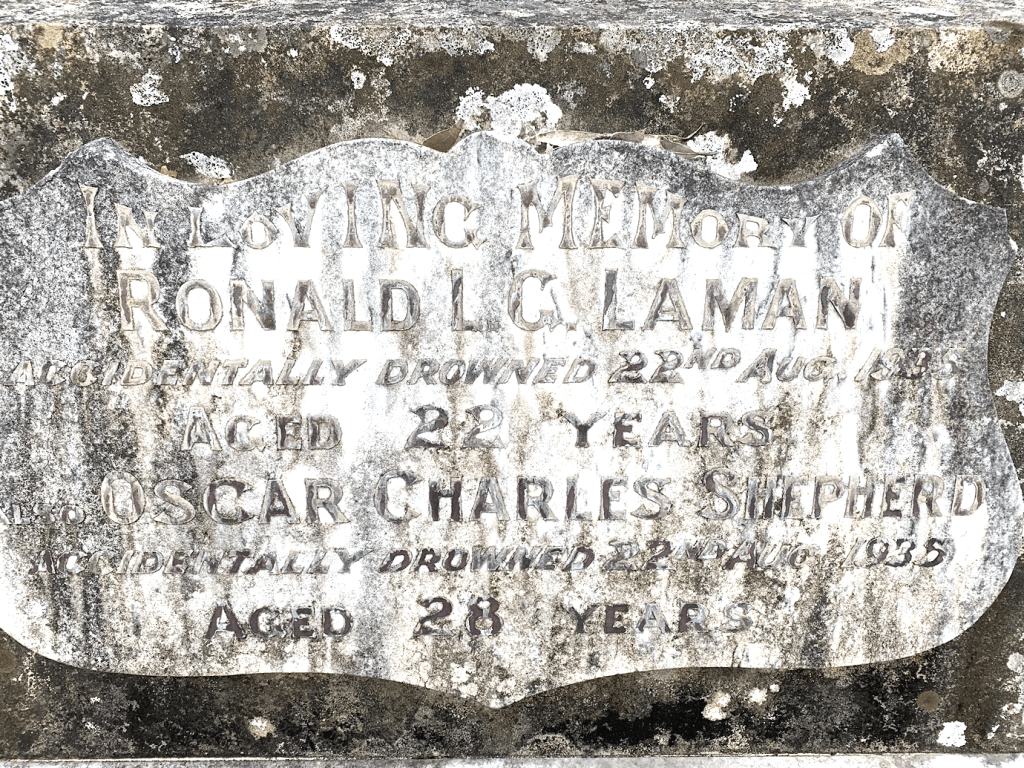
Wording of the Gravestone [Author photo, January 2023]
Coroner’s verdict
The Newcastle Morning Herald and Miners’ Advocate of 4 September 1935, page 5, reported:
‘At a magisterial inquiry at Tea Gardens, the Coroner (Mr. E. Hitchins) found that on August 2 Oscar Charles Shepherd and Ronald Leslie Gordon Laman, at Bowler Bay, south of Port Stephens Lighthouse, were found drowned without any marks of violence appearing on their bodies, but by what means they were drowned the evidence did not enable him to say. “I consider it my duty to express my sincere sympathy to the relatives,” added gratitude to the ceaseless and untiring endeavours of Constable Overstone, of Tea Gardens, and the untiring and unselfish endeavours of Alfred George Tarrant and George William Homer in the recovery of the bodies.’
Epilogue
The Port Stephens community, while mourning the deaths of Oscar Shepherd and Ronald Laman, had to deal with a third drowning in four days. The Newcastle Sun of 26 August 1935, page 7, reported:
‘The third man to lose his life at Port Stephens within four days, Eppienetus F. Hunt, aged 41, of Donald-street, Hamilton, fell from a fishing launch near Nelson’s Bay yesterday, and died soon after he had been lifted back into the boat.
Other members of the fishing party dived to his assistance and two of the rescuers got into difficulties. According to the other members of the party, Hunt appeared to be swimming strongly but be collapsed as his rescuer was assisting him into the boat. ‘”Is extremely lucky that there were not other victims,” said Alexander Gardner, a member of the party, in an interview today. “One of the men who dived in to rescue Hunt caught hold of another member of the party, mistaking him for Hunt, and it seemed likely that one of them would be drowned. They both got back to the boat, but one of them, who went ashore to raise the alarm, collapsed when he returned. ……
Describing the fatality this morning, Gardner said that the party left Lemon tree about 6.30 a.m., and was fishing inside the port, nearly opposite Nelson’s Bay. “About noon,” he said, “we heard a splash and we saw Hunt in the water. I did not see him fall in as I was on the cabin, and I do not think anybody else saw him fall. “Almost immediately several of the party dived in. Hunt, who we regarded as a strong swimmer, was about 30 yards away before the boat could be turned, and by that time several were on their way toward him. Plain reached him and was supporting him, and then we saw Smith grab Richardson. Evidently, he thought it was Hunt. They both went under.
“Plain and Hunt were now treading water, and Hunt seemed to be all right. We manoeuvred the boat over to them, and as Hunt was being pulled aboard, we saw him go black in the face. “We started artificial respiration as soon as he got into the boat, and when we reached the shore the efforts were continued. “Everybody thought that Hunt was all right until we saw him collapse.” When Newcastle ambulance arrived the new resuscitating apparatus which has recently been acquired was brought into use, but all efforts to restore animation failed.’
Researched and compiled by Kevin McGuinness
January 2023

 Port Stephens - a history exploration