
Introduction
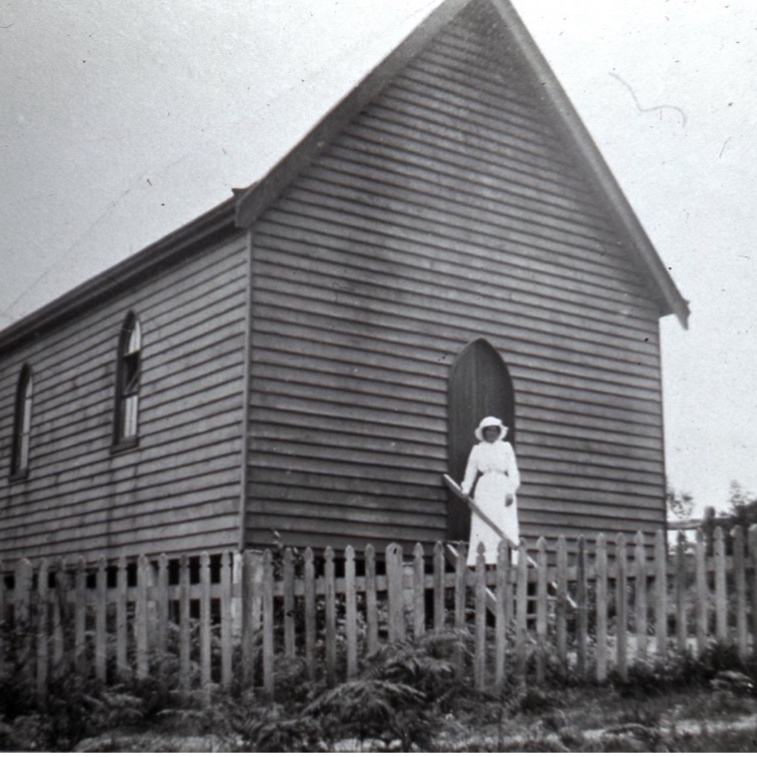
The first church was built in Nelson Bay in 1909 at West Point in Laman Street. It was of the Methodist denomination and was built on land donated Captain John Dalton who had a large land holding in the adjoining area.
The current church building which was completed in 1954, still stands at the corner of Laman and Church Streets. However, it is now privately owned and services are no longer conducted there.
This paper tells the story of the history of the Methodist Church community at Nelson Bay from its foundation to later years. It also looks at the contribution of the families of its congregation and the many events held there.
Early Wesleyan Services at Nelson Bay
Around 1889 Wesleyan services were first conducted in the Nelson Bay area by Rev. John Robson, at that time the Wesleyan minister in charge of the Morpeth circuit. Over the years he was assisted by a band of helpers, with divine service being held at regular intervals.
It was originally a Wesleyan denominational Church which was merged into the Methodist Churches of Australasia on 1 January 1902. In 1977, the Methodist, Presbyterian and Congregational Churches joined together to become the Uniting Church.
Wesleyan Sunday School Anniversary – 1900
The Newcastle Morning Herald and Miners’ Advocate of 1 June 1900, page 6, reported:
‘The … anniversary of the Wesleyan Sunday school was held on Saturday. During the day the scholars were treated to a picnic by their superintendent (Mr. James Dalton), and after games, swings, &c, the children, numbering about 40, were each presented with a beautiful prize. Mr Dalton, in addressing the children, impressed upon them the good which would be obtained for guidance in their future care at the Sunday school, also expressing regret at elder children discontinuing attending Sunday-school after getting into their teens. Mr Dalton was ably assisted by Miss Sladden, who devotes her time on Sundays to teaching the little ones.’
Sunday School Picnic – 1901
The Newcastle Morning Herald and Miners’ Advocate of 16 May 1901, page 7, reported:
‘On Saturday the annual picnic of the Wesleyan Sunday school was held in Mr. Dalton’s paddock [this property adjoined the future church site]. The children, dressed and each armed with a mug and a handkerchief, arrived at Mr. Dalton’s about 2 o’clock, bent on having a good time. After indulging in games, swinging, etc., tea was served on the lawn by Misses Dalton and Sladden and Mrs. Laman and Mr. James Dalton. At 6 o’clock the children were called together, and Mr. James Dalton (the superintendent) addressed a few words to them, stating that the year had been a most successful one, also that the parents and he were indebted to Miss Sladden for the interest she hand taken in the school by giving her services on Sunday, after teaching in the public school during the week. Mr. Dalton then handed each of the 46 scholars a prize. After singing “God Save the King,” and giving three cheers, the children wended their way home, well satisfied with their day’s enjoyment.’
Opening of the Methodist Church – 1909
The Newcastle Morning Herald and Miners’ Advocate of 20 February 1909, page 3, reported:
‘The desire for some suitable building in which to assemble has long been expressed, and has now materialised in the erection of a neat and commodious Methodist church, which reflects credit upon the builder, Mr. W. King, of Largs. The opening ceremony took place on Saturday last. Visitors from Anna Bay, Salt Ash, Williamtown, Medowie, Raymond Terrace, and Miller’s Forest were present, and made warmly welcome. After partaking of lunch provided by the ladies of the bay, the visitors and residents assembled in the church, to witness the opening ceremony, which was conducted by Rev. W. M Woodhouse. Captain John Dalton declared the building open, and the treasurer announced that although it had cost £145, the building was free of debt. The gathering soon after dispersed with numerous expressions of the wish that the great fact for which the church stood might become increasingly real to the place.’
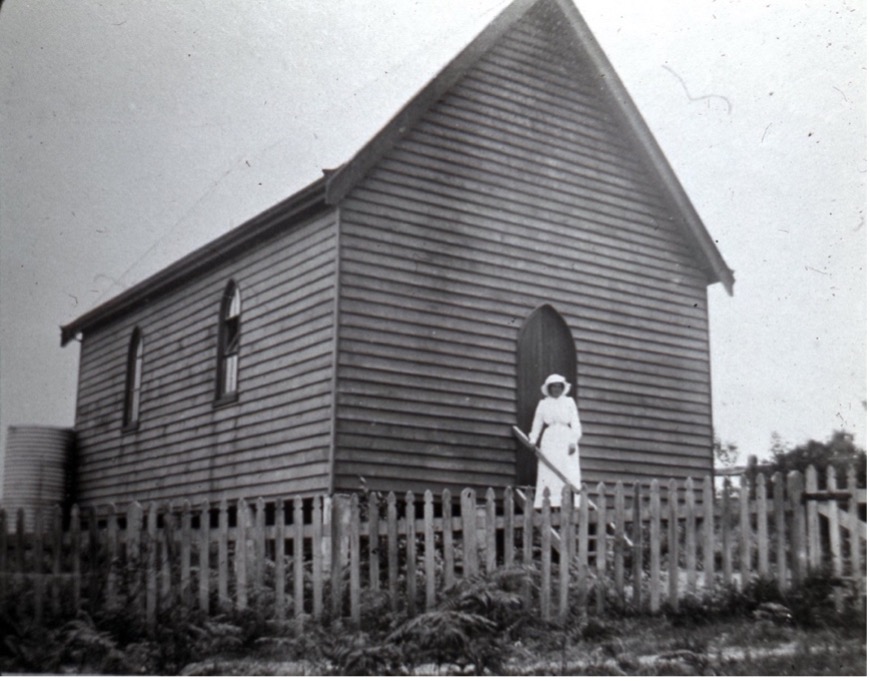
Original Nelson Bay Methodist Church – Photo showing Eliza (Ida) Dalton (1890 -1971) on the steps. From Dalton Family Photos collection, University of Newcastle Library]
Death of James Dalton 1909 – Benefactor of the Nelson Bay Methodist Church
The Newcastle Morning Herald and Miners’ Advocate of 2 December 1909, page 6, reported
‘Mr. James Dalton, of “Westward Ho,” Nelson’s Bay, Port Stephens, died in his sleep on Sunday. He was born in Yorkshire, England, and was in his 73rd year. For many years he was employed as a public school teacher, principally in Manchester, but owing to ill health he gave up teaching, and came to New South Wales, where he resided for the past 27 years. During the last 20 years Mr. Dalton employed himself in teaching the Sunday school and other religious work at Nelson’s Bay, where he was much respected. His remains were interred in the Methodist portion of the Nelson’s Bay Cemetery, Rev. Mr. Woodhouse officiating.’
The Methodist of 25 December 1909, page 9, published the following obituary:
‘At the little village of Nelson’s Bay, Port Stephens, on the night of November 28th, 1909, the summons to come up higher was responded to when the soul of James Dalton passed beyond the veil. Deceased was of Wesleyan parentage, and was born at Burton-Agnes, Yorkshire, England, in the year 1836. He was a diligent student and when quite young was appointed pupil teacher at the Nafferton Wesleyan School, afterwards passing through the Westminster Training College. He was then appointed to the Connexional School at Barnstaple, where he laboured for 10 years, removing only because called to a wider sphere as Headmaster of the Wesleyan School at Gravel Lane, Manchester.
After some years of strenuous exertion, his health failed; but his committee paid the expense of a trip to America, in the hope that he would recover sufficiently to enable him to take up his work again. The hope was not realised, and upon his return he was entrusted with the charge of a new and smaller school at Lower Broughton. The attendance grew until there were 1200 scholars under his care. The demands were more than an already enfeebled constitution could meet, and he suffered another and more serious breakdown, from which he never completely recovered; and on the recommendation of his medical adviser, he resigned his position and came to Australia in 1882. He spent a year or two in Sydney from whence he removed to Nelson’s Bay, where he resided until his death.
Although his life was a busy one, he found time to perform many religious duties, for while at Nafferton he had been powerfully impressed under a local preacher, and led to decide for Christ. During his stay at Barnstaple, he was for 10 years a class-leader, worked also in connection with the Sunday-school, and his name appeared on the plan as an exhorter. He continued to act as class-leader at Gravel Lane, Manchester, meeting three classes per week, each of from 60 to 70 members. Besides which he conducted a school for the benefit of poor children. His exertions in these directions, no doubt, helped to undermine his health, but he won for himself the esteem of his associates and the affection of the children among whom he worked.
At Nelson’s Bay he found the white-field. A religious service here before his arrival was almost unheard of, but soon after he established a Sunday-school which was indeed a light in a dark place, and into the conducting of which he put the best resources of his heart, mind, and purse, until failing health forced him to desist after more than 20 years in its service.’
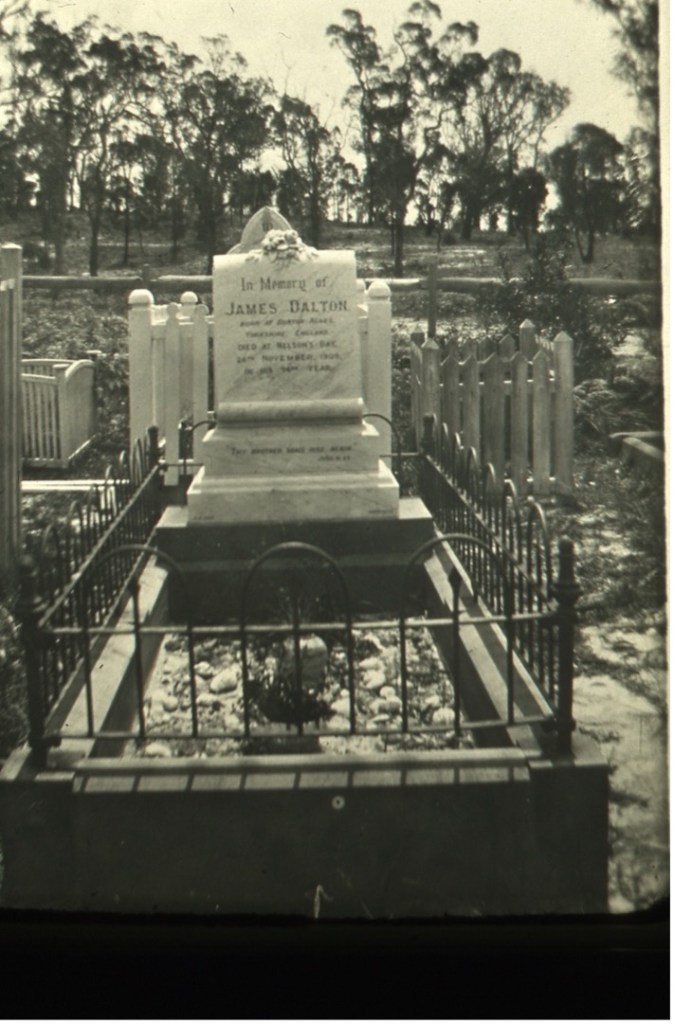
Grave of James Dalton at Nelson Bay Cemetery. His epitaph reads “James Dalton Founder of Methodism in Nelson Bay” [University of Newcastle Library]
Sunday School Concert to Aid Organ Fund – 1911
The Maitland Weekly Mercury of 7 October 1911, page 8, reported:
‘Owing to numerous requests , the concert given by the Sunday School children a fortnight ago and organised by Mrs. Chas Laman in aid of the Nelson’s Bay Church Organ Fund, was repeated to a large and representative audience on Friday night last. On this occasion the funds are to be devoted to a deserving case in the neighbourhood, which will benefit to the extent of about £4, after de-ducting £1 the purchase of books for the Sunday School children. The hall was artistically decorated as on the previous occasion with wild flowers and flags from the ship Inca, now in port.
The performance was most creditable, and showed that the promoter must have spared no pains, in training the children to such a degree of perfection. A considerable number of the items were rendered with lime-light effects, which together with the different coloured costumes of the children, and their happy faces, created a scene which will not be readily forgotten by those who were fortunate enough to be present. To dwell at length on each item would be necessary to convey all the pleasures of the function. Suffice to say that each item was well received.’
An Estey American organ was subsequently purchased.
Death of Captain John Dalton 1912 – Benefactor of the Nelson Bay Methodist Church
John Dalton donated the land upon which the Methodist Church was built.
The Newcastle Morning Herald and Miners’ Advocate of 13 August 1912, page 6, reported:
‘The funeral of the late Captain John Dalton took place on Monday afternoon. The cortege, which was representative of the shipping interests of the port, left the late residence of the deceased and proceeded by way of ferryboat from Stockton wharf to the Methodist portion of the Stockton Cemetery, where the service was conducted by the Revs. W. F. Oakes and R. C. Oakley. The late Captain Dalton was a native of Burton-Agnes, Yorkshire, and followed the sea from the age of 12 years. His seafaring career was a varied one. He was on a Danish transport during the war between Denmark and Austria, and was engaged in the transport of troops at both the Crimean war and the Indian mutiny. Returning from the West Indies, he passed up the English Channel during the gale in which the London foundered.
He arrived in Australia in the year 1877 and was mate of the s.s. Maitland and Captain of the Kembla. He owned the Waratah, the first steam ferry to run to the Dyke [at Newcastle]. He was trading to Port Stephens from Newcastle with the Kingsley for seven years, during which time his home was at Nelson’s Bay. He then settled down to farming at Salt Ash, where he remained for about 15 years. He moved to Stockton into a new residence he had had built about eight months ago. He was attacked about three weeks ago by influenza, and was subsequently removed to the Pipitea Pah Hospital, where he passed away on Sunday morning at the age of 79 years. The deceased leaves a family of four sons and three daughters. Wreaths and cards of sympathy were forwarded by numerous friends.’
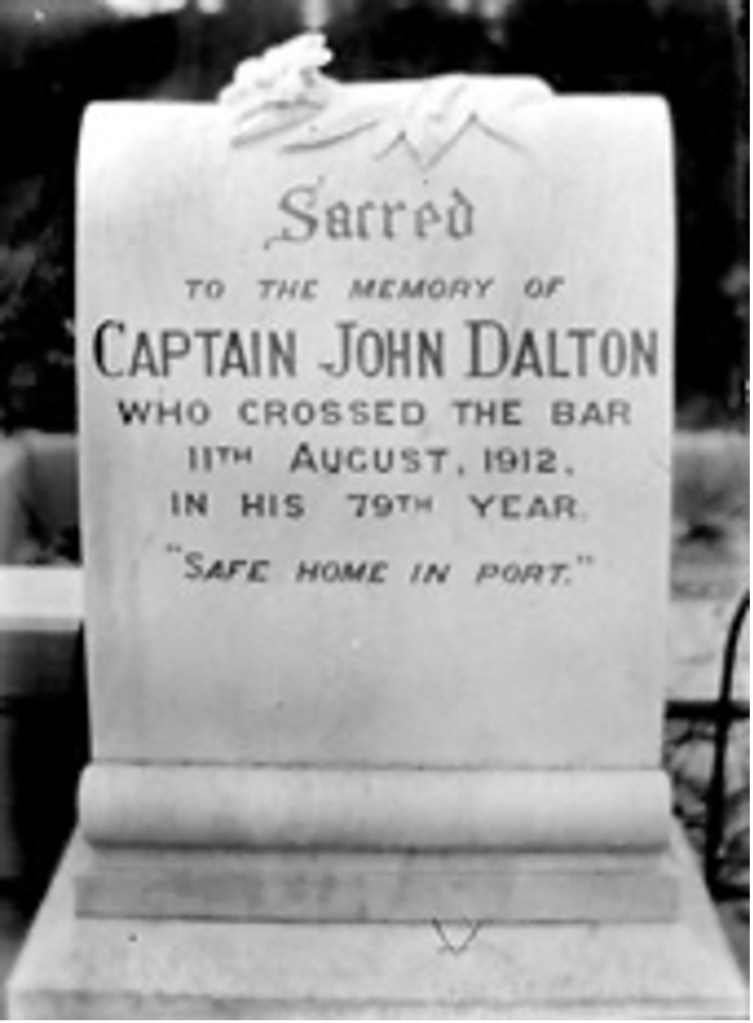
Grave of John Dalton at Stockton Cemetery [University of Newcastle Library]
Experiences of a Preacher at Nelson Bay – 1918
The Methodist of 27 April 1918, page 3, provided an interesting insight to the early efforts made by the Methodist Church to minister to the Nelson Bay residents:
‘A local preacher [Rev. G. O. Cocks] from my circuit, who was contemplating a trip to the above little-known resort [Nelson Bay] about the end of last year, made the offer of his services to that particular part of the Raymond Terrace Circuit with a view to taking appointments in the Nelson’s Bay Church. By correspondence with the superintendent this offer was gratefully accepted, and the services were held, much to the appreciation, edification, and satisfaction of the members of this little community.
On the local preacher’s return he strongly urged the writer to pay a visit, mentioning the fact of the isolation of the place, the few services on account of the unwieldy nature of the circuit, and the difficulty of access [no trafficable roads led to Nelson Bay after Salt Ash]. The natural beauty of the situation was set forth, but more especially the claims of the fishermen and their families, fishing being the chief industry of the locality. A promise was given of a probable visit at the earliest opportunity, which was made possible by the kindness of one of our esteemed supernumerary ministers, who came from Sydney to fill my local appointments. The date fixed was April 7th, and on the day before a start was made about noon by motor ‘bus from Newcastle, via Stockton and Salt Ash, in the midst of showers of rain and in the face of considerable difficulties.
The car was crowded and close, and evidently overladen, as after covering the three miles it broke down, occasioning a delay of over three hours, another car being requisitioned. The roads were rough, with miniature lakes on the surface, but the bumping and delay was endured with good grace. The steamer which took us from Salt Ash to Nelson’s Bay was commodious and comfortable, but owing to the delay mentioned, the best of the scenery, which is found near the end of the journey, was lost in the mist and darkness, as our destination was not reached until 7 p.m. The route to Nelson’s Bay traverses Tilligerry Creek, the broad and rather shallow sheet of water which eventually enters Port Stephens. At its mouth, after rounding Bull’s Island, a fine, extensive view of the port is obtained to the heads on the east, and Sawyer’s Point at the entrance of the Karuah River on the west. The trip from the Middle Island to Nelson’s Bay is a fine one in the daytime and with favourable weather, with beautiful views ever before the traveller.
Nelson’s Bay lies in a secluded spot, protected from strong winds by Flagstaff Hill, and rising ground to the south and west. It is the favourite headquarters for sportsmen and fishermen in Port Stephens. During my visit, one of Sydney’s most famous and skilful physicians, who is also an “expert” with rod and line, was located at one of the boarding houses. Nelson’s Bay is situated in close proximity to the Heads and the ocean islands, round which there are splendid deep-sea schnapper fishing grounds. The local school-teacher met me and conducted me to his residence, where I was most generously entertained during my brief stay.
On the Sunday, three services were held in the neat little church on the hill, which overlooks the bay and the entrance to Port Stephens. The congregations were small, and the men were conspicuous by their absence, largely accounted for from their precarious occupation. The children’s service at three was well attended by the young people, who were bright and intelligent. At night we had the largest company, and more attentive and devout worshippers it would be hard to find. The service, which was of an evangelistic character, was closed, but an invitation was given, and an appeal made for any to remain who were willing to surrender themselves to Jesus Christ. A prayer meeting was not announced, partly because of the cosmopolitan nature of the congregation, and not knowing on whom to call to pray. The solo, “O, Be Saved,” was sung, but no one left the building. Those were then asked to stand who were prepared to accept Jesus Christ as their Saviour and to serve Him, and the whole congregation stood, and after resuming their seats, were instructed in the way of salvation.
Omitting the young children, the names of some thirty adults and young people were taken. On the Monday following, several came for a personal interview and further instruction, while a large number were visited in their homes. A lecture had been announced for the Monday night, but it was ultimately agreed that part of the evening be devoted to the lecture, and the remainder to further counsel and exhortation on matters more closely connected with the Kingdom. Arrangements were made for the young converts to be met regularly by local workers, and a large parcel of literature, through the kindness of a well-known lay-man, has been forwarded.
On the Monday night it was my privilege to see the fishermen haul in the net about the centre of the bay, and of the fish caught, they filled thirteen baskets. But while their joy was great that they had gathered so many so near home, it could not be compared to that of God’s servant in the number of souls gathered in on the previous night. An attempt is being made, with the concurrence and cooperation of the superintendent of the circuit, to get a more regular supply of services for the conservation of those already “brought in,” and the salvation of the remainder of the residents over whom the young converts are yearning, and for whom earnest prayer is made continually.
A visit was also paid to the lighthouse [inner lighthouse] at Port Stephens in the afternoon, and the view from that eminence was most charming. The fishing grounds could be traced, and Boondelbah Island was pointed out, where some twenty Greeks are engaged in lobster fishing. On the opposite side of the bay, and near the mouth of the Myall River, is the Pindimar fish factory, where a considerable amount of the fish is sent, a regular bi-weekly supply being also forwarded direct to Newcastle by sea.
The Methodist Church is the only church in Nelson’s Bay, although the people are not all of our denomination by any means. The late Mr. Jas. Dalton, in whose memory a marble tablet has been erected in the church, was responsible for the position we occupy there, for he not only gave the land, but donated and obtained help towards the construction of the church. There is a very sweet-toned Estey American organ in the church, having a movable keyboard for altering the tone of the instrument. Further efforts are being made to get pulpit supplies for future services, meanwhile the Government is being petitioned by the inhabitants of Nelson’s Bay to have the road completed via Anna Bay, when the appointments would not be so difficult to arrange.
Since writing the above a letter has been received from the schoolmaster, indicating that a meeting was held the following Saturday night, which was attended by sixteen of those whose names were recorded the previous Sunday evening, and on the following Sunday night the number was augmented, the teacher conducting a Bible reading, which was supplemented by prayer and singing. His letter concludes thus: “The good work is now started. I would suggest that before long a visit from one of your helpers, or preferably yourself, would keep the fire burning; but with God’s help, we will endeavour to keep on. I feel personally that your visit has done inestimable good. Let us pray that it will be lasting.”
First World War Memorial held at the Church – 1918
The Raymond Terrace Examiner and Lower Hunter and Port Stephens Advertiser of 24 May 1918, page 3, reported:
‘A memorial service was conducted in the local Methodist Church on Friday night last, in memory of the late Sergeant Herbert Laman, killed in action, on October last and previously reported missing. The church was draped for the service by the girl friends of the fallen soldier. The Rev. Stuart-Wright preached to a large congregation, and in the course of an appropriate address, eulogised the spirit of the young man who gave his life in his country’s cause. Suitable hymns for the occasion were sung, and at the conclusion of the service the organist played the “Dead March in Saul,” and Bugler Johnson sounded the Last Post.’
Lecture to aid Church Repair Fund – 1920
The Raymond Terrace Examiner and Lower Hunter and Port Stephens Advertiser of 27 February 1920, page 3, reported:
‘A most interesting and instructive lecture was delivered in the local Methodist Church on Tuesday 17th inst. by Sergeant Rev. Bostock Jones, of the 30th Batt. A.I.F. The subject chosen was “Experiences in France — In the Trenches, and in the Billets.” By special request the chair was occupied by Mr. P. Groves, editor of the “Austral Briton” who in introducing the lecturer, gave a brief resume of Mr. Jones’ military career. The Rev. Bostock Jones spoke of his experiences on the Somme, at Ypres, Bullecourt, Peronne, and other centres of activity, and gave a beautiful word picture of the life endured by our Australian boys in the various phases of warfare. The lecture was interspersed with humorous antidotes of life in the billets, wherein the lecturer demonstrated the adaptability, and resourcefulness of the digger in all manner of situations.
The lecturer was listened to with great interest by the large and appreciative audience. During the evening Miss Smith of Fuller-ton Cove sang very nicely “God bring you back to me,” to organ accompaniment played by the church organist, Miss Freda Laman. A collection was taken up in aid of the church repair fund, £2 10s 9d being contributed. At the conclusion of the lecture a hearty vote of thanks was accorded the Rev. Bostock Jones, for his assistance, and proceedings closed with a vote of thanks to the chairman, and the singing of the National Anthem, the Doxology, and the Benediction.’
Later in 1920 the Methodist Church was treated to a coat of paint, and minor repairs, and was reported to then present a most attractive appearance.
Farewell to Minister – 1926
The Newcastle Morning Herald and Miners’ Advocate of 24 March 1926, page 9, reported:
‘At the conclusion of service in the Methodist Church at Nelson’s Bay on Sunday evening last the congregation wished their minister, Rev. L. H. Rolph, of the Raymond Terrace circuit, goodbye. For the past three years Mr. Rolph has ministered to the Methodists of Nelson’s Bay, and throughout that term has shown himself a sympathetic and energetic worker. At the last conference in Sydney Mr. Rolph was transferred to the Clunes circuit, on the up-per north coast. The local congregation made him a present of a handsome travelling rug as a small memento of the esteem in which he was held. Rev. Williams, who is relinquishing Gosford circuit, replaces Mr. Rolph and takes up his duties next month.’
Anzac Day Service at the Church – 1926
The Newcastle Morning Herald and Miners’ Advocate of 29 April 1926, page 5, reported:
‘The Methodist Sunday School picnic, which was to have taken place at South Head, Port Stephens, on Saturday last, had to be postponed owing to the inclemency of the weather until Saturday next. Anzac Day was observed on Sunday at Nelson’s Bay by special memorial services at both the Church of England and Methodist Churches. The pulpit of the Methodist Church was draped with a Union Jack, while an Australian flag surmounted by a laurel wreath formed an appropriate background. The officiating minister was Mr. Gilbert, of the C.M.M. of Newcastle. Special hymns, including “Lest We Forget,” were sung during the service. A number of local returned soldiers were in attendance.’
The Newcastle Morning Herald and Miners’ Advocate of 6 May 1926, page 7, reported on the previously postponed Sunday school picnic:
‘The first annual Sunday school picnic of the Nelson’s Bay Methodist Church was held at South Head, Port Stephens, on Saturday. Two launch loads of children and adults made the trip, and an enjoyable day was spent.’
Lining of the front porch and interior paining of the Church – 1926
The Newcastle Morning Herald and Miners’ Advocate (NSW : 1876 – 1954), Tuesday 3 August 1926, page 3
‘The front porch on the Methodist Church, which was built voluntarily eighteen months ago, has now been lined with Baltic pine, the material and labour for which was donated by the children of the Sunday school. The work was done under the voluntary superintendence of Mr. I. N. Gordon. The contract for paint-ing the interior of the church has been secured by Mr. L. Hanlon, the local paint-er, who expects to commence operations early this week. The cost of painting— over £21— is being guaranteed by the Ladies’ Church Aid and church stewards.’
Church Concert – 1926
The Newcastle Morning Herald and Miners’ Advocate of 1 October 1926, page 5, reported:
‘A successful concert was held in Arcadia Hall, Nelson’s Bay, under the auspice of the Methodist Church. A packed audience greeted each item with the appreciation it deserved. ….. The Rev. G. Williams, superintendent, minister of Raymond Terrace Circuit, thanked the promoters and public for their splendid support, and especially Mrs. Cody and Mr. W. Thompson for placing Arcadia Hall at the church’s disposal ‘gratis’. …. The proceeds amounted to over £20. At the conclusion of the “Mock Wedding” supper was served. A wedding cake made and presented by Mrs, C. Laman to the one who guessed nearest to its weight was won by Mrs. R. Gordon.’
Memorial Bell Dedication – 1927
The Newcastle Morning Herald and Miners’ Advocate of 29 August 1927, page 5, reported:
‘The dedication of a bell to the memory of Mrs. Mary Ann (Grandma) Thompson took place at the Methodist Church on Wednesday evening, in the presence of a representative gathering of residents, reatives, and friends. The bell is hung in a small belfry erected by Mr. J. N. Gordon who, although having only one hand, has done excellent work. The district chairman of the Maitland Methodist Churches was to have dedicated the bell, but being away on the date chosen he asked Rev. J. Woodhouse, of Hamilton-Wickham circuit, to act in his stead.
Rev. G. Williams, pastor of the circuit, opened the service with the hymn “O God, Our Help in Ages Past,” and prayer, then another hymn and the unveiling of the bell rope, which is enclosed in a cabinet bearing a tablet inscribed: “To the Memory of Mary Ann Thompson. Erected August, 1927.” The unveiling was done by three grandchildren, Miss Myra Deimar, who drew the bow-strings and unlocked the door of the cabinet enclosing the bell-rope, Miss Thelma Deimar and Miss Una Thompson drew back the Curtain at either side, and so exposed the bell-rope, upon which the Rev. Woodhouse dedicated the bell for the service of the church and to call to the people to worship for the glory of God.
The service continued with the Scripture reading by Mr. Wm. Rowe, in charge of Nelson’s Bay end of Raymond Terrace circuit. The Rev. Woodhouse preached a sermon on “God is a Spirit, and those who worship Him must do so in spirit and reality.” Before leaving Mr. Woodhouse said he hoped again to visit the Bay and conduct service.’
Jumble Stall Concert – 1927
The Dungog Chronicle of 28 October 1927, page 2, reported:
‘A jumble stall concert and entertainment was held in the Arcadia Hall on Wednesday 12th inst., in the interest of the local Methodist Church. The concert was under the guidance of Mr. C. Laman. The attendance was good in the face of rain coming at the critical moment when people would have come from their homes. Some even turned back after getting a bit wet, fearing worse conditions as it looked as if it would have been a very wet night, but it cleared after some 2 hours’ rain in showers.
The people who came meant biz. as the stall and dips were cleared in a comparatively short time. Everything for sale was sold. The concert platform was presided over by Mr. Rowe. The platform gave general satisfaction. The local talent is greater and higher than most expected to find it, after the example of Wednesday night. The artists were warmly clapped as they ended their items.’
Spring Fair and Concert – 1928
The Dungog Chronicle of 16 October 1928, page 2, reported:
‘The Methodist Church held its Spring Fair and Concert in the Arcadia Hall on October 4th, directed by the L. C. A. For success in any public function, the ladies are indispensible. The stall of useful and fancy articles were of good value and were well displayed and from the time of opening up to the time for the concert a brisk business was done, with Mrs. M. Laman, Mrs. B. Tarrant and Miss Laman as counter attendants. Things offered got into buyers hands quickly. The lolly and cake stall did good business with Misses T. Diemar, G. Laman, A. Collins, as also did a fishpond game in the hands of young ladies. Mostly the provision for the fair were the gifts of the ladies. Great credit is due to the committee for the arrangements in provision and exhibited effect. The concert party consisted of the young folk of Tea Gardens repeating their sacred concert given at Tea Gardens some weeks ago. ….. Appreciation was manifest by the attention of the audience of 150 or more persons. The hope is that the party of young people will keep together and with patience and practice will become a worthy choral party. The programme, was in the hands of Mr. H. G. Reeks, who is hopeful for service in the ministry. In the early part of the week, with the westerly blowing almost a gale, it was feared a postponement would he unavoidable, but the wind lulled by Thursday evenings so that the fear of the waves fled and the party came over in good spirits on Korsnian Bros’. launch, and if there is a boat that is easy to ride on it is Mr. Korsman’s ‘Yoothopona. ‘ At the close of the programme Mr. Rowe proposed a vote of thanks to all the artists of the concert and all who helped to make the function so successful. Mr. W. W. Lamon secconded, and a hand clap carried it by acclamation. Proceedings closed with the National Anthem. The takings were just over £26.’
Addition of Front Porch for Church – 1933
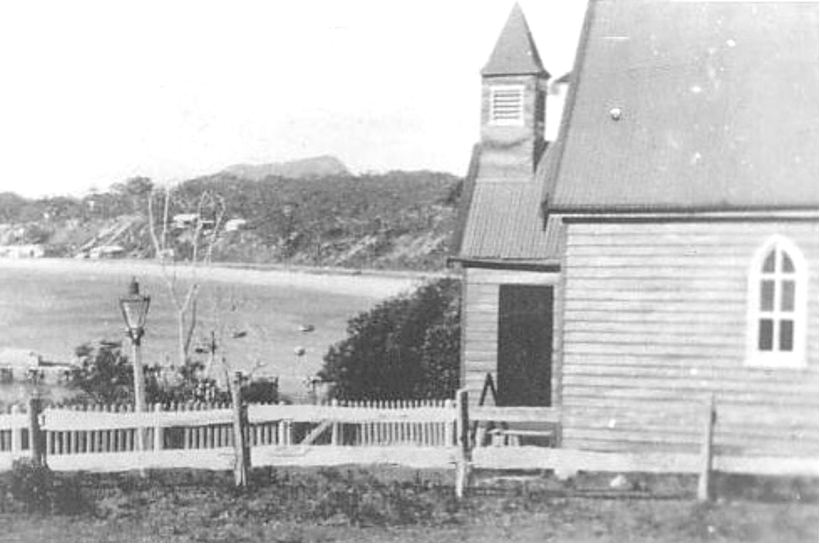
Methodist Church showing new front porch, with street light visible at left – 1933
New Minister – 1936
The Newcastle Morning Herald and Miners’ Advocate of 12 May 1936, page 9, reported:
‘The newly appointed Methodist home missionary, Mr. Andrew Palmer, has begun his ministry in the Nelson’s Bay-Raymond Terrace district. Formerly, he had been engaged as circuit steward in the Belmont area, A large congregation attended the special Mother’s Day service on Sunday. The juvenile members of the Sunday School took part in the service. Mr. J. Laman sang, and Mr. Palmer gave the address.’
Death of Eliza Jane Dalton 1943 – Benefactor of the Nelson Bay Methodist Church
The Methodist of 10 April 1943, page 12, reported:
‘Eliza Jane Dalton, who died at her home at Stockton on 21st January last, was born on the Macleay River almost 83 years ago. The first home she remembered was built of slabs with earth floor, and stood in the centre of a small clearing among the forest giants, including cedars, of her father’s ‘selection.’ Here she gleaned a rudimentary knowledge of reading and writing from her parents, this being practically the only schooling she ever had. Her father was a Protestant, her mother Roman Catholic. Services, sometimes Protestant, sometimes Catholic, were held at her father’s or at neighbours’ homes in which all joined. At a very early age she went to live with a God-fearing aunt in Sydney, whose influence on her naturally gentle nature was very great. She obtained work as a domestic, where for some months her remuneration was keep, clothes and one penny per week. Up till this time she never remembered having owned money.
After her marriage to Captain John Dalton, who owned the small coastal steamer, “Kingsley,” she spent much of her early married life at Nelson’s Bay, Port Stephens, where, among the very few pioneering families of the “Bay’s” fishing industry she proved an ever-present help in adversity, the bark humpies of the aborigines knowing her presence in sickness and in death, and in every time of need. Her interest in the welfare of coloured people was retained to the end of her life, and for many years she was the representative at Stockton of the British and Foreign Bible Society.
While living at Nelson’s Bay her brothers-in-law, Messrs. James and William Dalton conducted a weekly Sunday school in a disused house. Here also the “Bay’s occasional services (Methodist) were held. Later (about 35 years ago) the present Methodist Church was built on land donated by her husband. ….. During the pneumonic influenza epidemic of the war years, the late Mrs. Dalton ministered to the needs of dozens of stricken families in Stockton.’
Dedication of New Methodist Church and Extension to Old Church at Nelson Bay – 1954
The Raymond Terrace Examiner and Lower Hunter and Port Stephens Advertiser of 30 September 1954, page 1, reported:
‘Owing to a steep in-crease in the enrolment of Sunday School scholars, the Trustees and Sunday School staff of the Nelson Bay Church and Sunday School were called together by the Minister of the Circuit — Rev. D. E. Pickering and plans were formulated which would give adequate space for the teaching of the children.
The existing accommodation was hopelessly short of requirements but just how the situation could be met, urgently and with measured financial outlay, engaged the attention of the officers. The Church architect, Mr. W. C. Brown, of Sydney visited the scene with the Property Secretary, Rev. R. H. Doust, and held a conference with the local Minister. Plans were immediately formulated to provide a new church building and extensions to the old Church which would be used as a Sunday School Hall. Mr. M. Myers of Coal Point, was the successful tenderer and commenced work at the beginning of August. Although the President of the Methodist Conference, Rev. A. G. Manefield B.A., had been engaged for the occasion, an alteration in the original date precluded his final acceptance of our invitation. The Property Secretary and an ex-President of the Conference, the Rev. R. H. Doust, Lth. will therefore accept the property in the name of the Conference and Dedication to the Glory of God will follow.
The dedication service will commence at 3 p.m. and will be followed at 4.30 p.m. by tea provided by the Ladies of the Church Aid. Reports will be presented by the Secretary of the Trust, Mr. W. Main and the Treasurer, Mr. E. Glover. The entire cost of the scheme is slightly in excess of £2000.’
The Methodist of 6 November 1954, page 9, further reported:
‘Steep increase in Sunday school enrolments at Nelson Bay in the Raymond Terrace Circuit necessitated some additions to the existing small church. The enrolment had grown to over 90 scholars with a teaching staff of 14 many of whom were compelled to teach in the open air. The present minister, the Rev. D. E. Pickering, during whose term with us two other new churches had been built at Millers Forest and Soldiers Point, called us to face the challenge of present and future needs, and although this scheme involved an expenditure of over £2,000 we responded to his call. As a result, a lovely new church has been erected adjoining the old building which itself was extended by 10 feet, and will now be used as a Sunday school hall, with a small kitchen attached for social needs.
Practically all the furniture for the new church was donated by the local residents, not the least of which was a contribution by the Sunday school of £100. The Connexional Secretary of the Church, the Rev. R. H. Doust, opened and dedicated the new building on Saturday, October 9, before over 200 people. The Rev. D. E. Pickering assisted in the service. During the service of dedication Mrs. E. Glover sang “Open the gates of the temple” and “Bless This House”, while a special church choir sang the “23rd Psalm”.
Following the service, more than 200 people sat down to a very fine tea provided by the Ladies’ Church Aid, when reports from the secretary and treasurer of the church trust, Messrs. W. Main and E. Glover, respectively, were received. The opening indebtedness is £1,500. At the quarterly meeting of the Raymond Terrace Circuit, which was held on the following Monday evening, the Rev. D. E. Pickering intimated that it was his intention to move at the ensuing Conference. The circuit stewards and members of the meeting spoke of the exceptionally fine work done by the minister during his four years in the circuit. Reference was made to the fine spirit of comradeship which existed between minister and people, and all expressed regret that Mr. Pickering was about to leave us. The appointment of a successor was left in the hands of the Conference.’
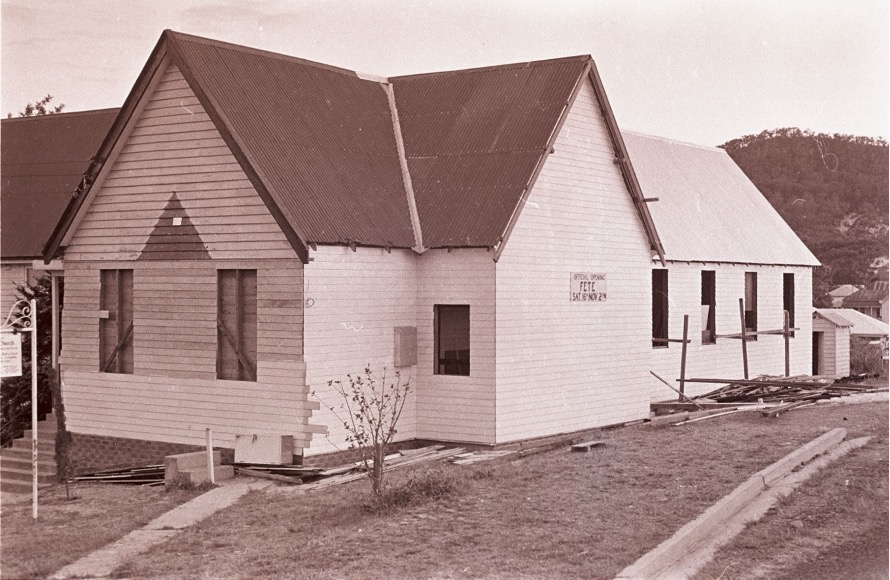
Methodist Church undergoing renovations with front porched removed – 1957
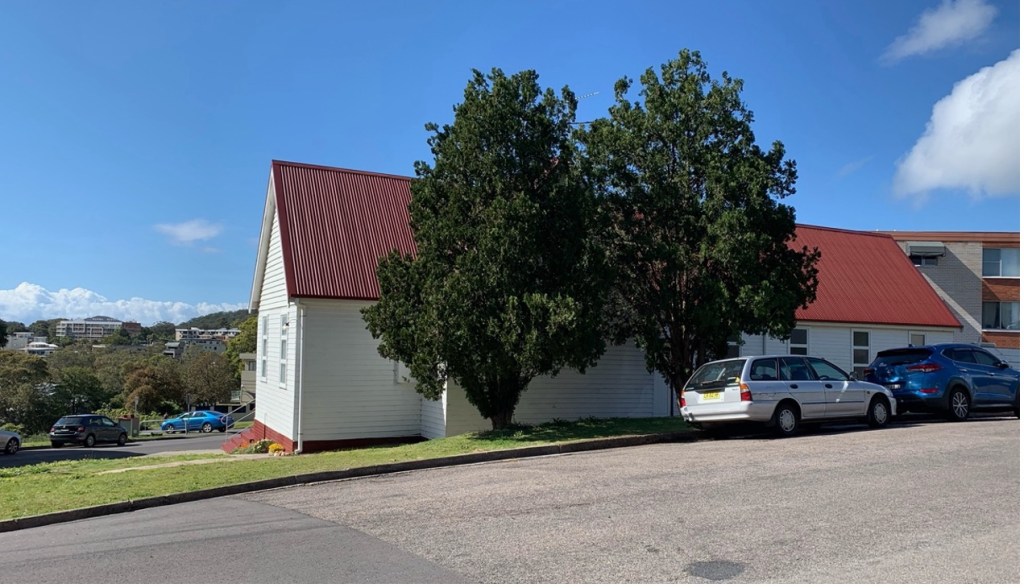
Former Methodist Church, Nelson Bay – cnr Church and Laman Sts [Author photo – 2022]
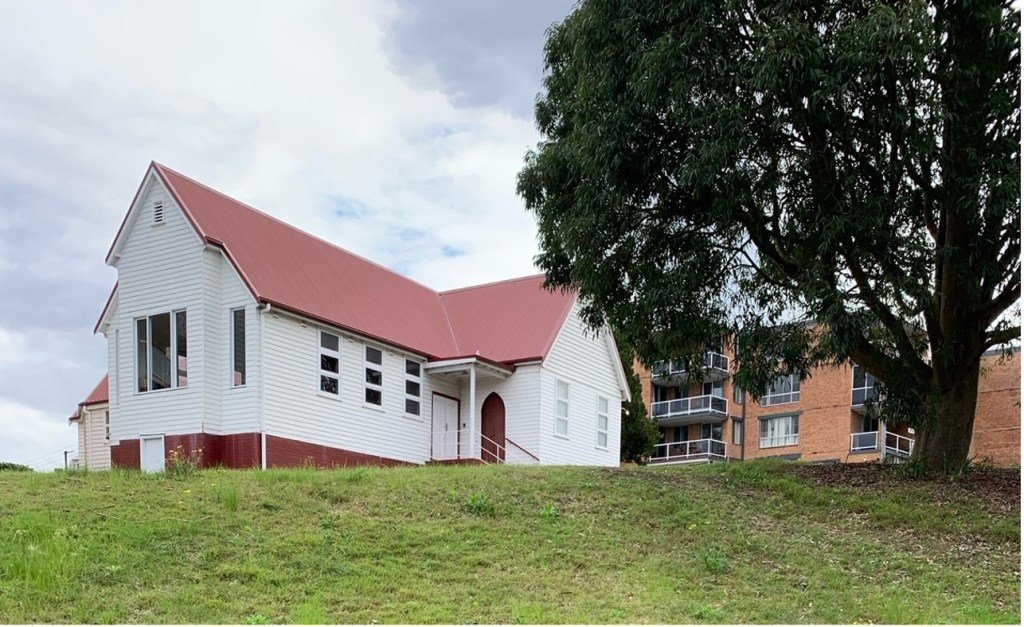
Former Methodist Church, Nelson Bay – looking up from West Point [Author photo – 2022]
Epilogue
A small article published by Nota (a journal that circulated in the Hawks Nest and Tea Gardens districts) of 1 March 1985, page 19, provided a fitting epilogue to the story of the rough old times when first church in Nelson Bay was in its early days:
‘A Methodist minister who used to cycle from Nelson Bay to Raymond Terrace to give a service, then on to Karuah and then to Tea Gardens 51 years ago, where he stayed overnight to return with Korsmans Boat to Nelson Bay on Monday morning attended — almost unnoticed — the weekly service in the Uniting Church Sunday night; February 10, 1985. He was the Reverend Batie. He still vividly remembered Dr Smith Gutteridge of Tea Gardens and Mrs Gazzard of Karuah who tended his cuts and bruises, when he had two bicycle falls on the very rough gravel road from the 12 mile creek to Karuah.’
Concluding Comments
The histories of several other churches in the Port Stephens region are published on this website and can be viewed at the following links:
The Carrington Church at Port Stephens
St. Andrew’s Anglican Church at Tea Gardens
St. Michael’s Catholic Church at Nelson Bay
St. Saviour’s Anglican Church at Williamtown
Former Uniting Church at Williamtown
Early History of All Saints Church at Nelson Bay
Researched and compiled by Kevin McGuinness
September 2022

 Port Stephens - a history exploration