
Introduction
The suitability of clay deposits at Pipeclay Creek in the Swan Bay district of Port Stephens, for the production of bricks, had been known since the late 1880’s.
By 1915, Leslie Barry-Cotter, oyster grower at Bundabah and a former school teacher at Nelson Bay Public School, saw the potential in the clay deposits to produce fire bricks that were capable of withstanding high temperatures and suitable for lining furnaces.
Up to that time most fire bricks had been imported into Australia, but with the onset of the First World War, the supply became difficult to maintain. Barry-Cotter recognised that these supply difficulties were an opportunity to fill the gap with a locally produced high quality fire brick product.
In 1915, Barry-Cotter founded the Port Stephens Firebrick Company Ltd., with the aim of manufacturing firebricks at Swan Bay, and using a ketch, Phil Forbes, which he owned, to transport the bricks to Newcastle and elsewhere. The company’s manufacturing operations were launched with much fanfare in February 1916.
Leslie Barry-Cotter only remained the company’s manager for one year.
By 1919, other firebrick companies had been established in New South Wales. The most significant competitor to the Port Stephens Firebrick Company being the newly established Newfold’s Fire Brick Company at Waratah, Newcastle, located near the steel works.
The Port Stephens Firebrick Company was financially disadvantaged in competing with the Newfold operation (and other competitors) due to its location for manufacturing the bricks and then having to transport them to Newcastle. The costs would have had been added to the price of the bricks.
This paper examines the first extraction of fire clay in the Swan Bay area, and the history of the Port Stephens Firebrick Company. The story is one of entrepreneurship at a time when the future of Port Stephens as a commercial port looked promising.
A Postscript looks at the fascinating history of the ketch Phil Forbes which was used to transport the company’s firebricks along Pipeclay Creek, Swan Bay, and then to market.
First Extraction of Fire Clay in the Swan Bay District by John Witt, of Tea Gardens – 1888
The Newcastle Morning Herald and Miners’ Advocate of 8 August 1936, page 7, published an article that reflected on the early days of pipe clay extraction in the area near Pipeclay Creek, Port Stephens:
‘Mr. Daniel James, one of the pioneers of Medowie, one of the rural towns adjoining Newcastle, is confident that the fine clay seam on the banks of Pipeclay Creek will prove a valuable adjunct to the industries that are developing so rapidly in the Northern district. Mr. James has lived at Medowie since his arrival from Wales half a century ago, and now devotes his time to fruit and vegetable growing. Speaking of the clay seam, he said yesterday that this should be better known by those in control of the large works. There was not a better seam in any part of the North. It had been proved by tests in many of the large furnaces to stand the heat in an unsurpassed manner, and was a first-class article for the manufacture of bricks, crockery, and even chinaware. He had been so informed by experienced men, and had personal knowledge of the value of this seam. Mr. James gave a little of the history of the place.
In 1888, he said, he selected 152 acres as a conditional purchase and 56 acres on conditional lease. In 1887, Mr. John Witt, a hotelkeeper from the Tea Gardens, Port Stephens, leased 40 acres—a mineral lease, partly adjoining the lease of Mr. James. “Soon afterwards,” said Mr. James, “I shifted my wife and four children to my farm. Mr. Witt constructed a canal for the purpose of punting the clay to the navigable waters, where a fairly large vessel can float. The canal did not act as expected. The work was too laborious.
Mr. Witt’s next move was to build a bank in another direction. He laid split sleepers and wooden rails in the form of a tramline for a length of 300 yards to this head of the navigable waters, and erected a wharf so that vessels were able to come near the deposits. His next move was to engage two practical brickmakers—father and son—from Sydney to make and burn his first kiln. I delivered all the wood required for that and other kilns that were constructed. I did the work on contract.”
Mr. Witt had built a good hut for the men to camp in, and three large sheds in which the bricks were set out to dry. These were covered with bark. In addition to the expert brickmakers engaged from Sydney, Mr. Witt employed other brickmakers, with men to dig the clay and wheel it to the beach. Some of the men, who had been used to the cities, did not stay long. They found the life too lonely, they said. “They were some what superstitious,” added Mr. James, “and were afraid of the snakes, iguanas, wallabies, kangaroos and emus, which, when I came here first, abounded in the country, with large numbers of wild horses and cattle.”
Like Mr. Witt, Mr. James had accepted his share of the hardships of early settlement. Mr. Witt, he said, was an old man, and his family objected to his undertaking such a difficult enterprise. His cash was also limited. The difficulties were great in the ordinary course of things; but these were made greater by the bush fires that swept the district, destroying everything except the sheds and fencing. “They made a clean sweep of everything,” said Mr. James. “We have good reason to remember those fires. The men in charge of the kilns had to clear to save their lives. Mr. Witt came to me, and I bargained with him to dig a shaft. He was told by the Government Geologist that he would find silver underneath the clay deposit. ……
“Mr. Witt showed me many references that he had received from persons, to whom he had, sent specimens of the clay and bricks,” said Mr. James. “Among others, one letter was written by the Manager of the Port Waratah Smelting Works (Mr. Thomas). These works stood where the great steel works of the Broken Hill Proprietary Company are now. When I met Mr. Thomas I asked him if the clay and bricks were as represented to Mr. Witt. Mr. Thomas replied that they were, and said that the clay was equal to or better than any clay that we had from any other part of the country. The clay, as mortar, stood solidly when the bricks from everywhere else were burnt to ashes. ‘But whoever made the bricks, Mr. Thomas told me, ‘did not know how to make a firebrick.’ “Mr. James looks forward to the time when there will be a big demand for this commodity, and feels that the enterprise of men like Mr. Witt and himself will be followed by others, who will be able to exploit the clay seam with modern appliances. The hardships of the pioneer were severe. They had been lessened, said Mr. James, and they needed to be.’
Formation of the Port Stephens Firebrick Company Ltd – 1915
The Sydney Morning Herald of 5 June 1915, page 15, reported:
‘The Port Stephens Firebrick Co., Ltd., has been registered with a capital of £10,000, in £1 shares. The objects are:—To acquire from Mr. L. F. Barry-Cotter all his mining interests in certain deposits of fireclay at Port Stephens, and carry on as manufacturers of firebricks, pottery, etc. The first directors are:—Messrs. L. F. Barry-Cotter (managing), J. R. Fulton, T. Cowan, J. W. Scobie, and E. W. Sparke. The registered office is at 19 Newcomen-street, Newcastle.’
The manager and founder of the company was Leslie Barry-Cotter, a former school teacher at Nelson Bay at Public School, to where was transferred in July 1909.
By 1914, Leslie Barry-Cotter had become an oyster grower with his wife, Laura, who been first granted an oyster lease in the Port Stephens area in 1912. The Barry-Cotters were large oyster producers at Bundabah, at Port Stephens. While located at Bundabah, Leslie must have foreseen the economic possibilities of the nearby high quality clay deposits at Swan Bay.
In 1914, Barry-Cotter purchased and repaired the ketch, Phil Forbes, which had run aground off Fly Point at Nelson Bay.
The Newcastle Morning Herald and Miners’ Advocate of 18 April 1914, page 3, reported on a party of campers who visited the Barry-Cotter oyster lease during the easter holidays of 1914:
‘On the third day we left Bumble Point after a late breakfast and returned to Duckhole and Port Stephens. Shaping another course, we made for Bundabaa [Bundabah], which is about 15 miles from Nelson’s Bay, passing on the way numerous bays and inlets, as well as Fame Cove. At Bundabaa, which is a large shallow cove, with a narrow channel, we commenced the most interesting part of our holiday. At this place Mr. Barry-Cotter has some miles of oyster leases, and he very kindly took the writer and two others of the party ashore, and explained the art of oyster farming.’
Further information on the Phil Forbes is available in the Postscript.
Official Opening of the Port Stephens Firebrick Company – 1916
The business plan of the company was basically to produce fire bricks at Swan Bay, and to transport the bricks to the company wharf located on Pipeclay Creek (located about 1.2 kilometres from the clay pit and the company works) by their tramway and then transport the bricks by the company owned ketch ‘Phil Forbes’, to Newcastle, or other ports. The company also proposed to produce other clay products, such as pottery, in the future.
The new fire brick company was officially opened with much fanfare on 2 February 1916 and was widely reported:
The Newcastle Morning Herald and Miners’ Advocate of 3 February 1916, page 5. reported:
‘The opening of the new works of The Port Stephens Fire Brick Company, Limited, at Pipeclay Creek, Port Stephens, which took place yesterday, was an event in which keen interest was taken, by reason of the fact that the works will provide an industry of great value, not only to the Port Stephens and Newcastle districts, but also to the whole of the State, for the supply of fire-bricks and other commodities, which can be manufactured from the resources at the firm’s command.
The function was attended by a large and representative gathering of commercial and manufacturing interests from various parts of the State, several of the visitors being from Sydney, and many others from Newcastle, Maitland, Dungog, Gloucester, and other parts of the northern district. The company had made complete arrangements for the carriage of their guests from Newcastle. The motor services of the Port Stephens Passenger and Tourist Company had been engaged to convey the visitors from Stockton, and a company of about fifty persons boarded the two char-a-bancs [open top vehicles] in waiting. After slightly over an hour’s run, Salt Ash was reached at 10.30 a.m. Here the company had the motor launch Replica in waiting. The trip along Tilligerry Creek, across Swan Bay, and up Pipeclay Creek, occupied two and a half hours. It was in every sense a delightful experience, and was manifestly enjoyed by all on board.
The visitors were welcomed on the company’s auxiliary ketch Phil Forbes, which was lying at the wharf, by Mr. L. F. Barry Cotter, chairman of directors, and manager of the works. Several trollies had been transformed into carriages, and the visitors, who included several ladies, were carried over the company’s tram line to the works, situated about three-quarters of a mile from the creek. A brief inspection was made of the works, and the visitors adjourned for luncheon, which had been laid in one of the drying sheds. The building had been decorated with foliage and flowers, and an excellent luncheon was served by Messrs. Way, of Newcastle.
Mr. L. F. Barry-Cotter presided, and proposed the toast of “The King.” The chairman said that he was pleased to welcome the company as visitors and shareholders to the works, to witness the progress which had been made since the inauguration of the company on June 2, 1915. The company held two leases, one of 40 acres for twenty years, with the option of renewal for a further term of twenty years. The company had also secured a lease of land for tramway purposes. During the seven months the company had erected a private wharf, put down a tramway linking up the works and the wharf, erected a large machinery shed, and the three drying sheds. They had installed the plant and machinery, and practically completed the kiln, built a manager’s cottage, laid a telephone line to Salt Ash, and installed a 50 h.p. engine into the company’s boat.
The company had turned out 150,000 common bricks for the construction of the kiln from the overburden of the fireclay, and also made 30,000 fire bricks, ready for shipment to the market, and waiting to be burned. During the period from 15 to 20 men had been constantly employed on the works. The drying sheds were capable of housing 180,000 fire bricks, and they provided ample room for the present requirements. The machinery was proving very satisfactory. A large boiler supplied steam to a 15 h.p. engine, and ample power was provided for the necessary machinery. The wire-cutting machine was turning out from 25,000 to 30,000 bricks weekly.
With the opening out of the pit, and the better facilities for mixing and soaking down of the fireclay, the company would be capable of easily turning out 40,000 fire bricks weekly. The steam press would treat about 35,000 bricks each week, and it was consequently capable of keeping in touch with the wire-cut machines.
The company had purchased a vessel [Phil Forbes], which was suitable in every way for the carriage of the finished goods, and they had installed in it a 50 h.p. engine capable of providing a speed of seven knots at a total cost of £1800. The vessel would carry about 40,000 fire bricks. It would be used to carry the finished products of the firm from the works to Newcastle and Sydney. The company had been originally formed with a nominal capital of £10,000. Since its formation the full number of shares had been quickly taken up, and applications for shares had to be refused.
The directors, recognising the advantages of a strong company, with bright future prospects, and taking into consideration recent discoveries in the quantities and qualities of its fire clay deposits, decided to place the question of increasing the company’s capital before the shareholders. At a general meeting of the company, held at Newcastle on December 9, 1915, it was resolved to increase the capital of the company to £25,000, with portion of the new issue to be held in reserve. Applications for the subscribed portion were more than satisfactory, 1250 shares having been applied for within the past few days.
The expenditure in developing the mine, erecting the machinery and plant, the purchase of the vessel, and other matters previously referred to, totalled roughly about £5000. Within the next few weeks the company hoped to have for sale from 25,000 to 30,000 fire bricks weekly, and to place them within reach of suitable markets with their own shipping accommodation. The speaker said that it might prove of interest to state that the analysis of the company’s fire bricks showed that they were practically identical with the imported Stour-bridge fire bricks, and that on actual tests the article had proved itself equal to the imported one.
Mr. Barry-Cotter read an extract from the report of a test of the company’s bricks on the bridge of a refinery furnace, with an imported brick as a comparison. The report submitted by the manager of the English and Australian Copper Company had stated with reference to the fire bricks submitted for trial at the works, that both samples had been found most excellent bricks. They were placed on the bridge of the refinery furnace seven days previously, in company with a best English Dinas brick. The bricks were practically as good as the Dinas brick and they were certainly the best firebrick produced in Australia, which the company had tried. The bricks had also been tested in other furnaces with equally satisfactory results. Export opinion had been obtained, and everything possible had been done to prove the quality and the quantity of the fireclay. …….
The accessibility of the deposit to deep water carriage connecting with Sydney and Newcastle, in addition to an abundance of fuel in the immediate locality, guarantees low working costs, should works be established.” A sample of one cwt. of the clay had been forwarded to the Adamstown Brick Company for test, and Mr. T. Cowan, the manager, had reported that the clay was a plastic one of the finest quality, while the finished article was a white silica brick, which was a first-class acid fire-brick, able to withstand the severest test.
In concluding, the chairman said that with their deepest sinking they had not reached the bottom of the deposit, and the deeper the sinking the better were the analysis and the tests of the fireclay. The company had proved 20ft of clay with an over-burden of about 6ft, and there was every prospect of it continuing to a much greater depth.
Mr. W. H. Blaker proposed “Success to the Port Stephens Fire Brick Co., Ltd.,” and congratulated the chairman upon the lucid and satisfactory account of the operations of the company from its inception. The shareholders could thank Mr. Barry Cotter for discovering the fire clay which had been the means of inaugurating the company. There were many men present who understood firebricks, both theoretically and practically, and being in charge of large manufacturing industries, they would soon find out the value of the brick. The bricks had undergone the crucial test by experts, and there was no need to fear for the success of the company. He understood that in the past large quantities had been imported, but that had, he hoped, been stopped for all time. As the company was an Australian one, every possible endeavour should be made in its interests. Newcastle was destined to become one of the greatest manufacturing centres in the Commonwealth, and he did not see any reason why Port Stephens should not grow also into another large manufacturing district.
Mr. T. Cowan, manager of the Adamstown Brick Works, and a director of the company, speaking to the toast, reviewed the position of the company, and the work that had been done. He said that of late years a very great amount of fire bricks had been imported from Europe, but he considered that the day had now arrived when very few of these bricks need be imported while they had a deposit of such a character. The sheds at present erected were only about half of the project, and he looked forward to rapid strides in the progress of the company. The erection of the works had been superintended by Mr. Barry Cotter, and the thanks of the company were due to the great interest he had taken in the establishment of the industry.
Mr. C. Langwill, president of the Newcastle Chamber of Commerce, proposed “The State Parliament” He expressed regret that the welcome home to Colonel J. L. Beeston had precluded the Mayor of Newcastle and other prominent citizens from being present. On behalf of the Newcastle Chamber of Commerce he appreciated the invitation to attend the function, and he hoped that the company would reap the benefit of their enterprise. Personally, he believed that the lay-out of the works augured well for the future. Speaking upon Parliament he said that the Government had done well under trying conditions, and as far as Newcastle was concerned, they had every reason to be grateful to the present Government. ….. Referring to the company, the speaker said that its initial success was due to the energy of Mr. Barry Cotter, and there was no reason why works of the character should not prosper. He knew of no place in the country where there was such a fine deposit, and the company could replace the fire-bricks and goods imported from abroad. Mr. J. R. Fulton proposed, “The Press.”
A visit was then paid to the works, where the official opening was performed by Mrs. Barry Cotter, who turned the wheel, which set the machinery in motion. The visitors were taken over the works, and the process explained by Mr. Barry-Cotter, who was accompanied by his fellow-directors, Messrs. E. W. Sparke, J.R. Fulton, Flo. J. W. Scobie, and T. Cowan.
The material was carried into the pug-mill direct from the clay pit by means of a tram line. The clay was then transferred from the mill in blocks to the wire cutting machine, by which they were cut into the requisite sizes. The bricks were then wheeled away, to be stiffened and repressed with the steam press, and later to emerge from the works in the highly finished product, of which many samples were admired by men who knew and appreciated a thoroughly good brick. The machinery having been stopped. Mrs. J. W. Scobie presented Mrs. Barry-Cotter with a silver jewel casket, upon which were engraved her initials of “L.B.C.,” for which she suitably expressed her thanks. Cheers were given for Mr. and Mrs. L. F. Barry-Cotter, and the visitors returned to Salt Ash by the launch, and were from thence conveyed to Newcastle by the motor char-a-bancs, after an interesting and pleasurable day.’
The Maitland Weekly Mercury of 5 February 1916, page 5, when reporting on the official opening of the manufacturing operations, provided further insight into the background of the company’s manager, Leslie Barry-Cotter:
‘Hidden in the solitudes of country for which little use up to the present has been found and situated within a mile of the of the many tidal streams that belong to the famous Port Stephens harbour, a new industry has been established for the purpose of manufacturing fire bricks. The presence of the silicious clays, which has resulted in the establishment of the industry on its present site, has been known for many years, as evidenced by the name of “Pipeclay Creek,” where the works are situated, but there was needed someone with sufficient energy, enthusiasm, enterprise, and ability to overcome the many difficulties incidental to the establishment of an industry under the existing conditions.
Such a person has turned up in the presence of Mr. L. F. Barry Cotter, the moving spirit in the enterprise, and now the managing director and chairman of the board of directors of the Port Stephens Fire Brick Company, Ltd. This gentleman, a few years ago, was the public-school teacher at Nelson’s Bay, and he showed his ability to adapt himself to circumstances and use his opportunities by encouraging his pupils to get together a fine collection of the many varieties of fish inhabiting the waters of Port Stephens. Promotion in the Education Department was too tardy to suit a man of Mr. Cotter’s calibre, and he turned his attention to oyster culture, in which he achieved much success.
Mr. Cotter’s attention was next directed to the opportunities for the establishment of an industry to manufacture fire bricks from the deposits of suitable clay, to which reference has already been made. As most of our fire bricks are imported, and some have come to us from what are now enemy countries, and it is a matter of national importance to reduce imports of what can be produced here, and make the best, of our natural resources, the work to which Mr. Barry Cotter has devoted his energies is one of much public interest. Mr. Cotter has succeeded in getting together a company of men who combine the practical and cautious with the speculative, and the board of directors, in addition to the managing director consists of Messrs. T. Cowan, E. W. Sparke, J. W. Scobie, and J. R. Fulton.’
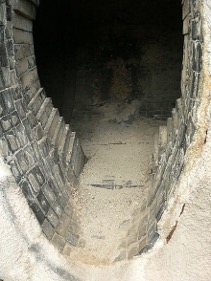
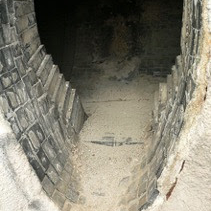
Fire bricks [Wikipedia]
Holidaying party visit the Company’s Works – 1916
A report published in the Maitland Weekly Mercury of 11 March 1916, page 7, of a holiday group who visited the company’s works, provides later insight into its operations:
‘On the last day of our stay we arranged to pay a visit to the Port Stephens Fire Brick Co.’s works, near the head of Pipeclay Creek. Unfortunately, it was a very wet day, but the skipper made things as snug as possible, and although the prospect was somewhat dreary, we were a merry party. ….. A run of two hours brought us to the company’s wharf, from which a trolly line has been laid down to the works three-quarters of a mile away. Here, we were received by the foreman (Mr. A. P. Baker), in the absence of the manager, and shown over the works, and the process of manufacturing fire-bricks was explained to us.
Mr. Baker also showed us the pit from which the silica is drawn for making the bricks. This at present is down 22ft. 6in., and the silica extends to another 18ft. in depth, so that there would appear to be an inexhaustible supply of material. Up to the present time almost if not the whole of the fire-bricks, in use have been imported, but owing to the war there is great difficulty in securing freight, and this fact would appear to mark the flood tide for such a company as this.’
Annual Meeting of the Company – 1916
The Raymond Terrace Examiner and Lower Hunter and Port Stephens Advertiser of 4 August 1916, page 2, reported:
‘The annual meeting of the Port Stephens Fire Brick Co. has been held and the old directors still hold their seats. Mr. Barrie-Cotter resigned from the management of the company whose place had been filled by Mr. Cowan [a company director]. At the meeting Mr. Richardson, the expert in the manufacture of this special brick, and imported from England for the special work, was present at the meeting. He spoke well of the material at their disposal, and with several minor additions to the plant, and careful management, he thought there were big prospects ahead. After hearing their new foreman of works explain in detail the manufacture of the article and also of art pottery the directors feel they have secured a most capable man. We like the directors wish the company every success.’
Foreman of Works dies – 1919
The Newcastle Morning Herald and Miners’ Advocate of 12 May 1919, page 6, reported:
‘Mr. Henry Richardson, of Dunbar-street, Stockton, who was taken to the Waratah Influenza Hospital on Saturday, May 3rd, died on Saturday. Deceased, who was the manager of the Port Stephens Fire Brick Company, was engaged by the company in England to come out to manage the works. The funeral took place yesterday, the interment being in the Congregational cemetery, Sandgate, the Rev. A. MacKinlay officiating. The following sent floral tributes: Directors of Port Stephens Fire Brick Company, Limited, Mr. and Mrs. Cowan, E. J. and A. Taylor, Mr. and Mrs. D. N. Morison, Mrs. W. Evans, and Stockton Congregational Church.’
Request for a Hand Punt – 1920
The Raymond Terrace Examiner and Lower Hunter and Port Stephens Advertiser of 16 April 1920, page 3, reported:
‘The Port Stephens Fire Brick Co. asked the [Port Stephens Shire] Council to place a hand punt on the Pipeclay Creek, to afford a more direct route from Swan Bay to Salt Ash road, the Company would help to form the road on either side. The application was refused, but no objection will be taken to a private punt.’
Proposals for Company Restructure – 1920
By 1919, it appears that the Port Stephens Firebrick Company, Limited was financially unviable. Various options were proposed to keep it as going concern viz:
- Company restructure in name only – May 1919.
The following notice was published in the Government Gazette of the State of New South Wales on 13 February 1920, page 1094, concerning the restructuring of the company [the new company would retain the former name]. The Resolution to wind up the Company was passed for the purpose of restructure only, and did not involve any disturbance in the business of the Company. A new Company had already been formed and had taken over the business of the old Company, and would continue the same.
‘An Extraordinary General Meetings of the above-named Company [Port Stephens Firebrick Company, Limited], duly convened, and held respectively on the seventh day of May, 1919, and the twenty-eighth day of May, 1919, the subjoined special resolutions were duly passed and confirmed:—
(a) That it is desirable to reconstruct the Company, and accordingly that the Company be wound up voluntarily, and that Douglas Sefton, of Stockton, be and he is, here by appointed Liquidator for the purposes of such winding up.
(b) That the said Liquidator be, and he is hereby, authorised to consent to the registration of a new Company, to be named the Port Stephens Firebrick Company, Limited, with a Memorandum and Articles of Association which have already been prepared with the privity and approval of the Directors of this Company.
(c) That the draft Agreement submitted to this meeting and expressed to be made between this Company and its Liquidator on the one part, and the Port Stephens Firebrick Company, Limited, of the other part, be, and the same is hereby approved, and that the said Liquidator be, and he is hereby authorised, pursuant to section 261 of the Companies’ Act, 1899, to enter into an agreement with such new Company (when incorporated) in the terms of the said draft, and to carry the same into effect with such (if any) modifications as he thinks expedient. Thomas Cowan, Chairman.’
- Floating of a new company, Port Stephens Fire Brick Tile and Pottery Limited – late 1920.
The investment prospects of the new company were deemed unattractive in an investment review published in the Smith’s Weekly of 11 December 1920:
‘This proposition is not at all attractive. Authorised Capital.— £100,000. Issued, 20,500 £1 shares fully paid to vendors, and 29,500 £1 shares for public subscription. 50,000 £1 shares in reserve. Object. — To purchase undertaking, assets, etc., of Port Stephens Fire Brick Co., Ltd., at Tilligerry Creek, Port Stephens. Assets. — Valuation not given. Vendor company has spent about £22,000 on plant, buildings, and development. It is proposed to instal extra plant, £5,800. Profits. — Estimated £11,000 yearly, 22 per cent, on paid-up capital, £50,000. Past profits or losses of vendors not stated. Allotment — Industrial Pigment, Ltd., receives 4,750 of vendors’ shares, and agrees to place 15,000 contributing shares. Members of vendor company have option over 10,000 contributing shares. 4,500 shares left for public, if above shares are taken up. Industrial Pigment, Ltd., likely to have control. The defects of the proposition are serious: — (1) No detailed statement or valuation of assets. (2) No statement of past profits of vendor. (3) Doubt cast on estimated profits by absence of past profits statement. (4) Possibility of control by Industrial Pigment Ltd., and outside shareholders having little say in management. Investors can do better elsewhere.’
Port Stephens Fire Brick Company Limited liquidated – December 1920
There is no evidence that the proposed new company was ever formed or traded. Essentially, the Port Stephens Firebrick Company, Limited was liquidated up in December 1920.,
The Sydney Morning Herald of 22 December 1920, page 13, reported:
‘The companies named herewith have decided upon winding up:
Port Stephens Firebrick Company Ltd., with a view to reconstruction under the name of the Port Stephens Fire Brick Tile, and Pottery Company, Ltd.’
Final winding up of the Port Stephens Fire Brick Company, Limited – 1923
The following was published in the Government Gazette of the State of New South Wales of 28 September 1923 page 4399:
‘In the matter of Port Stephens Fire Brick Company Limited (In Liquidation):
Notice is hereby given, in pursuance of section 141 of the Companies Act, 1899, that a General Meeting of the members of the abovenamed Company will be held at the office of Mr. Douglas Sefton, Thorn-street, Newcastle, on Friday, the twenty-sixth day of October, 1923, at 7.45 p.m., for the purpose of having an account laid before them showing the manner in which the winding-up has been conducted and the property of the Company disposed of, and of hearing any explanation that may be given by the Liquidator; and also of determining the manner in which the books, accounts and documents of the Company, and of the Liquidator thereof, shall be disposed of. D. Sefton, A.C.P.A., Liquidator. Dated this twenty-first day, of September, 1923.’
Further commentary on the Clay Deposits at Swan Bay – 1930
The Newcastle Morning Herald and Miners’ Advocate of 28 June 1930, page 8, published the following article about a renewal of fire clay extraction activity in the Swan Bay area:
‘Port Stephens Deposits within, 26 miles of Newcastle, in the Port Stephens district, are believed to be the finest fire-clay deposits in the Commonwealth. These have recently been tested by experts, and the value shown to be equal to anything procurable in the country. The deposits were discovered 18 years ago by Mr. J. Muir, of Merewether, [on his property] who, with his son, has acquired the freehold of 200 acres, located at the head of Pipe Clay Creek, on the Port Stephens foreshores. The clay has been proved to a depth of 42ft. It probably exceeds that, as will not doubt be later proved. At different points over the 200 acres bores have been put down, the quality of the fire clay not varying in any degree. “About 100 tons,” said Mr. Muir, yesterday, “have been delivered to the Steel Works at Newcastle, and another order is ready on the property awaiting transport by motor wagons. We have today obtained another contract for the supply of a large tonnage for Lysaght’s works at Port Waratah. This is prepared fire clay, and will be delivered continuously until the contracts expire. “The difficulty has been to get the clay to market. The roads are in a deplorable condition, that leading to the property—the Swan Bay road—being in an exceptionally bad state, and almost untrafficable. ……..
The clays are suitable for the manufacture of crockery, paints, and the highest quality of firebrick, and have been tested to stand a heat of 1675 deg. Centigrade. Mr. Muir, through Mr. Peter Connolly, M.L.A., intends making representations to the Government to see if some assistance can be obtained in order to facilitate the marketing of these clays, for which there is an ever-growing demand, following the development of the industries of the Northern district.’
Concluding comments
The considerable plans for the growth of fire brick manufacturing at Port Stephens failed to eventuate.
Despite its short life as an operating company, there was a high degree of entrepreneurial skills applied by both the company founder, Leslie Barry-Cotter and those who continued its operations thereafter.
The location of the works and the difficulty and cost of getting the bricks to market were to prove difficult, especially when a larger fire brick company had commenced operations at Waratah, Newcastle, close to the steel works.
POSTSCRIPT
History of the Ketch Phil Forbes
Phil Forbes (The Ketch) was owned and operated by the Port Stephens Fire Brick Company to transport fire bricks to markets in Newcastle and elsewhere.
The well-known coastal trading boat was brought by the company from its founder Leslie Barry-Cotter. The boat had a varied and troubled life, the story of which is told as follows.
Launching of the Phil Forbes – 1899
The Newcastle Morning Herald and Miners’ Advocate of 28 April 1899, page 3, reported:
‘On Saturday last was launched at Swansea, Messrs. Murray Bros’. new ketch the Phil Forbes. The occasion brought together about 300 people to witness the launch at “The Chinaman’s,” where the vessel was built. Mrs. J. Murray performed the christening ceremony, after which the vessel commenced to move on the slip amidst great cheering. Although this is not the first vessel launched at Lake Macquarie – (the 16th it is thought) – it was a novel sight, and full of interest to the people living at the lake.
The vessel is a centre-board ketch, double topsail rigged, and was built from a model designed by Mr. Phil Forbes, a native of Swansea, after whom the vessel is named. She is built specially to suit the requirements of the Lake Macquarie trade, and is to run coal from the Morrisset Colliery, owned by the Murray Bros. There are seven or eight other vessels running to the Lake in the same trade, but the entrance to the Lake is too shallow to allow vessels drawing over 6ft 6in to enter. This vessel is built to carry 130 tons of coal, and to draw 6ft of water. Her length of keel is 76 ft, and she measures 91ft overall. Her depth of hold is 6ft 9 in, and her beam 24ft. Her spars are Oregon pine, the mainmast being 66ft long with topmast 40ft, and her mizzenmast 53ft 6in. Her timbers are ti-tree, 9 ins apart, thus making her remarkably strong, and her fastenings are chiefly of copper.
Altogether the vessel does great credit to Mr. Forbes, and, unless appearances are deceptive, should prove herself one of the best of her class on the coast for strength, light draught, and fast sailing.’
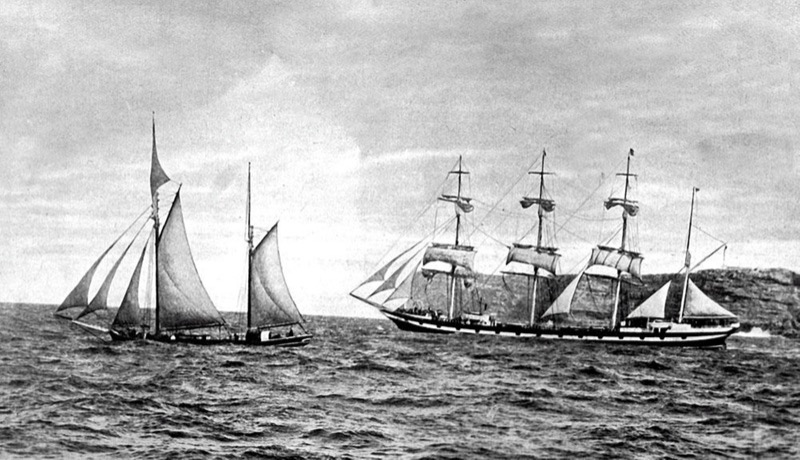
The ketch ‘Phil Forbes’ (left) and ‘Medway’ (right) off Sydney Heads [Sydney Mail, 17 May 1922]
Accident to a Crew Member – 1902
The Manning River Times and Advocate for the Northern Coast Districts of New South Wales of 30 August 1902, page 6, reported:
‘A sailor on the ketch Phil Forbes met with a very serious accident at Camden Haven Heads on Wednesday last. It appears that he was up the rigging, when he fell down on to the deck, a distance of about 30 feet; and it is feared he is hurt internally. He complained of having a bad back. Fortunately the Kincumber was just about to leave for the city, when Capt. De Fraine (the owner of the boat) was informed of the accident, and at once advised him to be placed on board and taken to Sydney for medical treatment. I have not heard how the patient is getting on since leaving here.’
Phil Forbes runs aground at Camden Haven – 1902
The Newcastle Morning Herald and Miners’ Advocate of 29 September 1902, page 4, reported:
‘On Saturday evening a telegram was received at Newcastle from Camden Haven stating that the ketch Phil Forbes, while proceeding to sea in tow of the tug Unique, at 5 p.m., grounded outside the Training Wall, where she remained on a sandy bottom, but in no immediate danger.’
TheAustralian Star of 29 September 1902, page 5, also reported:
‘A notice posted in the Royal Exchange this morning says that the ketch Phil Forbes, which is aground at Camden Haven, has, with the assistance of anchors and a tug, been moved a considerable distance nearer the training wall and in deeper water. It is expected that she will be floated tonight. There is 6ft. of water on the bar, and 3ft. 4in rise of tide.
TheDaily Commercial News and Shipping List of 1 October 1902, page 4, reported good news:
‘The Phil Forbes, ketch, which went aground on the outside training wall at Camden Haven while proceeding to sea in tow of a tug on Saturday afternoon, has been successfully floated.’
The Ketch blown ashore in Tasmania – 1903
The Daily Telegraph of 9 June 1903, page 4, reported:
‘A message was received yesterday from Stanley (Tasmania) stating that the ketch Phil Forbes had been blown ashore there during Sunday night. The damage had not been ascertained.’
The Examiner of 12 June 1903, page 4, reported on the successful salvage of the ketch:
‘The ketch Phil Forbes was floated off the beach just after midnight on Tuesday and is now discharging the timber at the old jetty. The vessel is not injured in any way, the only loss being the two anchors, which the captain hopes to pick up again. Captain Collins has decided not to go into Black river, as after surveying the channel and river inside he considers it is not navigable for a vessel of the Phil Forbes’s tonnage. It is some years since any vessels traded to Black River.’
Phil Forbes suffers severe damage in a storm – 1903
The Australian Star of 28 September 1903, page 3, reported:
‘The ketch Phil Forbes, a little vessel of only 87 tons register, has had a sensational experience at sea. She arrived in port [Sydney] on Saturday with her bulwarks patched up and her rigging temporarily stayed up. She was one of the best-known trading vessels on the coast for several years, but has been engaged in Tasmanian waters for some months past. She was despatched from Hobart 25 days ago for Sydney again, and only arrived on Saturday. Captain R. Collins, her new master, tells a tale of a trying time at sea.
The Phil Forbes was getting along very well until the 16th inst., when she encountered a terrific gale from the south-east. A mountainous sea was soon running and breaking heavily over the little vessel. Captain Collins hove her to, but the blow raged, more furiously; and the ketch was badly tossed about. For five days the gale continued, the glass going down to 29.10, and the Phil Forbes being practically under water the whole time. Everything movable was washed overboard, and the seas lifted the cook’s galley from amidships right over to port. There it mains still. The huge seas breaking on board smashed her port and starboard bulwarks badly. Then the water began to get below and the cabin was flooded, there being 2ft. of water in it at one time. Luckily the hatches stood the strain well, and no water got into the hold.
The little ship was hove-to for three days off Ram Head, near Cape Howe. Her mainmast rigging carried away in places under the great strain, and Captain Collins feared the spar would go over the side, but it just lasted the gale out. The vessel was only under a three-reefed main-sail and a reefed staysail, yet she laboured and strained violently, causing her crew the greatest anxiety. When the gale abated the bulwarks were temporarily repaired with timber from amongst the vessel’s cargo to keep the water off the deck, and sail was got on and port made as soon as possible. The crew report their experience as a very trying one throughout and were glad to get to port.’
The Ketch in Nelson Bay with damaged sails – 1904
The Newcastle Morning Herald and Miners’ Advocate of 11 July 1904, page 4, reported:
‘Captain Mackenzie, of the tug Leveret, reports speaking [communicating with] the ketch Phil Forbes yesterday. The ketch was bound from Port Macquarie to Sydney and had lost her mainsail and jib during the gale. The captain wished to be reported but was not in need of any assistance.’
The Australian Star of 12 July 1904, page 5, further reported:
‘Nelson’s Bay reported this morning that the ketch Phil Forbes was safe at anchor in Shoal Bay with the ketch Premier. All the Phil Forbes’ head sails were blown away. It will be remembered that she was sighted at sea by a tug hove to during the full force of Saturday’s gale.’
The Ketch runs aground again at Camden Haven – 1905
The Daily Telegraph of 11 December 1905, page 5, reported:
‘The Department of Navigation received a telegram on Saturday morning stating that the ketch Phil Forbes was aground at Camden Haven. The vessel grounded outside the training-wall, but her position was not considered dangerous.’
TheDaily Telegraph of 12 December 1905, page 6, further reported:
‘A telegram received from Camden Haven yesterday stated that the ketch Phil Forbes, which went aground there on Saturday last, was floated off at 5.30 yesterday morning. A telegram to the Department of Navigation reported that the vessel was leaking and was towed to an anchorage in the river.’
The Daily Telegraph of 16 December 1905, page 9, finally reported:
‘The ketch Phil Forbes, which went aground at Camden Haven on December 9, arrived at Sydney on Thursday. She will go into dock for survey.’
‘Phil Forbes’ floated Off Tuncurry Crossing – 1909
The Sydney Morning Herald of 23 March 1909, page 8, reported:
‘The small ketch Phil Forbes, which was reported on Sunday to be aground on the Tuncurry crossing, floated off early yesterday morning, and left for Sydney.’
The Ketch aground again – 1910
The Star of 21 March 1910, page 5, reported:
‘A telegram received by the Navigation Department from Foster states that the ketch Phil Forbes, which went aground at Foster, is now making water, and will have to be docked before she can come on to Sydney.’
TheDaily Telegraph of 26 March 1910, page 18, further reported:
‘The ketch Phil Forbes, which went ashore at the Cape Hawke entrance early in the week, was floated at 9 p.m. on Thursday. The vessel is badly damaged, and will have to be docked.’
Phil Forbes aground at Fly Point, Nelson Bay – 1914
The Evening News of 8 July 1914, page 6, reported:
‘The ketch ‘Phil Forbes’, which arrived at Port Stephens from Sydney this morning, has gone ashore and is likely to become a total wreck, according to a telegram received by the Navigation Department this afternoon. The message which was dispatched by the light-housekeeper at Nelson’s Head, states that the ketch went ashore on the rocks near Fly Point, and that a westerly gale is blowing.’
The Newcastle Morning Herald and Miners’ Advocate of 9 July 1914, page 4, further reported:
‘A message was received yesterday morning by Captain F. Cumming, Deputy Superintendent of Navigation, stating that the ketch Phil Forbes had got into difficulties in Nelson’s Bay, Port Stephens, and gone aground. The place where the little craft grounded is a hardy bottom, and the vessel was filling with water. Fortunately, the spot is close to the shore, and the crew who were in no danger reached land safely. The weather was exceedingly boisterous at Port Stephens during Tuesday night and yesterday, when the ketch went aground. The Phil Forbes, which is a well-known trader at Newcastle and along the coast, is, it is understood, timber laden.’
The fate of the ‘Phil Forbes’ looked bleak, according to the Sydney Morning Herald 10 July 1914, page 10:
‘The ketch Phil Forbes is still ashore between Fly Point and Nelson’s Head. Heavy westerly winds prevail, and the hull was pierced by the rock for about 20 feet. The cargo is all awash. The crew is standing by the vessel. There is every appearance of her going to pieces. She has a heavy list to seaward. The cargo, belonging to Mr. Croll, of Bungwahl, has been totally destroyed. It consisted of chaff, flour, and maize.
On her previous trip, the Phil Forbes left Sydney together with the schooner Aleda and the ketch Alfred Fenning, and narrowly missed going ashore with the southerly gale. She dragged her anchors for two miles, then held within 50 yards of rock Captain Harris Is in charge of the vessel, which is uninsured. The water policeman, Nesbitt, is watching the interests of the owners.’
The Sydney Morning Herald of 15 July 1914, page 14, further reported:
‘The ketch Phil Forbes, which has been lying on the rocks near Fly Point for seven days, may now be regarded as a total wreck. She has been subject to the whole of the westerly gale which has been blowing during that period and still continues. The bottom now appears to be entirely gone. Should the westerly continue, it is feared the main mast will go, as it is leaning heavily seawards. Her bows are now fast ashore with wire rope. Should this snap, she will probably slip into deep water. The crew, with the exception of Captain Harris, returned to Sydney by the steamer Karuah yesterday.’
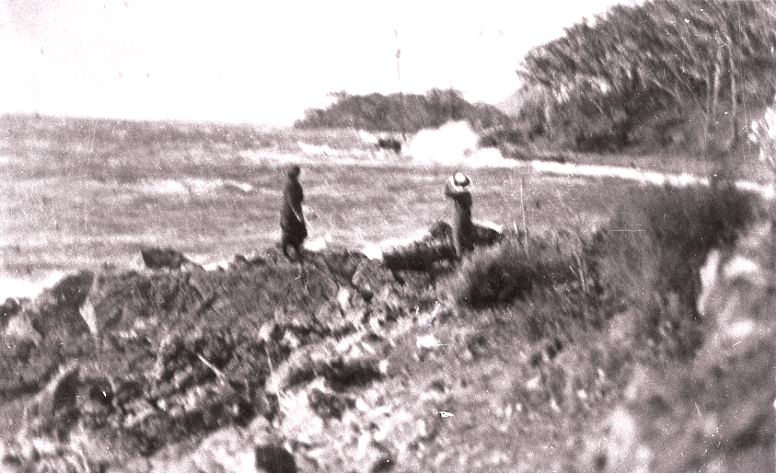
‘Phil Forbes’ aground on the rocks at Fly Point, Nelson Bay – 1914
Port Stephens resident purchases the Wreck – 1914
The Daily Telegraph of 25 July 1914, page 10, reported:
‘The ketch Phil Forbes, which was driven ashore at Fly Point, Nelson’s Bay, on July 8, during the westerly gales, has been purchased by Mr. Barry-Cotter, of Nelson’s Bay. The vessel was successfully refloated on this evening’s tide, and towed to Tea Gardens to undergo repairs.’
Mr. Barry-Cotter purchased the Phil Forbes for £30.
The Ketch purchased by the Port Stephens Fire Brick Company – 1916
In 1915, Leslie Barry-Cotter founded the Port Stephens Fire Brick Company to manufacture firebricks at Swan Bay. The Company purchased the Phil Forbes to transport the bricks to Newcastle and elsewhere. operations were launched with. By May 1919, the company was no longer using the ketch to transport the fire bricks.
Phil Forbes runs aground – 1919
The Sydney Morning Herald of 22 November 1919, page 14, reported:
‘The Navigation Department has been advised by the pilot at Harrington that the ketch Phil Forbes, while entering Manning River, grounded on the channel along the wall, and is now broadside on to the tide.’
The ketch did not spend long grounded and late made it safely into the Manning River. This was the last report of the ketch surviving regular marine mishaps.
Bass Strait Adventure – 1922
The Casino and Kyogle Courier and North Coast Advertiser 26 April 1922, page 4 (and other papers) reported on a Bass Strait salvage operation in which the Phil Forbes played a key role:
‘On Christmas Eve last the Union Company’s steamer Karitane was wrecked on Deal Island [Tasmania], while on the way to Sydney from Tasmanian ports, with a large quantity of produce and near-pure copper. The vessel struck a rocky ledge head on, and battered in her bows. She was subsequently beached. Owing to the vessel’s precarious position, the company decided to sell the cargo. The lure of gold has urged on men of all nationalities to the field of adventure, but in this case it was the lure of copper that resulted in a syndicate being formed in Sydney to embark on the quest. The cargo was bought, and the little ketch Phil Forbes chartered.
A crew, and an experienced diver, were assembled, and about a month later the band of adventurers, sailed out of the harbor, bound for Bass Strait. For two months, at lonely Deal Island, the work of recovering the valuable metal from the hold of the steamer proceeded apace. Great difficulties were encountered at first, owing to the large quantity of straw and other produce that was lying on the top of the metal. Gradually, the object of the quest was reached, and was hauled to the surface, and placed in the ketch alongside. When a fair quantity had been loaded, the Phil Forbes would, leave for the Tasmanian mainland, unload, and return. Calm weather prevailed during the early portion of the salvage operations, but towards the finish conditions were unpleasant. Nearly all the copper, together with some silver ore, and ship’s gear, were recovered. As about £60,000 worth of copper was on board the Karitane, according to statements made at the time of the wreck, members of the syndicate should reap a rich reward for their enterprise. Principals of the syndicate declare that the salvage work established a record in some respects, and was attended by unqualified success.’
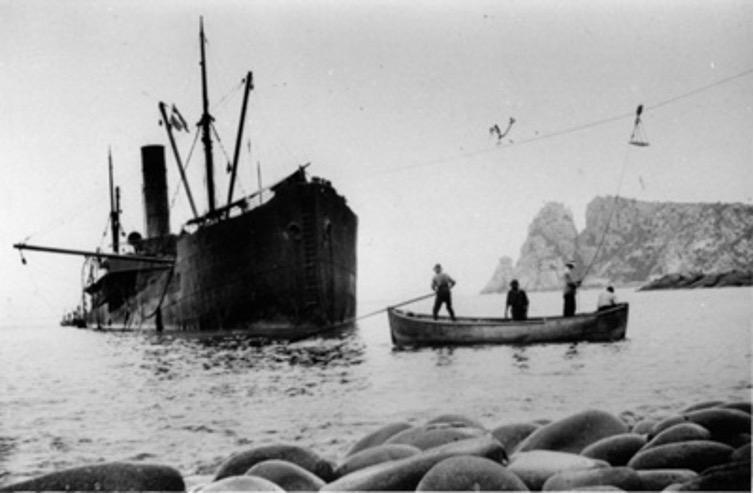
Wreckage of the ‘Karitane’ in Tasmania [Maritime Museum of Tasmania]
‘Phil Forbes’ founders – 1922
The Raymond Terrace Examiner and Lower Hunter and Port Stephens Advertiser of 12 May 1922, page 2, reported:
‘After an adventurous career in trading around the coast of Australia, the ketch Phil Forbes, owned by Messrs Forbes Bros founded near what is known as the Two Fathom Rock, about three miles north of Broughton Island, on Friday night. The master and the crew landed on the Island. The Phil Forbes arrived in Newcastle on Thursday from Sydney, where she had been refitted after being chartered by a syndicate for the recovery of copper and other cargo from the steamer Karitane, which was wrecked at Deal Island, in Bass Strait.
The Phil Forbes left Newcastle the following morning for the North Coast to take in a carg and passed the lighthouse at Nelson’s Bay shortly after noon on Friday. The lighthouse keeper there stated that the weather was favourable on Friday evening, and until a slight wind blew up towards evening, the sea was like glass. Even at night the sea was comparatively calm. He stated that the master of the steamer Kinchela had reported to the post master at Nelson’s Bay that he had seen the masts of the ketch standing out of the water near Broughton Island, and he had ascertained that the master and crew of the vessel had safely reached the island which was uninhabited, So far as the light-house keeper knew, the men were still there on Monday, but Greek fishermen who plied their calling in the neighbourhood of the island would leave and bring the crew back to the mainland. The Phil Forbes was blown ashore in Port Stephens a few years ago, and then sold for £30.’
The Port Macquarie News and Hastings River Advocate of 13 May 1922, page 5, provided further information on the foundering:
‘The events which surrounded the sinking of the ketch Phil Forbes; a well-known coastal trader, near Broughton Island, on the 5th inst., were related by the master of the vessel, Captain Muir, on his arrival at Newcastle on Tuesday afternoon from Nelson’s Bay, where the crew were taken after landing on the island. Captain Muir was accompanied by the four members of the crew of the vessel, and they were able to carry all that they had saved when the ship was lost. “It was just after dusk that the Phil Forbes foundered,” said Captain Muir. “The weather was fine and the sea smooth, and afterwards there was a bright moon. She went under just about a mile north of North-west Rock, to the north of the island. The ketch is now lying in about fourteen fathoms of water, and her masts are just showing above the surface. She filled and sank rapidly, and we had to leave in a hurry. All that we saved were our small personal belongings, and even the ship’s papers were lost.
Our ship’s boat was a good one, and we had no difficulty in reaching Broughton Island, where we landed in the dark. It is a rough, rocky country, and the island extends for about three miles by a mile. As soon as we landed we cast about for habitations, and came across some huts, which we learned afterwards belonged to Greek fishermen, who come, down from Port Stephens at the weekends. We broke into these huts, and found stocks of macaroni, which we relished. We had no trouble over water, drawing our supplies from two wells. We were alone on the island till Sunday morning, when some Greek fishermen from the mainland arrived, and after spending the day there they towed us back in our own boat to Nelson’s Bay, where we landed.
The Greeks did everything they could to help us. Captain Muir referred humorously to the presence of rabbits on Broughton Island, which was the site selected some years ago for the experiments of Dr. Dantzic, a German scientist, for the extermination of the pests by inoculation methods. He said that rabbits still abounded there, but, although traps were set, the crew failed to catch any of them. In view of a probable Marine Board inquiry into the sinking of the ketch, Captain Muir declined to state the cause of the vessel foundering.
The names of the crew were B. Hickson, engineer; H. A. Raahauge, mate; and T. Harper and L. C. Douglas, seamen. The Phil Forbes was owned by Messrs. W. Langley and Sons, and a somewhat interesting record attaches to her construction. Her builder was a Mr. Forbes, who, by serving three years before the mast of a well-known sailing vessel, the Nova Scotia, saved enough money to build first the ‘Forbes Brothers’, and afterwards the ketch which recently foundered.’
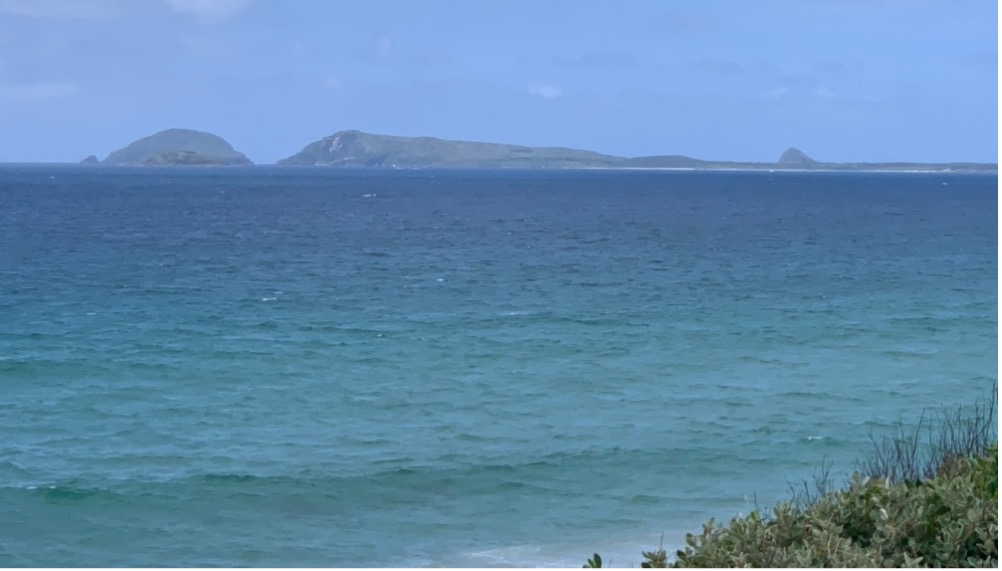
Broughton Island [Author photo – December 2022]
The Daily Examiner of 29 May 1922, page 2, reported on the state of the wreck:
‘The auxiliary ketch Phil Forbes, which foundered north of Port Stephens recently while on a passage to the Manning River, has been examined by Diver Anderson on behalf of the underwriters. The inspection was made under the direction of an officer of the Sydney Marine Underwriters’ Association. The diver found the vessel lying on an even keel in 9¾ fathoms of water. She is on a sandy bottom with a slight list. The planking, aft was found to have opened out. Owing to wreckage, the diver found it impossible to eater the cabin but he states that the engine appeared to be intact.’
Epilogue
The following ode, written by Alison Fraser of Point Piper, about the foundering of the Phil Forbes off Two Fathom Rock, Boughton Island, as published in the Sydney Mail of 19 December 1923, page 46, is a fitting way to end this history exploration:
‘She has gone to her rest,
In the heart of the waves;
She has answered the call of the sea;
In the shadows of night,
Like a gull in its flight,
Her quivering soul rose free.
Though her timbers may waste
In the arms of the tide,
Though embedded she helpless may be,
On the crests of the spray,
When the winter winds play,
Her spirit is riding free.’
Researched and compiled by Kevin McGuinness
December 2022

 Port Stephens - a history exploration