
Introduction
From the early 1900’s, the settlement of the areas around the Myall River and Myall Lakes progressed at a steady pace. The early settlers comprised farmers, oyster growers and fishermen, and timber-getters. Their establishments however could only be accessed by boat as there were no roads in the area.
In order to service these remote settlements, suppliers based at Tea Gardens used store boats to deliver food, hardware, agricultural supplies, mail, and any other goods that may have been ordered.
On their return journeys, the store boats would bring back produce from those settlements for market. In the latter years, some store boats also carried tourists on selected trips.
The store boats continued to operate until the early 1940’s by which time roads had been constructed to serve the settlements.
The biggest operator of store boats was Tea Gardens’ entrepreneur, George Adolph Engel of G. A. Engel and Sons Limited.
This paper captures the spirit of the store boats’ operations.

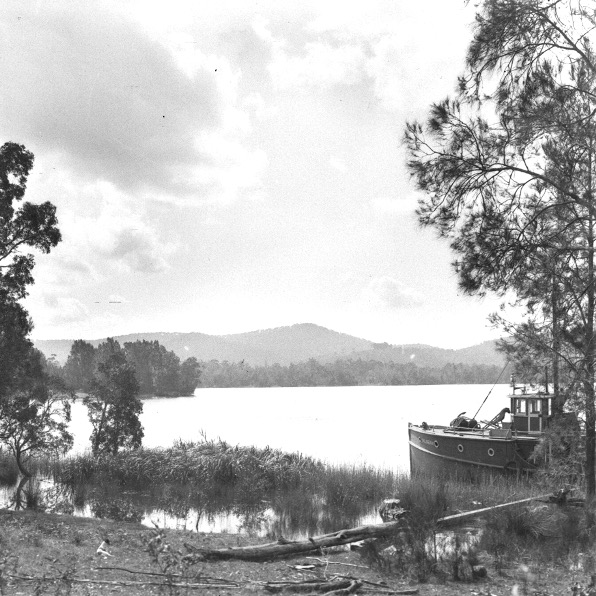
Store boat on the Myall River [State Library NSW]
Store boat Myall River and its bush crew – 1926
The journal World’s News of 9 October 1926, page 4, describes the manning of the store boat, Myall River that served Port Stephens and the adjoining Myall River and Myall Lakes:
‘The steamer Myall River, belonging to the Newcastle and Hunter River S.S. Co., Ltd., is a quaint specimen of the shipbuilder’s art. She is very broad and stumpy-looking, with a deckhouse, containing the crew’s quarters, and the engines that drive her single propeller, extending from right aft to a little less than half her length forward. In front of this edifice is a wide, broad deck, whereon she stows her extraordinarily varied cargo, which may range between piles and pianos, and casks of beer and kegs of ice cream.
With the exception of her master, who is also the company’s agent at Tea Gardens, and has not had in his varied career any experience as a deep-sea mariner, her crew, with the possible saving of the engineer, are all bushmen. And they are particular experts in two things—the expeditious handling of cargo and getting the ship off the mudbanks and sandbanks frequently to be met with in the more or less shallow Lower Myall. It is remarkable to observe the multiplicity of things they can do with the Macfarlane winch installed on the deck just below the wheel-house—they are almost miracles to the casual observer. No load is too awkward or too heavy for them to tackle. And when the ship takes the ground on a falling tide they sometimes use the winch, hauling on the top of a long pole, whose foot is underneath the ship, to lever her off into deeper water. It is a quaint manoeuvre of a sort that you will possibly see employed nowhere else.
She sails from the embryo city at Pindimar—whose streets, avenues, and squares are still in the gum-tree stage—calls at Tea Gardens, and then, all through sunny mornings, navigates along a leafy green arcade of tall trees that almost meet overhead, between low, fern-clad banks, above which flowering shrubs grow in among the trunks, making the air aromatic with their delightful scents. Great staghorns cling to the trees, and in their long aisles grow graceful palms, imparting a semi-tropical aspect to the scenery.
Every now and again a call is made at some timber-getters’ camp, where she shoves her nose into the bank, hoists out stores and equipment, and gossip from down the river, and proceeds along her beautiful pathway to the Lower Myall Lake, and the Upper Myall River beyond it. And the conversation of her crew is not of strange ports and distant seaside cities scattered about the Seven Seas—but rather of cows and horses, timber-cutting, and farming. There is no mistaking the fact that you are in a ship manned by mariners of the good, dry earth.’
Store Boat Nepean – 1926
The Dungog Chronicle of 26 November 1926, page 4, reported:
‘The launch Nepean ply’s twice a week to these parts. She has a general store fitted up on board. She also carries the mail, in conjunction with the store at Tea Gardens. The droghers are very busy, chiefly carrying timber. They are peculiar looking packets, consisting of a flat bottom punt with engine well aft, and a paddle wheel each side of the after end, and carry up to 200 tons of cargo.’
Store boat Kate Thompson – 1935
The Newcastle Morning Herald and Miners’ Advocate of 27 April 1935, page 14, reported:
‘The late Mr. Charles Burrows also built many craft on the Port Stephens waters. Included in these were the steamer Kate Thompson, which was used as a floating store by the Flanagan family, who 40 years ago were storekeepers at Tea Gardens. The steamer was built at Tea Gardens, on the river bank, at the intersection of what are today Jacob and Myall Streets.’
Value of the store boat – 1936
The Newcastle Morning Herald and Miners’ Advocate of 28 January 1936, page 4, reported:
‘This service [the store boat], which embraces the large expanse of all the lakes, has been a boon to those far from shops for nearly 40 years. Surprisingly few people live in the Myall Lakes district – they are dairy farmers, fruit growers, fishermen, or timber getters but to them the value of the store-boat service cannot be assessed in mere money. They are not, like the visitor, running away from the world; they depend on it for their living and their food. These people are found living at different parts of the lakes, usually miles from their nearest neighbours, but they are not distressed by their isolation. The store-boat never fails them.
It leaves Tea Gardens early in the morning and returns late at night, after having covered many miles with its freight of humans, mail, and necessities. At Myall Lakes, one can have the real holiday, the holiday of leisure, the holiday that restores energy and clarity of thought after an exacting year’s work. The quietness is its charm: in this restful haven, this serene backwater, life flows smoothly on. The days lose their identity, and only the whistling of the store boat makes one realise that it is Wednesday already, or that Sunday has come again.’
Yalinbah and George Engel and Sons, Limited
The Dungog Chronicle of 4 December 1936, page 3, provided the following details on one of its advertisers, G. A. Engel & Sons, Limited:
‘This firm was established at the Fens in 1888 as butchers and bakers. In 1893 they moved to Tea Gardens and five years later moved to their present site and opened a general store as well. A branch was opened at Nelsons Bay twenty years ago and later on was sold to Blanch Bros. The present brick store was built 14 years ago.
The “Yalinbah,” a floating store, goes up the lakes and around the harbour twice weekly. The first store boat the firm had was towed by a steamer “The Pearl.” Later the “Kate Thompson” was made into a store boat and later was replaced by the “Nepean.” The “Yalinbah” was first called the “Super Dreadnaught.” This firm has branches at Mayer’s Flat, and Hawks Nest. The head office and stores are at Tea Gardens. Shipping plays a big part in the business and the fleet includes the “Coweambah” (built by themselves), “Myall River,” “Anambah” and “Nepean.” The firm has the lease of the new pavilion at Hawks Nest.’
The following two advertisements appeared concerning the firm’s operations:
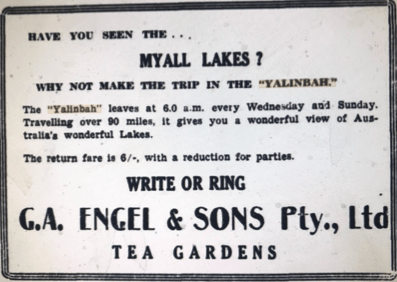
The Dungog Chronicle, 2 February 1940, page 4
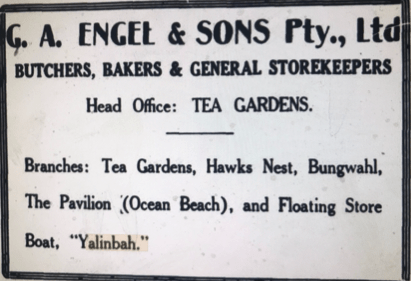
The Dungog Chronicle, 23 May 1941, page 4
A trip on the Myall River – 1936
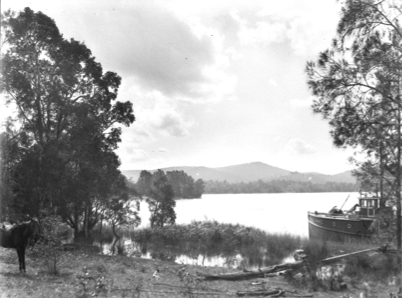
‘Yalinbah’ store boat at Cutlers Beach, Myall River [State Records of NSW]
The Sydney Mail of 15 January 1936, page 2, carried a report by W. Gilmore, which describes a passenger trip on a store ship up the Myall River and Lakes. The trip was most likely taken on the Yalinbah which was operated by G. A. Engel & Sons, Limited:
It describes the beauty of the riverine environment of Mungo Brush, Tamboi and the Broadwater and up to Bungwahl, with the peak of Bulahdelah to the west and the coastal sand dunes to the east.
‘On a still spring morning, as the sun throws its gold over the mile-long waterfront of Tea Gardens, transfiguring the cottages and the densely leaved fig trees into a fairyland, a little Diesel-hearted launch impatiently tugs at its moorings and suddenly spurts out into the stream towards Witt’s Island and the narrowing Myall River beyond. It has business to do, as you may know if you have, watched it loading meat, bread, and numerous packages consigned for many places of call; besides, its interior is packed with all kinds of tinned eatables and domestic wants. The tide may be low, in which case it will bump its way from one bank of the river to the other, following the deepest channel, for the Government cannot afford to do a great deal of dredging for vessels that manage to get on without it.
In fifteen minutes, the launch stops beside the substantial wharf of a dairy farm where an orchard of oranges and lemons can be detected by the rich smell that floats to your nostrils, and shortly afterwards, you pass a plantation where logs from the far end of the lake. In the old days it was the custom to use tea-tree poles to propel the punts over the lakes, a task for time, a stout heart, and a favourable wind. On a fertile point at the northern end of the lake is Legge’s Camp, where the cackling of fowls comes with the soothing drone of bees in an orchard. The rich soil of this basaltic outcrop corresponds with that at Mungo Brush, near the ocean.
Millions of years ago we are told, these were the tops of mountains, and, later, islands. Here the waters of the lakes are confined, but the banks presently widen and several calls are made to deliver goods or take aboard a basket of eggs or other produce from a farm. At the end of two long reaches of lake is Booloombayt Creek, its entrance marked by a long avenue of reeds from which comes the warbler’s exuberant song. The narrows at Violet Hill and Johnston’s are the deepest part of the lakes, passing which the most northerly lake comes into view, its wooded islands lending their charm to promontory and steep, cleared grazing country.
To the north-west is 1500 acres have been cleared and planted with pines. Then the little ship traverses a winding area fringed with she-oak, graceful paper-bark tea-trees, and palms. At the next stop two red-faced, bare-legged fishermen with sugar-bags in their hands are waiting for their stores, and a tent is pitched on the only rising ground visible. A few miles farther on is Tamboy, a fishing and prawning centre. Suddenly the glassy surface of the Broadwater opens out before you like a huge mirror, on which is reflected blue sky and islands of white cloud. The low, dark shores of the lake emphasise its expanse, and the peak of Bulahdelah, nine miles away, stands boldly against the haze wrapped mountains beyond.
Eastward the palms of Mungo Brush are silhouetted against the skyline, and a bald patch of sand marks the spot where an attempt was made forty years ago to cut a channel through the dunes to the ocean. As the little launch pulls up halfway across the lake to attend to the wants of a single rower, the stillness of your surroundings is intensified. It is broken only when a flock of swarls rise from their feeding ground or when a drogher comes panting with its burden of Mayor’s Flat, where a sawmill stands, and the wharf is so crowded with sleepers that it is almost impossible to find walking room.
Bays and pleasing headlands lead the way to Neranie, where the young white stems of tea tree grow thick on the low shores, and a rough bush road connects with the terminus of the launch’s itinerary at Bungwahl, a milling township of scattered bungalows and a red-roofed church set on the shoulder of a green hill. On Sunday afternoons the launch waits long enough to allow the lads and lassies on the wharf to inspect the travelling store at their leisure, then the vessel heads south again. Glaring sun is quickly followed by intense darkness as the vessel makes its way, apparently by instinct, across black stretches of water, and finally down the last sixteen miles of river on whose surface the stars are reflected like deceptive lights which flee at the bow’s approach. By this time you are tired of the promenade deck, and leave it without hesitation when a call comes from below to share in a fish supper which the young men in charge have thoughtfully prepared for your seaman’s appetite.’
Store Boat Yalinbah – 1937
The Dungog Chronicle of 5 February 1937, page 4, reported:
‘G. A. Engel and Sons store boat, “Yalinbah” leaves their wharf every Wednesday and Sunday morning for the Myall Lakes. Many tourists take advantage of these wonderful trips and enjoy them. The boat carries all the necessities of life for the lake side dwellers and is regular on its run. Hail, rain or sunshine, the “Yalinbah” can be heard making its way across the lakes and at the appointed time calls at each port of call. The staff are courteous and efficient. The boat is roomy and comfortable. About twenty ports are called at and passengers may go ashore while the local residents are getting their supplies.’
Yalinbah to the rescue – 1942
The service provided by the store boats is described in a report in the Dungog Chronicle of 19 June 1942, page 3:
‘While at work last week Mr. Stan Zeininger cut his foot. He had to walk a mile or so to his camp and get the assistance of his brothers. After dressing the wound the brothers started off in a pulling boat for Tea Gardens.
Luckily for them the “Yalinbah” arrived and after a quick run to Tea Gardens Mr. Stan was at the doctor’s who gave dressings and ordered him to hospital. Driving with “blackout masks,” [a war time security measure] it was midnight before Maitland Hospital was reached and he was admitted with a very badly Cut Foot And Much Blood Lost.’
Epilogue
The early years of the Second World War coincided with the downturn of the cargo boat business on the Myall River and Lakes. In 1942 the store boat Yalinbah was withdrawn from service around Port Stephens, having been requisitioned by the Commonwealth Government for war duty.
The Dungog Chronicle of 9 October 1942, page 3, reported on the community atmosphere in Tea Gardens, after several boats had been withdrawn from duty around Port Stephens for war service:
The ‘Waiwera’ has left Tea Gardens; This launch was well known for its run to Nelson’s Bay and for carrying the wharf labourers to the ships. The ‘Yalinbah’, the well-known store boat that has been travelling the Lakes and Port Stephens for over twelve years, is ready to go to sea.
As well as on the Lakes and harbour, the ‘Yalinbah’ will be missed at Tea Gardens, where she could be heard going on her trips and then her cheery whistle when she came home at night. The crew to take her to sea are Captain Tom Boyd, Messrs. Eric and Cyril Engel. The “Star” will take over the run.’
Researched and compiled by Kevin McGuinness
November 2022

 Port Stephens - a history exploration