

Introduction
The area of Sunset Park at Tanilba Bay was previously where convicts assigned to Lieutenant William Caswell in 1830s, burnt locally sourced oyster shells to produce lime for building purposes. Some of the lime would have been used to construct the nearby historic Tanilba House. Stone kilns were constructed around the present park area. Stone seating and fireplaces built by the land developer, Henry Ferdinand Halloran are still in the park today.
The Newcastle Morning Herald and Miners’ Advocate of 27 February 1932, page 7, described Sunset Park at Tanilba Bay in the following terms:
‘Sunset Park and picnic grounds, including the whole of Sunset Point, with its grassy slopes, shady trees and sandy beach, have been elaborately equipped with modern improvements. including large pavilion, water supply, lavatories, picturesque stone seats, tables and fireplaces, swings, and other playground
apparatus, and are available at all times for picnic parties and tourists.’
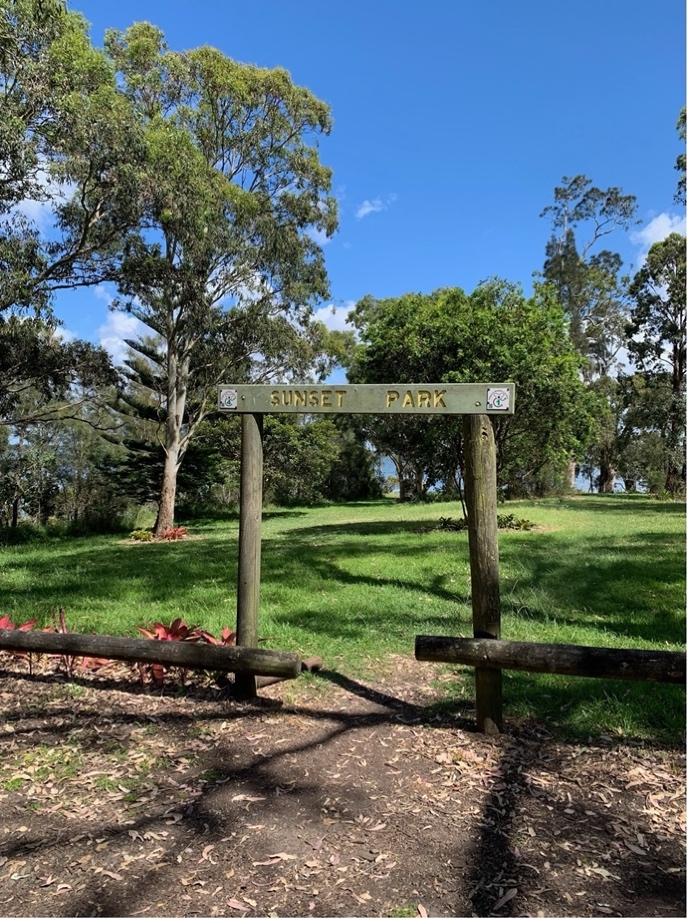
Sunset Park, Tanilba Bay – site of the Girl Guides camps. [Author photo – 2022]
In 1930’s, the Girl Guides movement held several camps in the park area, and this paper reviews some of the camps held, based on articles published in ‘Trove’.
The Camp of 1932
The Newcastle Morning Herald and Miners’ Advocate of 3 September 1932, page 6, reported on the Girl Guides Camp held at the park site:
‘Tanilba Bay, at Port Stephens, has been placed at the disposal of Girl Guides as a camping ground, and about 60 guides will spend the coming week under canvas. Mr. E. O’Halloran has gone to much trouble to assist those in charge to make the camp a success. A large pavilion is erected on the grounds, so that in the event of rain the guides will not lack shelter. Misses Radford and Taylor (Sydney) and Misses Fry and Bowes (Newcastle) will be in charge. Visitors’ day will be observed on Sunday when inspection by relatives and friends will be welcomed. Tanilba Bay is but an hour’s journey by car from Stockton.’
The Camp of 1933
The Girl Guides Camp held in September 1933, is the most extensively reported in terms of number of newspaper articles and photos published.
The Newcastle Morning Herald and Miners’ Advocate of 11 August 1933, page 19, reported:
‘At the monthly meeting of the Newcastle Girl Guides’ Association it was reported that a donation of £1/1/ had been received from Mrs. Upfold, of Hamilton. This amount will be awarded for the best essay on the camp to be held at Tanilba Bay. About 60 Girl Guides, including representatives of all companies in the Hunter Division, and a party from Sydney, under whose supervision the camp will be held, will go into camp for one week on September 2. The prize donated by Mrs. Upfold will be competed for amongst the Guides in camp.’
The Newcastle Morning Herald and Miners’ Advocate of 8 September 1933, page 7, carried an extensive report, including pictures, of the camp:
Letter opening
‘Comradeship and Service Envelopes were torn open. The contents were eagerly scanned, and laughing, sun-tanned faces told the news that all was well at home. Some amusing little incident related in a letter brought forth a ripple of laughter, and was related to another group standing close by, who joined in appreciation of the joke. Some stood by without letters, and momentarily looked glum, but their faces soon cleared when they were cheered by their mates who said, “One is sure to come to-morrow.” ‘This was the scene which greeted us this week when we had the opportunity of spending several delightful hours with the Girl Guides who are camped, at Sunset Park, amid the historic surroundings of Tanilba Bay, about 35 miles from Newcastle.
From above, the sun shone on us from an azure sky, and we gazed upon the placid waters of the bay, while overhead birds warbled merrily in the tall trees, giving welcome to the return of Spring. Dotted around the headland of the peninsula were a number of bell and ridge tents, and in merry groups the girls chatted and went about the tasks to which they were assigned. The camp is on portion of the grant made by His Excellency Lieutenant Ralph Darling, Governor of New South Wales, in March, 1831, to William Caswell, of Tanilba, a lieutenant, in consideration of his services in the Royal Navy for upwards of 20 years. It is a delightful spot, not well known to many, but with marvellous potentialities.
Tanilba House, built by convicts
There is much in the immediate surroundings to charm and interest the girls. Tanilba House, which is in close proximity to their camping ground, was built by convicts 100 years ago, and overlooks Meridian Park. To the left is Sunset Park, and in the grounds [of Tanilba House] stands an old warrior-an olive tree 100 years old. The house has been renovated and modernised, but the work of the convicts is still in evidence and in a wonderful state of preservation. The grounds are being made very beautiful. A wishing chair built of stones found on the property is a source of interest to the girls, and is being used as a means of obtaining revenue for the hospital. Sitting on the “Magic Carpet,” one is greeted by “Fortunam ritius reperias quain re-tineas” (you may find fortune more easily than you can retain her). The pergola, constructed of similar stone, is very artistic, and was constructed by Mr. Powe. Adjoining the house is the gaol, a tiny structure about 7ft. square, where in olden times 30 or 40 convicts were imprisoned together. A large brass bell from the training ship, s.s. Sobraon, which bears the date 1866, is in a wonderful state of preservation, and still rings clearly.
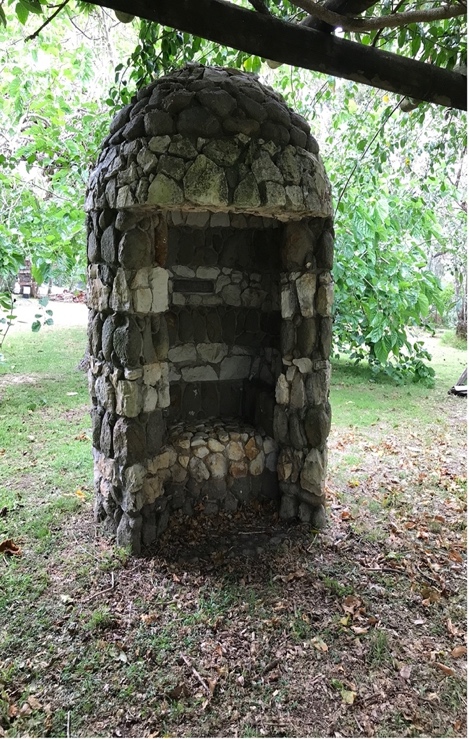
Wishing chair at Tanilba House [Author photo – 2017]
The entrance to Tanilba is through the Centenary Water Gates, a magnificent structure designed by Mr. F. Halloran, and built by Rr. W. Powe in 1931. Passing up the path, a wonderful piece of architecture known as “The Temple” is nearing completion by Mr. Stone. It is constructed of pink and white felspa stone, and water-washed stones, in the grounds are rustic seats built of stones from the forsehore, and lending charm to an historic spot. From the front of this old homestead we looked across the peaceful bay to Tahlee, where another old house built by convicts is still in sight.
Amidst all this picturesqueness, and with delightful weather, the girls are having a wonderful holiday camp. There is everything to thrill the hearts of adventurous girls. They arrived in camp last Friday. We were tremendously impressed by the thorough and efficient manner in which they had arranged their camp. There are 41 girls, whose ages range from 14 to 18 years, from Newcastle, Maitland, Cessnock, and Port Stephens areas. They are under the supervision of Miss M. Bilton (Sydney), Commandant of the Camp, Miss E. Fry, Divisional Commandant for Hunter district, and Miss G. Batty, Secretary of the camp.
Comfort in the tents
A trained nurse, who is also a guider, is in camp to minister to the Guides if needed. So efficient is she in her task that the girls are afraid to sneeze, lest they should be threatened with castor oil and bed. Four girls occupy each tent. With a ground sheet and straw palliasse, they are quite comfortable. Everything about the camp is in perfect order. An inspection revealed the result of their woodcraft. Shoe racks and towel rails have been constructed out of anything they could find, and are evidence of their initiative. The beds were rolled up, and deposited in a spot where the fresh air could play around them. Each day they are shifted to another spot, so that these may always be good ventilation and airing of the whole area occupied by the tent.
Close by their quarters is erected the Hospital Tent, where the trained nurse has equipment ready for any emergency which may happen in camp. A telephone is quite handy at the Guest House, so that if anything untoward should happen a doctor may be summoned promptly. The camp is well organised, and the duties are divided and changed daily. Each day brings new interests, and certain hours are set aside for rest. Their day begins with reveille at 6.30 a.m. This is the signal for the cooks and wood and water patrols to rise and attend to their duties. The cook lights the cookhouse fire and takes instructions from the Quarter master, and reports to her three-quarters of an hour before meals. Her duties also include the washing-up of cooking utensils. The patrol-in-charge of “mess” set, clear, and wait at tables, and wash up crockery. They are responsible for the tidiness of the shelter where their meals are served, and the grounds surrounding it. They report to the Quartermaster half an hour before meals, and also attend to the washing of tea towels, &c. They must also see that there is always a supply of hot water available.
The “wood patrol” sees that a supply of wood is always on hand at the cook-house and bath fires, and the “water patrol” keeps the water supply at the cookhouse and bath fires. Each girl accepts her duties cheerfully and gladly. There is no scheming to get out of doing certain tasks. and there is a marvellous spirit of comradeship amongst them.
Menu
At 7.45 a.m. breakfast is served. Crispies, and stewed fruit or porridge, scrambled eggs, curry, or tomato and bacon, is a typical breakfast menu. Dinner consists of roast meat, potatoes, three different kinds of vegetables, and sweets. For tea, soup and salads, bread, butter and jam are served. There is a conspicuous absence of tin-opener at this camp. Training in out-door cooking obtained by the girls is one of the features of the movement.
After breakfast, colour ceremonial and prayers are held. Parading in a semi-circle in front of the flag, which is erected on the top of a tall mast, the colours are “broken” and the National Anthem is sung. After this ceremony the work of the day begins. Dishes are washed, water and wood collected in readiness for the next meal, tents are cleared, the grounds straightened, and at 10.15 a.m. an inspection is held, and then morning tea, consisting of a fruit drink and biscuits, is partaken. The programme for the day is then carried out.
Sometimes the girls go hiking, taking with them chops, which are grilled. Into the bush they go, collecting specimens of the many beautiful flowers now blooming in profusion in that area, and these are studied and classified on returning to camp. Overhead, birds sing merrily, and these, too, provide them with opportunities for study. Perhaps a trip around the foreshores is planned, and this provides many thrills. Paddling, however, is not allowed unless arranged, and swimming is allowed only under the supervision of a trained lifesaver.
One is impressed by the efficiency and precautions taken for the well-being of the girls. At 12.30 p.m. dinner is served. We had the opportunity of partaking of a meal with the girls. What delightful cooks they are! Although the cook patrol on duty, when we visited them, were girls in their early teens, they served an excellent dinner. The few days in the fresh air have developed appetites tremendously and those who went into camp with pale faces and jaded appetites are eating astonishingly, and have acquired beautiful sun-tanned complexions.
The canteen hour is looked upon as a great treat. The “shop” is open for a quarter of an hour, and each girl is only allowed to spend 3d each day. Their money is held by the Secretary of the camp.
Around the campfire
At 1.45 p.m. comes rest hour. Every tent must be vacated. There is no play or hiking during this period, and so books, letter writing, and stories occupy many of the girls, while others have a little doze. At 2.45 p.m. the afternoon’s programme is begun. Tea is served at 5.30, and then comes one of the most delightful hours of the day. Against a setting sun, with tall trees silhouetted, and casting shadows on the peaceful lake, the girls take their hurricane lamps to a grassy patch near the water’s edge, and enjoy folk dancing to the strains of gramophone music. Then, having lit their camp fire, they gather around, meanwhile singing the round in six parts, “Fires burning, fires burning; draw nearer, draw nearer, in the gloaming, in the gloaming; come sing and be merry.” Around the fire they enjoy their songs and listen to stories, and watch the splendour of the moon rising across the bay.
Sometimes a patrol will present a sketch. At 7.45 supper is served, with a choice between hot cocoa and fruit drink with biscuits, and at 9 o’clock “lights out” is sounded. That is the order for all talking to cease, and, although there may be a few whispers, the girls generally are very obedient to the wishes of their camp commandants. Every second night the girls have hot baths. Large tubs are provided for the purpose, and special bath tents have been erected. On alternate nights plenty of hot water is available; 12 kerosene tins full are kept merrily boiling.
Health rules are strictly enforced in camp. The outstanding impression of the camp was one of extraordinary cleanliness and order in every section. Sanitation has received special attention. The theoretical part of training is put into practice in such a camp, and the driving home of the necessity for attention to health and other needs of daily life is brought before the Guides in practical manner. In the store tent everything is spick and span. Jam and biscuits are set on boxes, and the whole tent gives the impression of on excellently managed home or store. Service in camp is outstanding. The big girls look after the little ones, and everyone “pulls her weight” in making the camp run smoothly and happily. When they return to their homes at the weekend, the girls will be renewed in health and vigour, and inspired by the tremendous advantages offered to them by the Girl Guide movement.’
The above newspaper published the following five ‘black and white’ photos and descriptions of camp life:
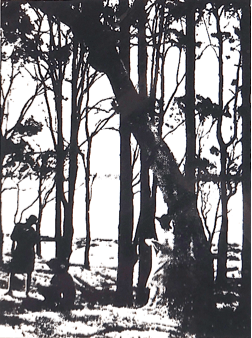
A silhouette of tall gums where the girls sketch and write on the sunny shores of Tanilba Bay.
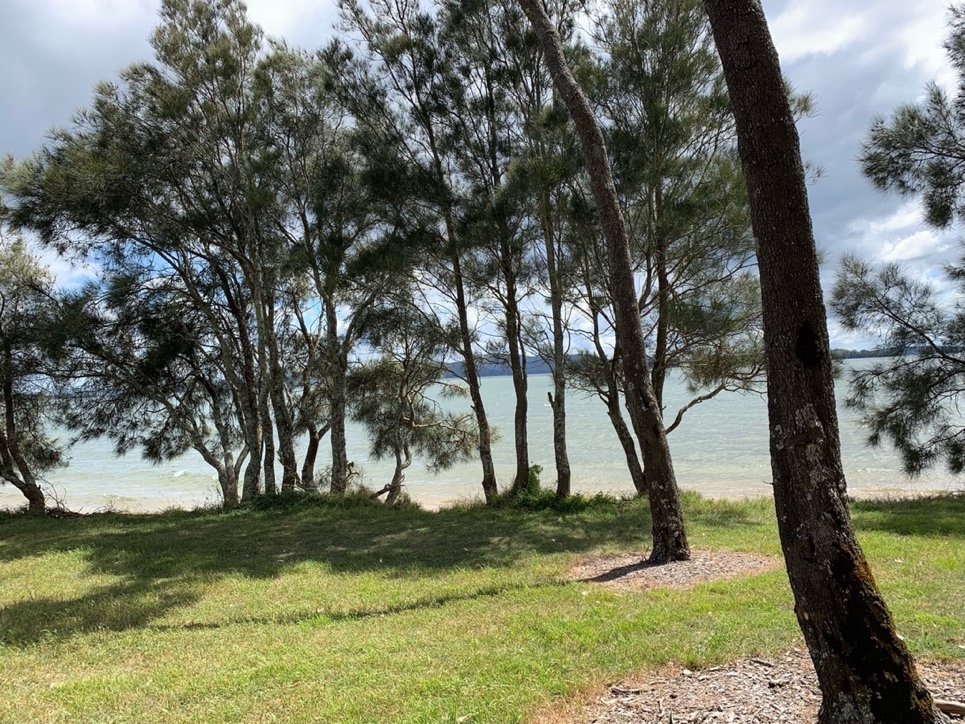
Section of Sunset Park where the above photo was taken. [Author photo – 2022]
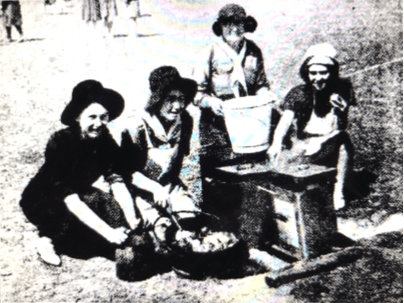
No home-cooked delicacy was ever more appetising than the meals prepared in this camp oven, with the fire built in a hole in the ground.
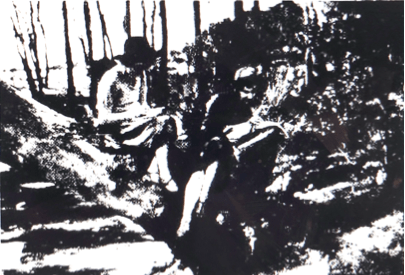
Getting inspiration for their essay on the camp with a gnarled tree trunk for their desk amid the perfume of bush flowers.
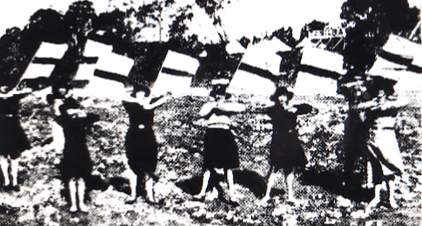
One of the duties of the guides is to learn flag signals, and these girls are going through their drill with the proficiency of experts.
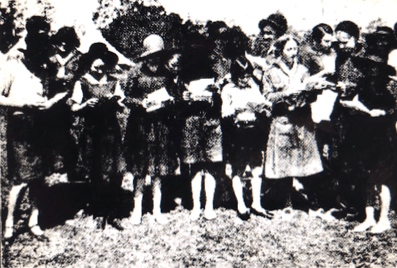
Not the least enjoyable of the camp routine is the arrival of letters from home. The mail had just been distributed when this picture was taken.
Essay Competition
The Newcastle Morning Herald and Miners’ Advocate of 7 October 1933, page 12, reported on the essay competition held during the camp:
‘In association with the Girl Guides’ Camp held recently at Tanilba, Mrs. Upfold, of Hamilton, offered a prize for the best essay written by a Guide concerning experiences in camp. Out of a number of essays submitted by those who attended the camp, the prize was awarded for that written by Miss Queenie Hunter, of Port Stephens. Her essay is published herewith.
‘Tanilba has gained for itself the appreciation of all who have seen its wondrous beauty. What could be a more pleasing picture than to see the snowy bell tents swaying so little in the soft breeze with the verdant carpet of green as the background of this delightful scene? There is nothing more alluring or grand than to sit in one of the quaint rustic seats and watch the golden sun slowly setting, spreading its mantle of ever changing colours over the few fleecy cloudlets seen in the blue dome above. A bank of clouds was peeping just above the mountain tops a few evenings ago, when it suddenly became a ridge of gold, so bright, and so dazzling that my eyes became a little misty as they followed every change of colour till the sun slowly dipped behind the filmy veil. Then there is the stately Tanilba House. The house shows a wonderful panoramic view of Port Stephens, for in the distance one of the heads at the entrance to the port can be seen.
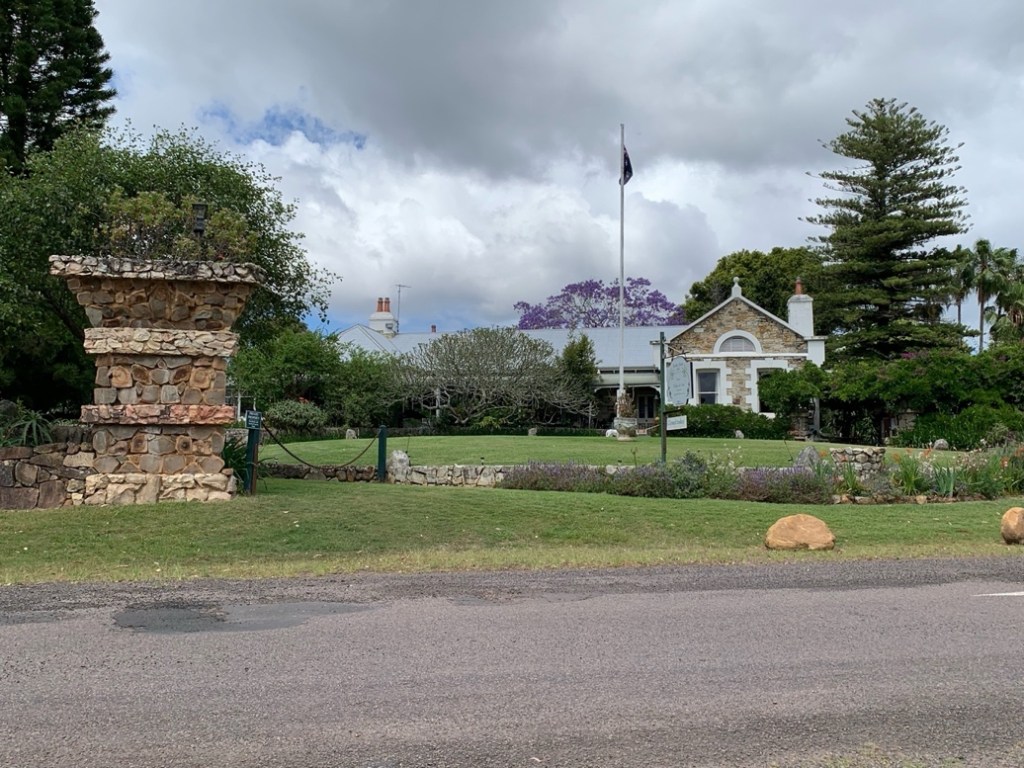
Tanilba House [Author photo – 2022]
Tanilba House itself is one of my favoured beauty spots. The ancient stone pillars, with their pink and white ledges, are of unusual design and beauty. It is also a very historical place, having once been a convict settlement. The wishing well proved a great attraction for me. The inscription is aptly suited to the purpose and deserves every encouragement. I have wandered along the boundaries of the camp and have been amazed and thrilled at all the different changes of scenery, so compact for such a small place. Walking from one corner along the top of the hill and gazing seawards, Pelican Island is to be seen standing surprisingly clear and defined against the more distant hills, while the shining scintillating waters set off the isle to perfection.
Still strolling on, and rounding the bend of Sunset Park, I unexpectedly came across the most unique little table I have ever seen. It was the surroundings and atmosphere that at once suggested sunbeams playing hide and seek with the shadows of the guardians of our playground, namely, the stately swaying she-oaks. Now to stand apart inside the ground and set as a looker-on. There is laughter and happiness simply effervescing from girls who are enjoying every minute of their stay at Tanilba. Just see the sparkling eyes and rosy cheeks of girls chasing one another in innocent fun, or the cute look of one mischievous little maiden who has just planned another trick to play on her long-suffering companion sometime after “lights out.”
How the laughter peals forth as the swings go sailing into the air, and watchers from the pavilion smile at one another in evident amusement. Tanilba is truly a place of convenience as well as beauty. Then again, in the early morning it is delightful to wake in time to see the sun in all its splendour peeping over the azure misty mountains and bidding me bestir myself and see what can only be seen in the very early morning. The fresh, clear crystal air gives one an exhilarating feeling due to outdoor spaces, and happy healthy surroundings. The dew looks like myriads of diamonds scattered freely over the meadow. Hark! What is that? I turned just in time to see a flash of gaudy, magnificent colours of red, blue and green. It was a pair of rosellas flying together in happy contentment to get their early morning breakfasts. Again, little brown birds called to all the camp a good morning greeting, their throats trilling to the very joyousness of their songs.
The whole bush by this time is athrob with the winging of industrious insects doing their round of practical duties in such a lively, human way that it made this world a world of happiness, contentment and song. One glance across the clearing, and what little picture comes to my mind. Why, none other than the merry little sunbeams either kissing the golden, glossy buttercups to bid them unfold their petals, or see them skipping lightly over the ridges to the hillocks nearest them.
But now I think this is the crowning glory of Tanilba. The sun has dipped, evening is closing in; there is a hush over everything. Birds are settling in their nests with but a few chirps to tell a silent watcher of their whereabouts. The full, mellow moon has risen a little and has sent her gossamer nymphs to play all night with the elves and fairies of the woodland. Such are the thoughts that are passing through my mind is I waver a little at the door of slumber. But my last thought is one of keen appreciation of those who have given me the opportunity of writing about Tanilba and what I have seen.’
The Camp of 1934
The Maitland Daily Mercury of 6 September 1934, page 10, reported:
‘A detachment from the 1st Branxton Girl Guide Company, in charge of their captain, Miss E. Gauchet, entrained for camp at Tanilba Bay on Wednesday. It is expected that they will remain in camp until Monday next, to compensate for the camping time lost owing to the wet weather. The Girl Guides who attended the camp at Tanilba last year spent a very instructive and enjoyable time.’
The Camp of 1935
The Maitland Daily Mercury of 9 September 1935, page 6, reported:
‘Girl Guides from the Branxton, Maitland, Hamilton and Nelson’s Bay companies were encamped at Tanilba, Port Stephens, from Saturday, August 31, until Saturday, September 7. Mrs G. Batty, the Divisional Secretary and Captain of the Maitland Guides, was in charge and was directly responsible for the great amount of preparatory work and transportation. A lorry load of equipment and provisions was despatched the day before the girls went into camp.
The Maitland company joined Branxton and travelled to Newcastle by train, where they caught the service ‘bus across to Stockton and proceeded thence to Tanilba. Engine trouble was experienced on the way, delaying the passengers considerably, but the trouble was rectified and the ‘bus arrived at Tanilba without further mishaps.
The first gateway was marked by four stone pillars about fifteen feet high and a decorative stone wall. About half a mile further on the main entrance to Tanilba was reached. Again were seen high stone pillars with the sign “Tanilba” in ornamental ironwork arched over the roadway. The immense amount of picturesque stonework formed a magnificent entrance. Nature’s Beauty An abundance of beautiful wild, flowers in a great variety of colourings, the brightness of the bushes of edible berries, which grew nearby, the glorious sunshine and sparkling waters of the bay, a truly Australian scene, made a splendid welcome for the girls.
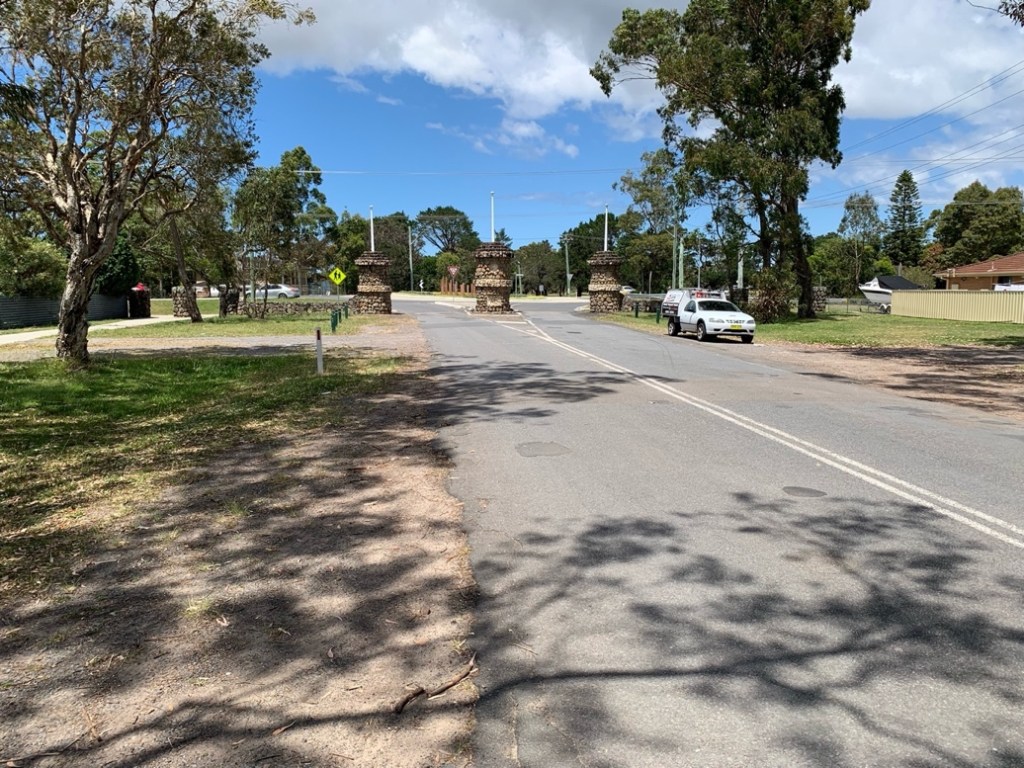
First gateway to Tanilba Bay [Author photo – 2022]
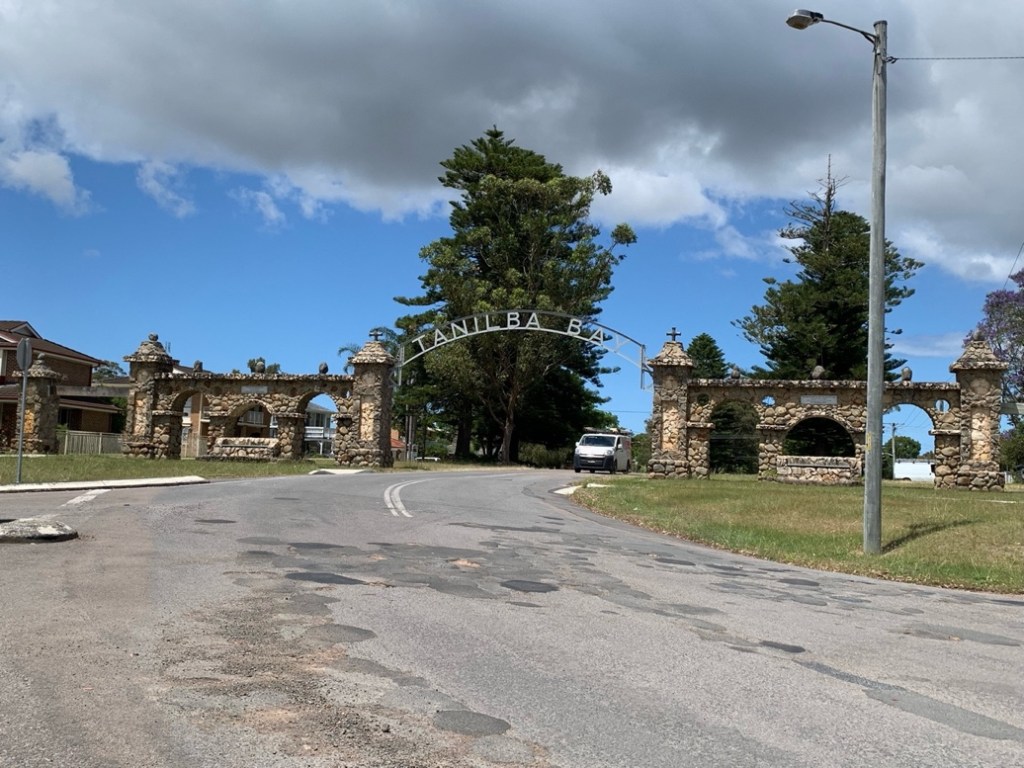
Centenary entrance at Tanilba Bay [Author photo – 2022]
Soon Tanilba House was reached, and more beautiful stonework, including the temple, with its inlaid stars and surrounded by poinsettias growing in profusion, could be seen. A remarkable stone chimney, a veritable work of art, stood close by. The camp was pitched on the elevated ground overlooking the vast expanse of water, known as Tanilba Bay. A most enjoyable week was spent by the girls. Hiking, when they lunched in typical Australian bush, was a popular pastime; and some passed their stalking, tracking and fire lighting tests. There were paddling parades, everyday camp-work and singing at night around the blazing campfires.
The bell-tents were arranged in horseshoe fashion, with the flagpole at the open end, and the Union Jack was hoist every day after breakfast and lowered at sunset. As usual, a trained nurse, Sister Matthews, was in camp, and she spent a busy time attending to minor injuries. Friday afternoon was spent in sports, when the girls thoroughly enjoyed themselves. One of the most exciting events was the Guiders Handicap, won by Divisional Commissioner E. Fry, with Miss Batty, scr., second.’
The Camp of 1936
The Maitland Daily Mercury of 11 September 1936, page 6, reported:
‘During the recent school vacation, the Girl Guides held their annual Michaelmas camp at Tanilba, Port Stephens. The tents were pitched beside the beautiful Tanilba Bay, and in this ideal situation the girls enjoyed themselves immensely. Swimming and hiking, as well as the usual orderly work, filled seven delightful days, which passed all too quickly.
Attending the camp were guides from 1st and 2A Maitland and 1st Waratah Companies. The guiders in charge were Misses M. Tarrant (2A Maitland), G. Batty (1st Maitland), J. Smith (Maitland Brownies), and H. Rowe (Waratah). The quartermasters were Mesdames Whitney (Nelson’s Bay) and Wadell.’
The Camp of 1937
The Maitland Daily Mercury of 14 September 1937, page 4, reported:
‘Representatives from 1st Maitland, 2A Maitland and 1st Branxton Companies spent an enjoyable time last week at the annual Girl Guide Camp at Tanilba, an historic as well as picturesque site at Port Stephens. The days were passed pleasantly hiking in the bushlands among myriards of wild flowers, and swimming in the bay. On Thursday a sports day was held, when the most amusing of the races were the obstacle race and the guiders’ race.
The Guiders present were Misses G. Batty (District Commissioner and Camp Commandant), E. Fry (Division Commissioner and Q.M.), M. Tarrant (Captain of 2A Maitland), M. Hatcher (Lieut. 1st Branxton), and H. Rowe (Lieut, 2A Maitland), Sister V. Woodbury was the camp nurse.’
Concluding Comments
No further camps were publicised as being held at Tanilba Bay, past 1937. But those held were a testament to the wonderful opportunity afforded to the participants of the Girl Guides camps in the pre-war years.
Further information on the Tanilba area is published on this website and can be viewed at the following links:
Henry F. Halloran – Town Planner at Tanilba Bay, Port Stephens
The Legacy of William Caswell and Tanilba House
Early History of Lemon Tree Passage Road
Researched and compiled by Kevin McGuinness
November 2022

 Port Stephens - a history exploration