
Introduction
A ‘peripatetic’ is a person who travels around a lot, living or working in places for short periods of time.
The author of an article published in the Maitland Weekly Mercury of 5 January 1907, page 9, used the nom de plume, ‘By Peripatetic’, to describe his Christmas excursion to the Port Stephens region at Christmas time in 1906.
The article is published in full, with headings [in brackets] and photos added at my discretion. It gives a snapshot of a traveller’s experience in the Port Stephens region when it was sparsely populated, and a variety of travel means was necessary to complete a tour.
The Christmas Excursion
‘My holiday travelling was done partly in railway trains, sulkies, omnibus, spring cart, and ferry steamer, but a sufficient part was done on Shanks’ pony to justify the use of the above nom de plume. Hexham was my first objective. This may seem an unimportant wayside station, but it has an importance of its own. From here twice a day — excluding Sundays — and more often on occasions the “puffing Billy” takes its load of passenger carriages to the picturesquely situated, but unpicturesque township of Minmi. Here the large output of coal from the Back Creek, Duckenfield, and Pelaw-Main mines is tipped into small vessels at the wharf on the Hunter or continues its journey by Government line to the great coal port of the North. Here, too, mails, passengers, etc., transfer themselves or are transferred from train to couch for the coastal settlements between the Hunter and the Macleay. From here, too, vehicles ply to and from Raymond Terrace, and on one of these I seated myself on the Saturday afternoon before Christmas, and so for four days bade good-bye to the railway track.
[From Hexham]
Crossing the Hunter by the steam punt, the approaching abolition of ferry charges was the topic of conversation. The removal of this impost will lighten a bunion which unfairly rests upon those living near the coast as compared with those higher up the rivers who have been provided with bridges at the public expense. Hard-worked ‘bus and coach horses should share in the relief in the shape of more corn and less whip; one was nearly saying more oats and less oaths, but that might be inflicting an injustice on some.
[To Raymond Terrace]
The route to Raymond Terrace is traversed by a pleasant country road, and on the way Arnott’s dairy farm [of Arnott’s biscuits], Brown’s training stables, and the fine residences and estates of the Peppers and Windeyer’s are pointed out to the stranger. Raymond Terrace, as the initiated in the topography of the district well know, is situated on the north (or east) bank of the Hunter, just as its junction with the Williams. The rich river flats of Miller’s Forest and Nelson’s Plains are in its near neighbourhood. The Terrace, as it in popularly designated, was better known in the pre-railway days, when it was on the main line of traffic from Sydney to Green Hill or Morpeth, Maitland, and the North.
It is not without new houses but is not rapidly progressive. The business places are on a flat, but the churches and many of the residences are on a gentle slope to the east, commanding a capital view of the fertile lands about the junction of the Hunter and Williams. On an eminence at the north-east of the township, off the Stroud road, are to be seen the fine buildings, butter factory, and manager’s residence, belonging to the Raymond Terrace Cooperative Dairy and Produce Co. The company value their buildings, machinery, launch, and land at upwards of £4000, and in their first complete three years they have manufactured 1451 tons of butter, realising £131,421. In addition to communication by coach to Hexham to meet trains, the Raymond Terrace people have their own daily steamer ”Planet” to Newcastle, and the Williams River steamer “Favourite” calls every day, one day for Newcastle, the next for Clarence Town.
[To Williamtown]
The road from the Roman Catholic Church to the Miller’s Forest punt was thronged on Sunday morning, as the worshippers from the early morning service, sensible hour for summer time, returned home from church. My objective on Sunday morning was Williamtown. The road from Raymond Terrace to Williamtown, about 10 miles, has good ends and a bad middle. Between the two places is a moor, which in wet seasons is a swamp, and in dry, as of late years, the track is cut deeply into ruts. The road for about three miles may be described as rutty, stumpy, and sandy. A sigh of relief escapes the traveller as the horse finishes its laborious walking through the sand, and trots smartly along the level, metalled road. A sum of money has been voted for a road over the sandy stretch, and as there is a good deal of traffic and would be more provided the road were better, the completion of the work will be a great public convenience. Between the moors and the sand hills there is a strip of good country, closely settled by dairymen and market gardeners.
The largest single source of cream supply to the Raymond Terrace factory is Williamtown. The dairymen send their cream to Raymond Terrace in cans, and the separated milk to Newcastle in pigskins, providing good dairy fed pork for the butchers’ shops. Water can be obtained at a little depth, and windmills, some of which, cheap and good, are made locally, are much in evidence. All the cows look in splendid condition, and the large and comfortable houses give evidence of general prosperity.
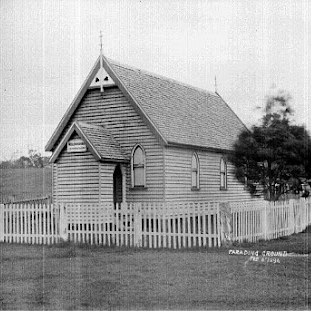
Williamtown is in the Morpeth-Raymond Terrace Methodist circuit, and in the Stockton Church of England parish, and ministers from Raymond Terrace and Stockton hold services regularly. The place where the Methodist Church is situated is called Parading Ground, a name said to be derived from the habit of the cattle in the early days coming off the moors and mustering on the adjacent sand hills.
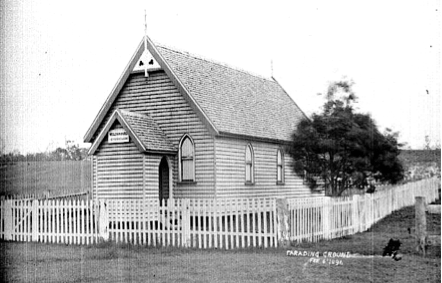
Williamtown Methodist Church at Parading Ground [Williamtown] – 1896
[To Salt Ash]
A few miles north of William Town is Salt Ash, at the head of Tilligerry Creek. A small steamer plies from here to Bungwahl via Anna and Nelson Bays, connecting with coach from Stockton. At this place there is a union church, at which Methodists and Church of England hold services on alternative Sundays, and the services for the best part are attended by the same families.
[To Karuah (Sawyers Point)]
Returning to Raymond Terrace on Sunday evening, Monday morning at 4.30 found me starting out on a ramble on foot to Sawyers Point, Karuah River, a distance of 18 miles. Walking has its drawbacks, but there are compensations. The walker is gaily independent. He doesn’t have to catch and feed his horse, he hasn’t to bother about fixings for bicycle or motor car. He has no axle to grease or harness to patch up. When on his journey he is not afraid of punctures, nor of his horse going down and breaking its knees, nor does he need a horse to pull to its destination the ignominious disabled motor car. He does not have to worry about missing trains, nor dawdle about waiting for dilatory coaches.
Along a good road through poor country, with little settlement, the pedestrian pushed on, and in three hours, “Berlang” McNivin’s (12 miles) was reached; where a good rest, a good wash and a good breakfast were enjoyed.
The road to Sawyer’s Point, indicated by a small signpost, and a large dentist’s advertisement, branches off the Stroud road at right angles just past the 12-mile bridge, a few chains on the Raymond Terrace side of McNiven’s. The remainder of the journey was completed at 10. 30 a.m. At Sawyer’s Point the Kuruah River joins the extensive broad waters of Port Stephens. The aboriginal reserve is situated on the south bank of the river a few chains west from the point. The river is crossed here by means of a punt, and the roads continue to Tahlee and to Tea Gardens. I was the guest for two days of Mr. C. H. Harrington, of the Aborigines’ Mission. On Christmas afternoon we sailed down as far as Tahlee, the fine and beautifully situated marine residence of Mrs. R. H. D. White.
Nearly forty miles of the foreshores of Port Stephens are leased for oyster culture, and nearly 2000 bags of oysters are taken annually from these leases. The lessees are in the habit of staking in their leases areas, to protect the oysters from the sting rays. In some cases, the fences are right out from the shore, and where they are covered at high tides they are a source of danger to boats.
[To Salt Ash]
On the morning of Boxing Day, I started the homeward journey by sailing boat. 1n spite of all said about the advantages of walking I made no serious objection to returning by an easier mode of locomotion. The boat party landed me at Pipeclay Creek, one of three many offshoots of Port Stephens. There are said to be large deposits of splendid pipeclay here, which would make fire bricks equal to the best imported. An hour’s walk from the landing place at Pipeclay Creek across moorlands, bright with wildflowers, brings one to the wharf at Salt Ash, at the head of Tilligerry Creek, on the inland passenger route from Port Stephens to Newcastle. Three miles more brought me to the limit of Sunday’s journey, so by this time the block had been completed.
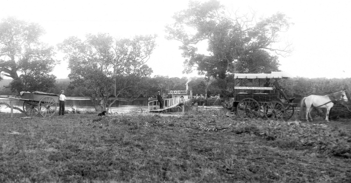
Wharf at Salt Ash with a Harold Matthewson coach waiting for passengers
[To Williamtown]
The William Town people were enjoying themselves at a picnic at Parading Ground. Rounders were the exciting pastime when the scribe arrived, and it was interesting to watch the intense interest of the grandfathers, who joined with the young people in the game, in the success of their side. The cow is an exacting mistress and gives no full holidays, so soon after 4 the company dispersed to enable the dairy workers to get to the afternoon’s milking in good time.
[To Stockton and Maitland]
The drive to Stockton via Fullerton Cove in the evening was very pleasant. Small properties of 10 acres, owing to nearness to a good market, afford a fair living to market gardeners. Approaching Stockton, a good view is obtained of Newcastle Harbour. The Bellevue pleasure grounds are passed, and the dog quarantine, and then in a few minutes the village of Stockton is reached. Without delay a ferry steamer, is caught just in time to enable the traveller to board the 8.10 p.m. train to Maitland and the four days’ Christmas excursion is happily and safely concluded.’
Concluding Comments
The following travel stories of trips to various parts of the Port Stephens area are published on this website and can be viewed at the following links:
The Lakes Travel Route to Mid-North Coast
A Four Day Excursion to Port Stephens – Christmas 1906
A Personal Tour of Port Stephens – 1914
Excursion from Newcastle to Port Stephens by Sea
A Journey from Port Stephens Up the Myall Lakes to Forster – 1908
Journey from Maitland to Port Stephens – 1889
An excursion to Port Stephens by Dr Richard Arthur, MLA – 1914
‘Dungog and Round About’ – 1909 and 1910
A Description of Nelson Bay – Port Stephens – 1892
A Vacation Cruise from Sydney to the Myall Lakes – 1892
A Journey Around Port Stephens – 1894
Researched and compiled by Kevin McGuinness
October 2022

 Port Stephens - a history exploration