
Introduction
This is the story of a rogue German marine mine that was laid off the east coast of Australia during the First World War. It was washed up on a beach near Anna Bay at Port Stephens in 1919.
The stranding of the live mine on the beach posed a major safety hazard to local residents who gathered in the vicinity to examine it. Its demolition by authorities almost caused injury among those who witnessed its destruction.
A background to the laying of marine mines off the Australian and New Zealand coasts is also presented.
Sinking of SS Cumberland – 1917
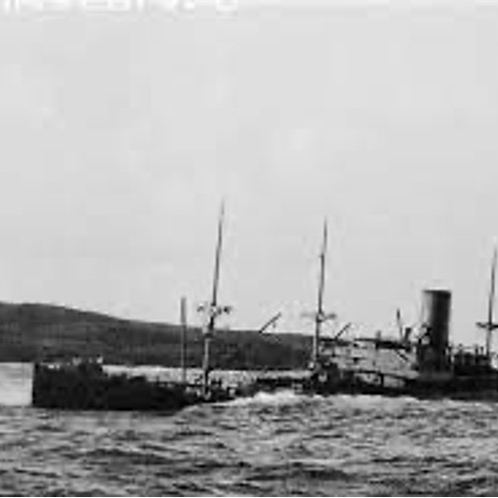
On 6 July 1917, the SS Cumberland, an international steamer owned by the British Steam Navigation Company, was rocked by two explosions as it steamed near Gabo Island, just off the north-eastern coast of Victoria. It was carrying cargo from Townsville, Bowen and Sydney en route to the United Kingdom.
Unbeknown to those on board, a German ship had recently laid a minefield near Gabo Island, on the eastern Australian seaboard trade route and this was the likely cause of the explosion.
The Cumberland was beached on Gabo Island and initial repairs were done. However, when it was being towed to Eden for further work, a storm overtook it and it sank about five miles south of Green Cape on 3 August 1917.
‘SS Cumberland’ near Gabo Island after receiving damage from a mine – July 1917
This incident effectively brought the First World War to Australian shores for the first time.
A second incident at Anna Bay in May 1919 was to bring the War even closer in Port Stephens.
Mine sweeping operations
In September 1917, the Naval Board decided to sweep the area around Cape Howe and Gabo Island using crews from the recently established mine sweeping section of the Royal Australian Naval Brigade (RANB). The RANB enlisted personnel from the coastal trawling industry and commandeered several sea going vessels for temporary service.
Operations began on 8 October 1917, and the first mine was swept off Gabo Island the following day. The concussion from the detonation could be felt on Gabo Island and as far south as Mallacoota in north-eastern Victoria.
The Richmond River Express and Casino Kyogle Advertiser of 16 October 1917, page 2, reported on this mine explosion:
‘No water was thrown up, but the surface ‘boiled’ for an area of about 100 square yards, stunning the fish and covering the sea with a black powdery substance smelling like sulphur. The concussion was felt at Gabo Island. A significant feature is that Cape Howe is on the direct route between Melbourne and Sydney, where the volume of shipping exceeds that of any other route in Australasia. Fortunately, very few ships have been in commission lately owing to the strike, but it is possible that the colliers which resumed the coal trade from Newcastle last week as well as cargo steamers manned by crews of volunteers passed within a short distance of the mine.
The proximity of Gabo Island recalls the loss of the Cumberland, which was beached there after an explosion. In shipping circles the opinion that the Cumberland disaster was due to a mine has been freely expressed. A submarine mine is so suspended under the surface of the water as to be invisible. Mine-sweepers are not specially built for this work, but any available craft is pressed into the service. This mine would probably have been detected by dragnets or cables suspended between two mine-sweepers. Mines are sometimes raised and exploded by rifle fire. The construction of these mines is such that upon explosion they hit at the point of greatest resistance. Ordinarily this would be the hull of a ship. It is not yet possible to say how the mine came to be in such a locality. That it was actually placed in position by an enemy ship is most improbable. The more feasible explanation is that it was put there by a ship in enemy pay.’
Several more mines were discovered in the vicinity and on 15 October 1917, the Minister for the Navy announced that a minefield had been laid near Gabo Island.
It was later revealed that this had been the work of the German armed raider Wolf which had laid mines in an extensive area in both the Indian and Pacific Oceans from 1916-1918.
Mines laid by experts with local knowledge
The Farmer and Settler of 6 November 1917, page 2, supplied further information on the enemy mining operations, obtained from an officer of one of the mine sweeping vessels:
‘The mines were the latest and most powerful that Germany was known to possess. … The mines secured by the sweepers were either unhooked or exploded. One mine, when about 13 feet under water, suddenly exploded. The water within a radius of 100 yards bubbled like a huge boiling cauldron for some time, and thousands of dead fish floated to the surface. “The remarkable thing about a mine,” the officer said, “is that when it explodes it does not throw any great quantity of water into the air, but instead, it emits a great volume of thick black smoke, and, in the case of this mine, the bank of smoke reached over 100 feet into the air.”
Another mine that was found in the same vicinity broken away from its moorings and on to the surface of the water. At the time of its discovery night was approaching and, there was a danger of the mine being lost in the darkness. Under these circumstances, the commander of the sweepers ordered a vessel to explode it by rifle fire. In the bad light it was found necessary to approach nearer to the mine than safely warranted. The usual distance to stand off and fire was 200 yards, but on this occasion the sweeper closed in to a distance of 60 yards, and the rifleman exploded it. The result was nearly disastrous. A great burst of crimson flame shot above where the mine had been, a widening column of smoke mushroomed overhead. Then a thunderclap of noise almost paralysed the senses of the watchers, a blast that threw them about the decks was followed by quivering of the tacked hull of the mine-sweeper. Pieces of chain and jagged lumps of the broken mine fell on the deck. The captain was blown right across the bridge and nearly into the sea. The binnacle lamps, the binnacle, and both compasses were broken. A man who had been viewing the operations through a porthole, was driven across his cabin into the opposite wall with a resounding bump.
‘These mines,” the officer stated, “were laid out in a proper and scientific minefield, extending for about five miles. They were situated right on the direct route for vessels in that vicinity, and were laid by somebody with an expert knowledge, of that branch of naval warfare, and an equally good knowledge of the vicinity and its traffic. The mines were so laid as to be of no danger to the coastal shipping or vessels of light draught, but a vessel the size of the Cumberland, steaming through the field, could only escape destruction by a miracle.”
Questioned as to how the field had been laid, the officer said that it was quite impossible for an open boat to put off from some unfrequented port, as had been suggested, and to lay the mines. The mines were sown in “cradles,” and to put them overboard would require special appliances, which it would not be possible to fit on to a small boat. “A seaman,” he continued, “could have sown them easily without detection, as by improvising a sort of a railway track over the stern of the vessel, all that would be required would be to push them overboard. The mines were all contact mines, and naturally could not have drifted. They were found fastened by a hawser to a float, and were situated at the depth that the class of average steamer trading overseas was known to draw. The mines, when released by the laver in the cradle, after touching the bottom of the ocean, automatically float to the required depth. Their pattern was such that a pressure of 7 pound, no matter how exerted, was sufficient to explode them.’
State Government trawlers commandeered for mine sweeping operations.
The NSW Government State Trawling Scheme was set up in 1915. Its aim was to coordinate all aspects of the NSW fisheries industry, from the initial catch and netting of fish, through to its sale in Government owned fish shops.
The four ocean-going fishing trawlers that had been purchased by the Government as part of the trawling scheme were commandeered for a period by the RANB to undertake its mine sweeping operations in 1917-1918.
The establishment of the new Fish Receiving Depot at Pindimar, Port Stephens, was part of this government scheme. The requisitioning of the trawlers was one of the factors that was to lead to the failure of the scheme and the Pindimar Depot by 1922.
Mines laid off New Zealand Coast – 1918
In March 1918, the New Zealand Government announced that German mines had been found off the coast. The mines appeared to be of the same type as those discovered off Gabo Island, being the most powerful that Germany was known to possess.
The Border Morning Mail and Riverina Times of 1 March 1918, page 3, reported:
‘The Naval Adviser to New Zealand Government announces the discovery and destruction of five additional mines in the suspected area off Cape Farewell, South Island.
The Naval Adviser, referring to the recent discovery of five floating mines on the New Zealand coast, said they were distinctly of German type and origin, and were firmly moored in position. Only in very exceptional circumstances would they drift. It could be safely assumed that they were laid by a vessel properly fitted for this purpose by the enemy, and thoroughly organised for this special class of work.’
In April 1919, it was reported that a mine had blown up on the beach at Woodleigh, about 30 miles south of Auckland. The mine killed two men and several cattle. Investigation showed that the catastrophe was the result of a stranded German mine blowing up.
Mines found off Eden – 1918
The Newcastle Morning Herald and Miners’ Advocate of 14 August 1918, page 6, carried a report about mines found along the south coast of New South Wales:
‘A sensation was caused at Eden by the news that two enemy mines were discovered at 6 p.m. on Sunday by the steamer Emerald Wings, bound from Sydney to Port Pirie, when about 50 miles east of Green Cape. One mine was secured and towed slowly towards Twofold Bay, where, in a position between the north and south heads, it was exploded by rifle fire at about 8.30 on Monday morning. The explosion, which furnished a striking illustration of the force of German high explosives, was witnessed by a large number of townspeople. Every house in Eden was shaken by the force of the explosion.’
Mine found on Tasmanian Coast – 1918
In April 1918, the Hobart Mercury stated that a fisherman recently found a German mine on the Tasmanian coast. The matter was reported to the Naval authorities, and the mine was exploded by rifle fire.
Mine found on Queensland Coast – 1921
The Riverine Herald of 22 February 1921, page 2, reported that a German mine was found near Noosa Heads. The mine stood about four feet high and attached to it were broken pieces of chain. It was evident the mine had broken away recently from its anchor. It was hoped to explode the mine or withdraw the charges.
German mine washes ashore at Anna Bay Port Stephens – 1919
A significant local event in Port Stephens occurred on 21 May 1919 when a German mine was washed ashore at Birubi Beach at Anna Bay.
The Newcastle Sun of 22 May 1919, page 2, was the first paper to break the story that was to attract much local attention, and which could have ended in tragedy:
‘An enemy mine was found washed up on the beach at Anna Bay (about 20 miles from Newcastle, beyond Stockton beach) last night; and it is a wonder that a terrible tragedy did not ensue immediately. The discovery was made by a local boy named Hyde. This youngster imagined the uncouth monster to be some kind of lifebuoy, and he commenced to play with it. He rocked it about to the full extent of his strength, then went forth to proclaim his find.
He encountered Mr. Paddy King, the well-known boxer and theatrical manager, who went with him to investigate. Mr. King promptly recognised the find as a mine and forbade the boy to go near it. The mine was the sight of the district today, everybody turning out to inspect it from a safe distance.
The postmistress at Anna Bay, Mrs. C. Jonson, describes the mine as having five horns and two chain eyes. The latter are probably for anchoring purposes. It is encrusted with carbuncles, from which it is plain that it must have been in the sea for a long period. The mine was found at about the highwater mark on the sand, and no doubt the rough weather of the past few days has been the cause of its being washed ashore. How narrow an escape some of our ships have had from being sunk, under the circumstances, may be well imagined. The discovery was not reported to the naval authorities at Newcastle till this afternoon. Arrangements were made to take possession of it, and Commander Fearnley proposes to have it exploded.’
The Maitland Daily Mercury of 23 May 1919, page 3, further reported:
‘Mr. Paddy King, who is well-known in the Newcastle and Maitland districts, as vaudeville manager, who has been spending a few weeks’ holiday at Anna Bay, telegraphed to Newcastle yesterday that an enemy mine had been washed ashore about twenty miles from Stockton. The matter was at once reported to Commander Fearnley, at the Naval Depot, at Newcastle, who got into communication with Mr. King by telephone, and asked to be supplied with full particulars of the finding of the mine. Mr. King, who was camped at Anna Bay with three friends, informed the Commander that late on Wednesday afternoon the party saw what they took to be a huge sunfish approaching the shore, and they watched it closely. Eventually the object was washed up on the beach. Mr. King, to his surprise found it to be an enemy mine measuring 4ft 6 in. by 3 ft. It was very rusty and covered with marine growth and barnacles. Brass fittings were attached, and evidently the mine had broken from moorings. There are five horns on the mine, and as far as Mr. King could see it is quite intact. The mine will be exploded.’
It did not take long for people to determine that the description of the mine tallied with those discovered off the South Coast.
It was certainly of enemy origin and there were theories as to how it came to be beached at Anna Bay. Did it drift from the Gabo Island field, or from New Zealand, or even the possibility of it being laid in the Newcastle /Port Stephens area?
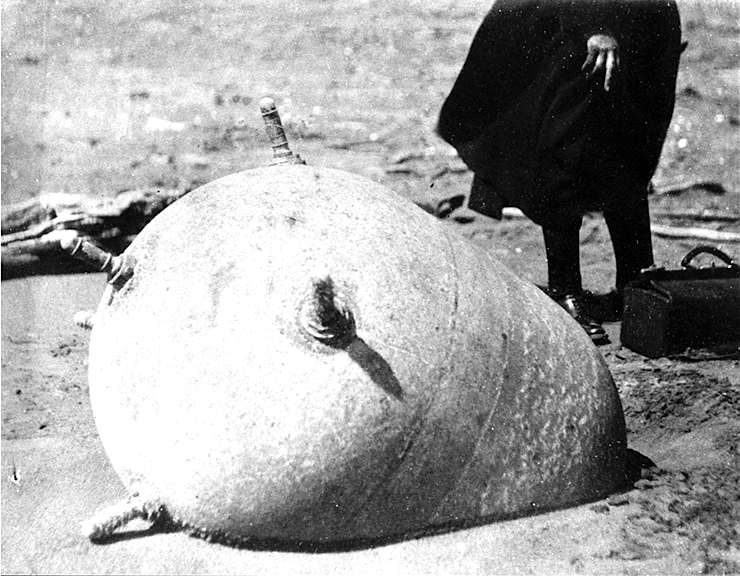
German mine of the type washed up at Anna Bay
Mine destroyed by Naval Party – 1919
A naval party in the charge of Commander Fearnley proceeded from Newcastle to Anna Bay to destroy the enemy mine. The Maitland Daily Mercury of 26 May 1919, page 8, picks up the story:
‘The party on Saturday proceeded to destroy the mine in the first place by placing a charge against the mine and trying to explode it. The charge exploded, but failed to destroy the mine, although one of the prongs was blown off. Rifle fire was then begun at a range of 350 yards, and at the eighth shot C.P.O. Harman succeeded in registering a hit, which exploded the mine.
The concussion was severe, and the force of the explosion excavated a hole in the hard sand thirty feet in diameter by five feet in depth. Fragments of the mine were blown a considerable distance, some falling near a knot of spectators who had assembled about six hundred yards away, and two pieces weighing between three and four pounds came down dangerously close to the firing party. The discovery of the mine created great interest in the district, and many people travelled long distances to view it.’
Aftermath of the mine explosion – 1919
The Newcastle Sun of 31 May 1919, page 5, reported that:
‘Fragments of the enemy mine that was exploded last week at Anna Bay by the naval authorities are still being picked up in the neighbouring bush over a radius of nearly three miles. One piece weighing about 4lb. has been brought to Newcastle by Mr. Paddy King and placed on exhibition at the offices of Mr. Leslie Drayton. The fragment is from the bottom of the mine and has a screw where it had apparently been loaded. Before the mine was blown up Mr. King watched it closely for two days and two nights to prevent its being tampered with by persons whose curiosity might have led to loss of life. Mr. King states that one man came along with tools, saying that he meant to get the brass-work off before the Government got it. The would-be brass collector and other residents got an idea of what Mr. King’s vigilance saved them from when the mine was exploded under the direction of Commander Fearnley. The shock was felt at Booral over 20 miles away. At the Tea Gardens, distant some 14 miles, crockery was shaken off the shelves and man and beast within a range of 500 to 1000 yards got a taste of shell shock.’
Concluding Comments
Today, the beach near Anna Bay, where the mine came ashore, remains one of the top tourist attractions of the Port Stephens region, but few visitors today would be aware of the First World War mine incident.
Two years after the marine mine was found, Anna Bay again featured in newspaper articles when the famous aviator, Bert Hinkler, landed his plane nearby on the beach. This story is published on the website and can be found at this link.
Researched and compiled by Kevin McGuinness
February 2022

 Port Stephens - a history exploration