
Introduction
Like many small towns, Karuah in Port Stephens, rose to the challenging times of World War One and supported its residents who volunteered to fight in Europe,
‘For God and the Empire’.
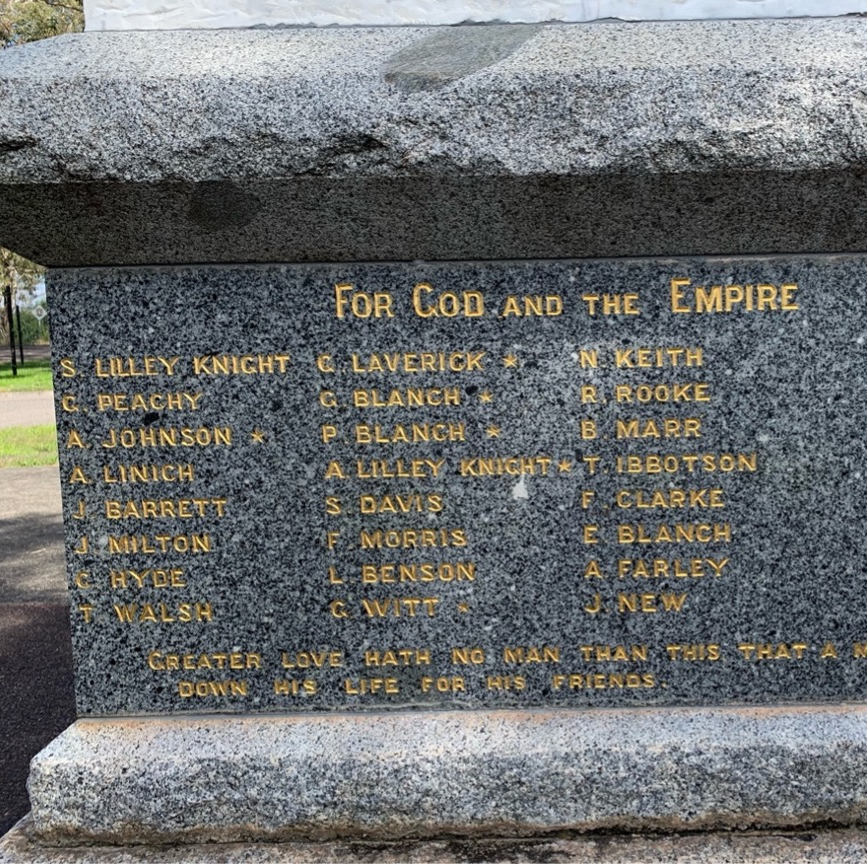
This paper examines the men who volunteered their services, several of whom lost their lives in battle in Europe. The names of the twenty-four volunteers are listed on the Karuah World War One Memorial, that is proudly situated in Memorial Park, on a hill beside the Karuah River.
The period of World War One lasted from 28 July 1914 to 11 November 1918. Within two months of its beginning, the first resident of Karuah had volunteered for military service. He was Thomas Augustine Walsh, a 35-year-old married man, who had previously served in the Boer War, in South Africa. Thomas embarked from Sydney for overseas duty on 24 August 1916. Luckily Thomas was to survive his war service and return to his family in Karuah in May 1919.
This paper examines the background to the establishment of the Karuah War Memorial or Roll of Honour as it was often referred to. It also details the service lives of the twenty-four soldiers listed on that Memorial.
The newspaper reports featured in this paper offer an extensive insight into the support that townspeople gave their soldiers, and of the hardship suffered by the soldiers while at the front line in Europe.
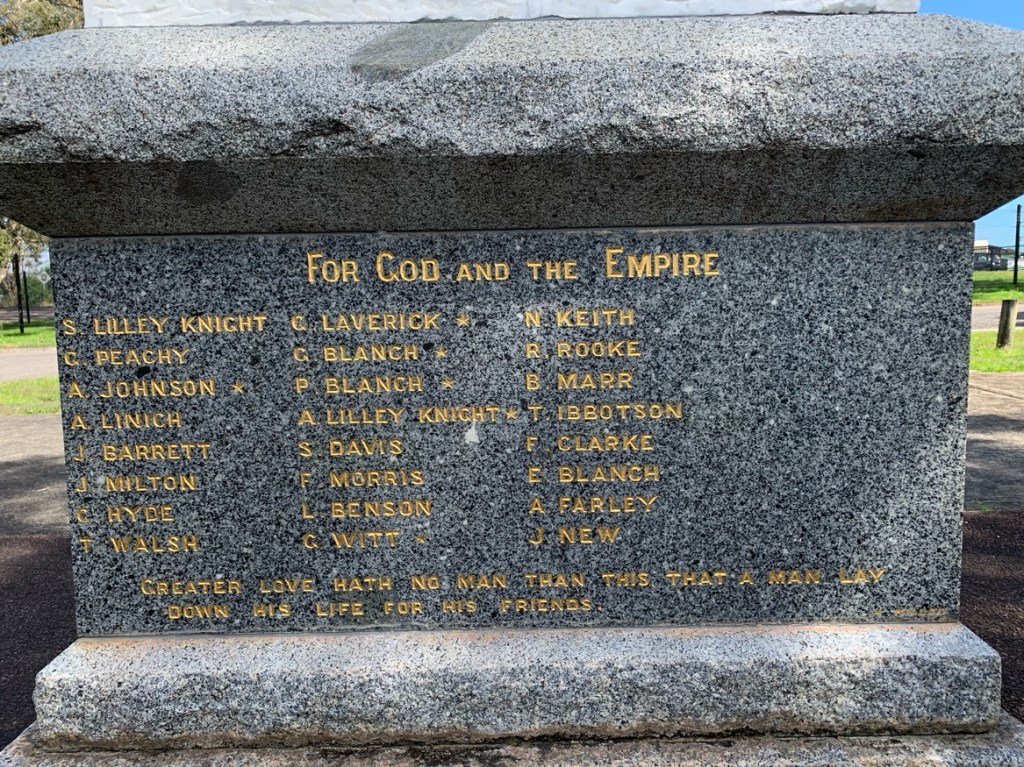
Twenty-four names on the Roll of Honor at Karuah [Author photo]
STORIES OF THE TWENTY-FOUR KARUAH SOLDIERS
Thomas Walsh Volunteers for Service – 1914
The Raymond Terrace Examiner and Lower Hunter and Port Stephens Advertiser of 18 September 1914, page 3, reported:
‘Mr T. A. Walsh, who has volunteered for active service, left by the Karuah on Monday for medical examination. Mr. Walsh served through the South African war, but the passage of years has not dulled the military ardour inherited from a martial ancestry. He is the proud possessor of medals of distinction won by his father in the Crimean war and Indian mutiny, besides a service medal of his own. His many friends wish the genial Tom success and a safe return.’
The Dungog Chronicle of 2 October 1914, page 10, further reported:
‘Mr T. Walsh, who has volunteered for the front, and already passed the medical examination, left by s.s. Karuah on Monday for Victoria Barracks. Mr Walsh was through the Boer war, and his father before him, was in the Crimean war. He is very popular, and all here wish him a good time and a safe return.’
Farewell presentation to Sid Lilley Knight – 1915
The Raymond Terrace Examiner and Lower Hunter and Port Stephens Advertiser of 15 October 1915, page 3, reported:
‘A farewell social and presentation was tendered to Private Sid. L. Knight, of the 19th Battalion, on Saturday night last, Messrs. T. A. Walsh and A. W. Linich acting as secretaries. Proceedings were opened by the chairman (Mr. Hartcher) in a brief speech.
Rev. R. G. Knox said our men were going on a crusade, as of old, to drive the Turk out of Europe. The Dardanelles recalled the oldest nations of history and some of history’s most stirring themes— the Trojan War for instance. Our young Australians were going forth, like young Trojans, to fight where the old Trojans fought. By their efforts we hoped to see Christian worship once more established in the beautiful church of St. Sophia in Constantinople. Our young friend was going to do his share, and he wished him success. Mr. J. H. Callaghan spoke of his pleasure in being present, and of the large attendance which testified to the esteem felt for the departing guest. He eulogised his action in volunteering, and the good example the young recruit was setting, and felt sure that others would soon follow in his footsteps. Mr. J. Oliver also spoke.
His Lordship the Bishop of Newcastle in making the presentation of a radium faced wristlet watch and a purse of sovereigns, spoke of his personal interest in the war. One son was now in Flanders, another was about to leave. He often wondered at the large number of boys taught in the Church of England who were doing their duty at the war. All must go who feel it their duty to do so. He himself, disqualified by age and his calling, regarded every man who went as doing his (the speaker’s) duty. Turning to the recruit, he said the first duty of the soldier was to be punctual and obey orders, to take care of himself, keep himself fit, and be on guard, not only against the enemy, but against temptations. The venerable speaker concluded his remarks with his apostolic blessing, and trusted God would bring the young soldier safely back.
Mrs. New and Mr. T. A Walsh also added their good wishes. Mr. Knox, replying on behalf of Private Knight, said that Sid’s heart was touched by the gifts and the remarks made, but felt that he would rather fight the Turks than make a speech.’
Farewell presentation to George Peachey and Albert Johnson – 1915
The Raymond Terrace Examiner and Lower Hunter and Port Stephens Advertiser of 3 December 1915, page 3, reported:
‘Two local lads (Messrs. G. A. Peachey and A. V. Johnson) visited Victoria Bar-racks last week, were accepted, and will go into camp in a few days. With the departure of these young men Karuah will lose two active and public-spirited citizens. Mr. Johnson is secretary of the Football Club and treasurer of the Cricket Club, while Mr. Peachey has for some time been a prominent official at the local Oddfellows’ lodge, whose place it will be hard to fill. Mrs. New and Mrs. Hartcher are organising a gift evening for tonight in Francis Hall. The function promises to be well patronised, a few cases of Xmas and New Year gifts for our troops at the front should be the result. A short concert programme is also being arranged, and refreshments will be served.’
Albert Johnson never returned to Karuah as he was killed in action in France.
The Raymond Terrace Examiner and Lower Hunter and Port Stephens Advertiser of 10 December 1915, page 3, further reported:
‘A goodly number gathered in Francis Hall on Monday evening last at the invitation of the Pride of Karuah Oddfellows’ Lodge to say au revoir to Bros. G. A. Peachey (elective secretary), and A. V. Johnson before their departure to take up training in the Australian Expeditionary Force. In the absence of Bro. A. W. Linich, N.G., owing to an injured knee, Bro., A. L. Farley, V.G., officiated in the chair. Other officers present were Bros. Mewett (P.N.G.), J. W. Johnson (Treas.), Hartcher (F.S ), Baier (Ward.), and A. S and H. G. Morante (Guardians). ……
Speeches eulogistic of the departing brothers were made by the chairman and Bros. Mewett, Fountain, Laverick, and Hartcher, and responded to by the young recruits. Messrs. C. Linich and Jas. Callaghan, senr., contrbuted songs, the latter also making an interesting speech.’
Goods donated to War Chest for overseas troops – 1915
The Raymond Terrace Examiner and Lower Hunter and Port Stephens Advertiser of 10 December 1915, page 3, reported:
‘The gift evening on Saturday last proved a successful function, quite an array of packages of varying sizes gradually piling up on the table in the centre of Francis Hall. Mrs. New, the hon. sec., states that 83 separate parcels were received.
A short concert programme, to which the following contributed — Mrs. New, Mrs. Hartcher, Mr. Linich, Mr. Hartcher, and Master Frank Keith, together with songs by groups of schoolboys and girls, was gone through, after which refreshments were provided by the ladies. A collection was taken up to defray freight charges, and the use of the hall was given free by Mr. Buckshi Ram. A couple of cases containing the gifts were despatched to the Secretary of the War Chest, Sydney, for further despatch to Egypt.’
The Raymond Terrace Examiner and Lower Hunter and Port Stephens Advertiser of 21 January 1916, page 3, further reported:
‘In connection with the gift evening, held here some little time ago, Mrs. New states that she received a letter of acknowledgment from Mrs. Antill, of the War Chest, Sydney. The gifts had been dispatched at once to Egypt. The freight paid amounted to only 3s, and of the £1 12s 6d collected in the Hall for that purpose, the balance, £1 9s 6d, was paid into the Raymond Terrace Red Cross Fund.’
James Barrett and George Laverick enter Military Service – 1916
The Raymond Terrace Examiner and Lower Hunter and Port Stephens Advertiser of 21 January 1916, page 3, reported:
‘During the week two more local lads joined the ranks of the Empire’s gallant defenders. Mr. James Barrett went into camp a few days ago and Mr. Geo. Laverick, teacher, of Mulwee, Swan Bay, goes in on the 31st. Both are members of the local Oddfellows’ Lodge, which, though small numerically, has now contributed about 20 per cent. of its membership to the A.I.F.’
Farewell presentation to George Laverick by the Oddfellows – 1916
The Raymond Terrace Examiner and Lower Hunter and Port Stephens Advertiser of 4 February 1916, page 3, reported:
‘An “Au Revoir” evening was tendered to Bro Geo. J. Laverick by the Oddfellows on Tuesday night, 24th ult. There was a good attendance of brethren and friends. Bro. A. W. Linich, N.G., presided, and said they had met to say au re-voir to Bro. Laverick on the eve of his departure to go into camp with the Australian Imperial Forces. They had always found the departing brother a good sport and while proud to see him go to answer the call of King and country, they were sorry to lose him from their midst. Bro. Laverick had been an active citizen since coming amongst them— had practically founded the football club. As a player he had always been a tower of strength to the club, and somehow when they had Bro. Laverick with them they generally won, while without him they lost. He hoped that their guest would carry same luck to the A.I.F. Bros. Farley, Ern. Blanch, Alf. Lilley, J. W. Johnson, and W. Hartcher also spoke, the latter dealing at some length with the share taken in the war by members of the Grand United Order, with the work done by our Australians at the front and our unbounded pride in their heroism, and devotion, and with the wonderful unifying influence which the war had exerted, and was exerting, not only in Australia, but throughout our Empire.
Bro. Laverick, in response, was visibly moved, and spoke briefly of his appreciation of the kind remarks made, which had touched him very keenly. He felt he was not deserving of all the credit attributed to him but had only done his duty as a loyal citizen. Refreshments were served later, and a very pleasant evening spent.’
George Laverick did not return to Karuah as he was killed in action in Belgium.
Albert Lilley Knight and Frederick Morris depart Karuah for Military Camp – 1916
The Raymond Terrace Examiner and Lower Hunter and Port Stephens Advertiser of 25 February 1916, page 3, reported:
‘Allie Lilley and Fred Morris left here on Monday last to join the Broadmeadow camp of the A.I.F.’
Farewell presentation to George Peachey by War Service Committee – 1916
The Raymond Terrace Examiner and Lower Hunter and Port Stephens Advertiser of 17 March 1916, page 3, reported:
‘At a social evening held in Francis Hall on Saturday, 11th inst, under the auspices of the War Service Committee, a send-off was tendered and presentations made to Private George Peachey, who was on final leave and will soon be leaving for the front.
The chairman of the committee (Mr. W. I. Hartcher) presided over a very large and representative attendance and made the presentations. In his opening remarks the chairman said that War Service Committees were public bodies, membership of which was open to any patriotic citizen. Broadly, the object was to secure the co-operation of every man and woman in Australia in prosecuting to the utmost our share in the war. Each War Service Committee was charged with the duty of organising, within its own area, all the energies of the people in whatever way possible, and of co-ordinating the patriotic endeavours of all citizens so that all efforts might contribute to the fullest extent in bringing about a successful and glorious termination to the present war, a termination crowned with lasting peace.
The need for organisation was supreme. We were fighting against a nation which was said to be organised to the highest point of efficiency in every department of its social and economic life, as well as in matters military; against an organisation which had been perfected after years of patient and scientific preparation; against an organisation in which every citizen’s efforts were being directed purposely and scientifically to contribute to one sole object — to win the war. If we were to win through against that efficiency, and bring the laurels of victory to our arms, we must meet that organisation with better organisation, that science with keener science, and that preparation with more complete preparation.
Everyone’s help was wanted. Everyone, however humble, could do something. It was the imperative duty of every patriotic citizen, man or woman, to get himself in touch with these War Service Committees, which were an important part of the organisation being provided by the Federal Government to coordinate and make effective the energies of Australia. The local committee was endeavouring to fulfil its duty as a part of the scheme. The most important function of the committees was in connection with the raising of our new Australian army of 50,000 men, and of the reinforcements necessary to keep it up to full strength. In common with other committees, a subcommittee had been appointed locally to deal with this phase, and under the direction of the Port Stephens Shire War Service Committee would be linked up with others of a similar kind throughout the shire.
It was hoped the combined efforts would ensure that this district would contribute its full quota to the new army and also sufficient men to reinforce it. The recruiting subcommittees would see to it that every man of military age was made fully conversant with the facts and conditions of the war, and of the responsibility that rested upon him in common with others to uphold the traditions of our free system of government.
Another function to which War Service Committees could usefully devote due attention was the proper recognition of the public spirit, self-sacrifice, and heroism of those who offered themselves as recruits to our Australian army to carry and extend the glories of Anzac and Gallipoli to other fields where the might of the enemy might be met and shattered. The local committee had decided to treat all recruits alike and present each man departing for the front with an appropriate and inscribed gold medal; and to carry out that decision, was appealing for funds. That night’s gathering was the first fruits of the policy.
The Rev. R. G. Knox, B.A., expressed his pleasure at being present. On behalf of Mr. Longworth, he expressed that gentleman’s pride in Private Peachey for his determination and his sorrow at losing him. He had always found George an honest-minded, clean-spoken, and reliable man. For himself, the speaker said he would miss George very much, for he had always been a good and willing helper in church work. He concluded with three maxims of advice that might be taken to heart by every recruit. Take good care of yourself; the sick man or man in hospital was no good to the army or himself. Take good care of your life; don’t expose yourself unnecessarily; your life belongs to your king and country. Lastly, make a friend of the chaplain; he was the soldier’s friend.
Mrs. New and Miss Stewart also spoke, and Mr. M. A. Johnson apologised for the absence of Mr. and Mrs. Peachey, the recruit’s parents. The presentation was then made by the chairman who also made a further presentation on behalf of Mr. and Mrs. Symonds. Private Peachey suitably responded. Mr. E. C. Mewett, of the local Oddfellows’ lodge, then presented Brother Peachey with a shaving set on behalf of the members. The lodge was sorry to lose Bro. Peachey, who had been a good and energetic worker, and he hoped he would return safely to them. Bro. A. W. Linich supplemented the P.N.G’s remarks, and the recipient suitably replied. Proceedings terminated with the singing of the National Anthem and cheers for the recruit.’
Farewell presentation to Albert Johnson by War Service Committee – 1916
The Raymond Terrace Examiner and Lower Hunter and Port Stephens Advertiser of 24 March 1916, page 3, reported:
‘Under the auspices of the War Service Committee, a send-off and presentation was tendered to Private A. V. Johnson, of the A.I.F., now on final leave. The chairman of the committee presided. Apologies for non-attendance were read from Messrs. W. Longworth, W. Brown, M. L. A., Mr. and Mrs. J. O. Johnson, and Mrs. New.
The chairman in opening proceedings dealt at some length with the objects of War Service Committees, Australia’s part in the war, the recruiting of the new army, and the need for organised and co-ordinated effort. He had known Private Johnson from the latter’s boyhood. He admired his sturdy manliness, and was confident he would render a good account of himself. Mr. J. H. Callaghan was glad to be present. He had watched the recruit’s career since childhood, and had often shared his company on the cricket and football ground, where he had proved himself a thorough sport. He knew he would be the same as a soldier. He wished him a safe return.
Miss Deadman was pleased to be present. She feared that we hardly realised what we were sending our brave soldiers to. It was difficult to grasp what the horrors of this awful war meant. Each one had a duty to get right with God. There was likewise a national duty. The nation must get back to God, and victory would come to our arms.
The Rev. R. G. Knox spoke of his pleasure in being able to take part in the function. There was no doubt that this was a terrible war. The central powers had a grip on Europe from Riga to Salonica, and almost from Calais to Czernowitz. They had straddled over Europe, as it were, and their lines were set strong like steel. It was our task to break those lines and force them back. It was true that war was not right; but the war was there as a fact, and we must meet that fact. The nation should have followed the advice of prophets like Lord Roberts. Now, the only thing was to meet force by force. We must fight or cease to exist. Our boys must put on khaki. It was a glorious thing to be able to go out and fight for one’s country but we must not forget that those who went were making great sacrifices The soldier offered his life for his country, but what of those at home. After all the biggest sacrifice was made by the women, the mothers. He was sure that Private Johnson would give a good account of himself. Mr. Knox, on behalf of the Karuah district, then presented the soldier with an inscribed gold medal, also handing over a gift on behalf of Mr. and Mrs. Symonds.
Private Johnson in responding said he fully realised the seriousness of the step he had taken; but if this country was worth living in it was worth fighting for. The chairman then called on Bro. E. C. Mewett, P.N.G. of the Pride of Karuah Oddfellows’ Lodge, who after a few happy remarks, presented Bro. Johnson with a shaving set on behalf of the lodge. Bro. Johnson suitably replied, and proceedings shortly after terminated with the national anthem, after which a social was held.’
Albert Johnson did not return to Karuah as he was killed in action in France.
Farewell presentation to Albert Linich and Ernest Blanch by the Oddfellows – 1916
The Raymond Terrace Examiner and Lower Hunter and Port Stephens Advertiser of 7 April 1916, page 3, reported:
‘The Pride of Karuah Oddfellows’ Lodge tendered an au revoir evening to Bros. A. W. Linich and Ern. Blanch on Saturday night last prior to their entering the A.I.F. at Maitland. Bro. A. L Farley, N.G , presided, and spoke of the loss the Lodge was sustaining in losing two good members, the former of whom had held various offices, only lately vacating the N.G. ‘s chair. Bros. Mewett, P.N.G., E. Thompson, and W. I. Hartcher also spoke, and the departing brethren suitably responded.
Up to date eight members of the local lodge have enlisted — Bros. Peachey, Alb. Johnson, Geo. Laverick, Jas. Barrett, Stanley Davis, A. W. Linich, E. Blanch and E. Thompson. Bro. Geo. Laverick. who before enlisting was teacher of the public school at Swan Bay (Mulwee) is now a Quarter Master-Sergeant in Maitland camp. At a recent series of instruction for non-commissioned officers he was successful in winning an entrance to Duntroon Military College, being one of the four who, out of 120 aspirants, succeeded in gaining that coveted distinction.’
Farewell presentation to Thomas Walsh by War Service Committee – 1916
The Raymond Terrace Examiner and Lower Hunter and Port Stephens Advertiser of 7 April 1916, page 3, reported:
‘At the last meeting of the War Service Committee on Monday night Messrs. T. Walsh and Arthur Johnson were appointed to represent the committee at the meeting of the Port Stephens Shire War Service Committee on the 4th inst. At the same meeting the resignation was accepted of the Hon. Secretary (Mr Walsh) owing to his having enlisted. Mr. Art. Johnson was elected to fill the vacant office.
The committee afterwards tendered Mr. Walsh an au revoir, at which congratulatory speeches were made by Messrs. Barclay, Jas. Callaghan, Arthur Johnson, J. H. Callaghan, and Hartcher. Mr. Walsh during his residence in Karuah has proved himself an energetic and public-spirited townsman, whose departure will leave a gap that will be difficult to fill. He has interested himself in every movement initiated locally for the good of the district and occupied various offices in the Railway League and Progress Association, the cricket and football clubs, and was always a tower of strength to every movement he associated with.
He has taken the keenest interest in the organisation of the War Service Committee, and following in the footsteps of his late father, a veteran of the Crimea and Indian mutiny, he was the first to offer himself locally for active service. He has previously seen considerable fighting in the South African war, having been associated with Brabant’s Horse in a number of notable engagements. Mr. Walsh is also the possessor of a most genial and pleasant personality, and to quote a speaker at the send-off, was always the same old Tom, with a smiling face and pleasant word whenever or wherever you met him.’
Recruitment Officer visits Karuah – 1916
The Raymond Terrace Examiner and Lower Hunter and Port Stephens Advertiser of 7 April 1916, page 3, reported:
‘Sergeant Miller, Recruiting Sergeant for the Port Stephens Shire, paid a visit here last week. Sergeant Miller was a member of the first division under Lieut. Colonel Braund, which participated with the much-famed third division in the glorious landing at Anzac, Gallipoli, on April 25th. The sergeant is very keen on his work, and being equipped with abundance of tact, should prove successful in his onerous duties. The shire is to be congratulated on the appointment.’
Farewell presentation to James Barrett, Albert Lilly Knight and Frederick Morris by the War Service Committee – 1916
The Raymond Terrace Examiner and Lower Hunter and Port Stephens Advertiser of 28 April 1916, page 3, reported:
‘Privates Barrett, A Lilley Knight, and F. Morris were tendered a farewell evening and presentation on Saturday night last. There was a large attendance. Mr. W. I. Hartcher, chairman of the War Service Committee presided, and in opening the proceedings read apologies from Mr. W. Brown, M.L.A., who wished the boys a safe return and every success; and on behalf of the Rev. R. G. Knox, B. A., and Sergt. Miller.
After some remarks explanatory of the object of the gathering the chairman tendered a hearty welcome to Privates T. A. Walsh (ex-Hon. Sec. of the W.S.C), S. Davis, A. W. Linich, A. Russell, F. Clark, and R. Rooke, all of whom were present on weekend leave. Further remarks by the chairman were followed by short speeches by Messrs. J. H. Callaghan, G. Page, and Alf. Lilley. The chairman then presented each departing soldier with an inscribed gold medal on behalf of Karuah and district. Privates Lilley-Knight and Morris suitably replied, proceedings terminated with the National Anthem and cheers for the King, the army, and the Karuah soldiers.
The ceremony was interspersed with gramophone selections by Mr. J. C. Davis, and cornet and violin solos by Messrs Rennie and J. Dillon. The remainder of the evening was devoted to dancing, Mr. J. W. Johnson acting as M.C.’
Albert Lilley Knight did not return to Karuah as he was killed in action in France.
Farewell presentation to Stanley Davis by the War Service Committee – 1916
The Raymond Terrace Examiner and Lower Hunter and Port Stephens Advertiser of 19 May 1916, page 3, reported:
‘On Wednesday, 10th inst., in Francis Hall, under the auspices of the War Service Committee, a farewell was tendered to Private Stanley Davis on the eve of his departure for the front. The chairman of the committee (Mr. W. L. Hartcher) presided over a large attendance, and after tendering an apology on behalf of Bro. E C. Mewett, of the Pride of Karuah Oddfellows’ Lodge, said that Private Davis had unexpectedly returned on final leave, and would be leaving next morning.
The present lad was the twelfth to go from the locality, eleven having already gone, while there were ten others in camp. There was no doubt that they would very soon be called upon to say au revoir to more of their lads, and how soon, was indicated by the suddenness of the present departure. Since they had last met to farewell 3 of their men about a fortnight ago’, another, Sergt Major Laverick, had sailed with only a few hours’ notice.
The night’s arrangements had been very hurriedly made, and while the large attendance was very gratifying, he was sure there were many absent who would have been present had there been more time to make known the holding of the function. The usual presentation medal which the War Service Committee was giving to every man leaving the district for the front had not come to hand in time, but would reach Private Davis later in due course. But while the trinket might be absent, the sincerest wishes of all went out to the young soldier for his success and safe return. He was going away to perform one of the highest duties that Australian citizenship had yet demanded of its sons, to uphold the honour and dignity of his race and nation, and to preserve intact those liberties that had been handed down to us as a priceless heritage from the past.
He was going away from the scenes of his childhood and from home and friends to take his place in the great army of Empire and freedom as countless thousands of his ancestors had done before, all down the long ages of a glorious and victorious past, since history had been recorded, and as thousands of our fellow Australians have done, and are doing, at the present time. Already our lads from sunny Australia, with its wide lands and open spaces, its freedom and unconventionality, had won for themselves a place high up on the long Honour Roll of the Empire; and had shown that the race, planted anew under these southern skies, and developing under conditions widely different from those of the lands that gave it birth, was true to its breeding and to its highest traditions.
Our soldiers fresh from the mine, the factory, the shop, from the inland station and the oyster-freighted foreshores, from Queensland’s cane fields and Tasmania’s apple gardens, from the jarrah Forests of the west and the pearling grounds of Torres Straits, had won places alongside the hardy pikemen and archers who fought at Crecy and Agincourt, alongside the war worn veterans who met the flower of Napoleon’s marshalls on the Peninsula, alongside those stubborn hearted present day warriors, who broke the wonderful and dogged retreat from Mons to the Aisne. Out among the shell scarred cliffs and ravines of Gallipoli’s western surface had been written by our Australian lads an imperishable story of bravery and devotion that would permeate Australian history and Australian literature for ages to come and be for generations yet unborn a pride, a glory, and an inspiration.
It was hard to part with our lads. Who could guess whether the parting hand-shake would ever be repeated? But our men were going forth to do a duty that could not be neglected, and a duty which, when set forth upon in the fight spirit appealed to the highest, the bust, the noblest, and the holiest instincts of our natures Those who heard the call of their country in distress and went forth to fight, no matter in what army, prepared to lay down their lives for their fellows, and sacrifice their all for what they believed to be right and just must in an especial way be under the peculiar care of Him who nineteen hundred years ago, in far-off Judea, laid down His life upon a cross that mankind might live. They could only abide their time in patience, trusting that this all-seeing and all loving care would bring their departing soldier friends back to them in full health and vigour, and in the full satisfaction of a noble and heroic duty, nobly and heroically performed.
Messrs. J. H. Callaghan and Amb. Blanch also spoke, and Private Davis briefly responded. A presentation of a case of razors was then made to Private Davis on behalf of the Oddfellows’ Lodge by Bro. H. G. Morante, V.G., who was supported by Bro. Alf Liilley, and the recipient suitably replied. Proceedings terminated with the National Anthem and cheers, the remainder of the evening was devoted to dancing, Mr. A. Morante officiating as M. C.’
Presentation to Thomas Walsh by War Service Committee – 1916
The Raymond Terrace Examiner and Lower Hunter and Port Stephens Advertiser of 26 May 1916, page 2, reported:
‘On Saturday night last the members of the War Service Committee at an informal gathering made a presentation of a silver cigarette case to Mr. T A. Walsh, who lately resigned the secretaryship of the committee and enlisted, and is at present at Rutherford camp. A very pleasant evening was spent.’
The Raymond Terrace Examiner and Lower Hunter and Port Stephens Advertiser of 7 July 1916, page 2, further reported:
‘Private T. A. Walsh has been selected to attend the School of Instruction for non-commissioned officers to be held in Sydney during the next month.’
Presentation to Neil Keith by War Service Committee – 1916
The Raymond Terrace Examiner and Lower Hunter and Port Stephens Advertiser of 30 June 1916, page 2, reported:
‘A farewell under the auspices of the War Service Committee was tendered to Private Neil Keith on Monday night last. The evening proved wet and cold, which fact, counted with the very short notice, militated against a large attendance. The chairman of the committee, who presided, explained that the committee had only been apprised of Private Keith’s return on Saturday night, and it was impossible to get the Karuah medal in time for the function, but it would arrive later, and be transmitted to Private Keith in due course through his parents.
The speaker devoted the main portion of his remarks to a resume of the life of the late Field Marshal Lord Kitchener. As in life, so in death, the dead War Lord had set an example of coolness, heroism, and devotion to duty that would concentrate the mind and energy of the Empire more firmly than ever on its great task of achieving victory. The spirit of Kitchener was today inspiring and welding not only the Empire, but the whole allied cause.
The chairman said he had not known the young recruit previously, but was acquainted with his father, and he was sure the lad was a chip off the old block; and coming from the land in the north, where the heather blooms — the land of warriors, statesmen, and poets — he would be true to the instincts of his country and go into battle prepared “to do or die.” On behalf of the district, he conveyed to Private Keith their admiration for his heroic conduct and sincere wishes for his success and ultimate safe return. Proceedings terminated with the National Anthem, and after some time devoted to dancing with Auld Lang Sine.’
Presentation to Thomas Walsh, Leonard Rooke, Charles Hyde, Stan Davis and Albert Linich by War Service Committee – 1916
The Raymond Terrace Examiner and Lower Hunter and Port Stephens Advertiser of 25 August 1916, page 3, reported:
‘A social evening and presentations were tendered to Privates T. A. Walsh, L. R. Rooke, C. Hyde, J. Davis, and Alb. Linich on Saturday night last in Francis Hall. There was a very large attendance from the surrounding localities.
The chairman of the War Service Committee (Mr. W. I. Hartcher) presided, and tendered apologies for absence from Mr. and Mrs. Geo. Davis, Mr. and Mrs. W. Longworth, and Mr. and Mrs. Peachey. After explaining the object of the function and a few other remarks, the chairman called on the Rev. R. G. Knox, B.A., to make the presentations. Mr. Knox in doing so spoke of his pleasure at being able to attend. He congratulated the War Service Committee for their good works. Their organisation was a model. Every man received the same treatment ; that was as it should be — every man made the same sacrifice. He found no better gathering anywhere in his travels. He went on to speak of the church in the war and referred to the heroic devotion of the late Rev. H. E. Maxted of Sydney, who was one of the eight chaplains who had lost their lives in the Jutland battle. The speaker concluded with some words of advice to the departing soldiers, to which reasons of space prevent an extended reference. Kitchener had said “Don’t be too familiar with the people of the place you are quartered in, and remember always that you are a British soldier.” He counselled them to so act as to be able to come back not ashamed to meet the girls they left behind in Karuah. Mr. Knox concluded a very fine effort in the words of a well-known hymn—”Bring our loved ones home in peace.” He then presented each man on behalf of the public of Karuah and district with the usual gold medal.
Private Walsh responding said it was difficult to find fitting words in which to express his thanks for the kind remarks and the handsome medal. He would treasure thoughts of the evening when far away. He had only done his duty by enlisting, and would have felt recreant to his duty to his wife and children and the Empire had he not done so. The least a nation could expect from her manhood was to bear arms in defence of her liberty. He offered special thanks to Messrs. Art. Johnson, Witt, and W. Longworth for bringing him to and from camp, also Mrs. Oliver for gifts. He hoped to return, but if he were fated to go under he trusted he would have the courage to die manfully.
Private Davis in response said he thanked all for their kindness and was pleased to see so many old friends around him. He was only doing his duty. The Empire needed every man. He hoped to be back among them all again. Privates Linich, Hyde, and Rooke also suitably responded. Bro. E. C. Mewett, P. N. G., then made presentations of cases of razors to Privates Linich and Davis on behalf of the local Pride of Karuah Oddfellows’ Lodge. He wished them a speedy and safe trip across, and same home, again. Suitable replies were made by the recipients. A welcome was tendered at the instance of the chairman to Private Geo. Blanch, who was present in uniform. With musical honours and the National Anthem the ceremony was concluded, and the remainder of the evening devoted to dancing.’
Karuah Cricket Club suspends operations due to War – 1916
The Raymond Terrace Examiner and Lower Hunter and Port Stephens Advertiser of 15 September 1916, page 3, reported:
‘The executive of Karuah Cricket Club met on Monday night, and, owing to the fact that most of the old members having enlisted, suspended all operations of the club until next annual meeting in September of next year. Financially the club is in a sound condition, and it has an equipment of all necessary material, and will be ready to resume operations again when peace smiles again and our lads return to don the flannels again after the sterner game that is being played in the trenches.
The club’s honour roll is as follows:— Q. M.S. Geo. Laverick, Privates A. V. Johnson (in hospital), G. A. Peachey, S. L. Knight (wounded), Jas. Holbert (wounded), Stan Davis, Jas. Barrett, Alf. Barclay, Alb. Linich, T. A. Walsh, John Davis, Geo. Blanch, Peter Blanch, Ern. Blanch, H. Melmeth.’
The Oddfellows Lodge reflect on members on Active Service – 1916
The Raymond Terrace Examiner and Lower Hunter and Port Stephens Advertiser of 15 September 1916, page 3, reported:
The local Oddfellows are arranging to celebrate the second anniversary of the opening of the Pride of Karuah branch, on the 7th of October, next. The District Master (Bro. S. N. Dark) will that night unveil a roll of honor of members of the branch who have enlisted, a roll which contains the names of one-third of the members of the branch. The unveiling will be preceded by a dinner tendered to the District Council officers and be followed by a social evening.
News was received during the week that Bro. Private A. V. Johnson, who had been in hospital in England with pneumonia was convalescent. Word has also arrived that Privates Sid. Lilley-Knight and Jas. Holbert have been wounded in action, and Mr. and Mrs. Benson have received a letter from their son Leonard, who had previously been posted missing, that he is progressing favourably in hospital, having been wounded in action. Private Jack Milton is also reported wounded.
Last weekend we had a visit from Private Tom Ibbotson, who is now at Rutherford in the 35th. Tom, who is a relative of Mr. and Mrs. Symonds, and from the old country, says the soldier’s life is ”the life.’ He expects to soon be on his final.’
Letter from George Laverick from the Front – 1916
The Raymond Terrace Examiner and Lower Hunter and Port Stephens Advertiser of Friday 22 September 1916, page 3, reported:
‘The following letter has been received from Sergeant Geo. Laverick by Mr. W. I. Hartcher, of Karuah, who before enlisting was teacher at the Mulwee school, Swan Bay. He is at No. 1 Lark Hill Camp and attached to C group of the Machine Gun Section: — I hereby extend my heartfelt appreciation to me and my wife in making such an extremely valued presentation to her when I was many miles from Australia on the sea. I can assure all my many and kind friends that it will live long in my memory, and someday I hope to wear it in the company of those many friends. I often think of the many good times spent with you, and wonder if those times will ever return. In a time like this, when one is so close to the firing line, he feels like getting in and doing it at once, and, if spared, get back to relieve those he left behind of the heavy burden of ‘wondering when.’
You will no doubt be pleased to hear that we are all close together — S. Davis, J. Barrett, George Peachey, A. V. Johnson, A. Lilley, and young Morris. Harry Goodsir, of the Branch, and the Holbert boys, of Tea Gardens, are here, also young Allen, of Raymond Terrace. We were all very sorry to hear that our old friend and good sport, Jack Davis, is ill in hospital, and all wish him a speedy recovery. England is a beautiful place, and all that it is pictured. One could sit and write of its beauty for hours. Its green pastures, beautiful wildflowers growing by the roadside, its ancient castles and old-fashioned buildings, including the old Roman walls, fills one with astonishment. I have been to London and right up the North of England to Newcastle-on-Tyne and seen the Cheviot Hills which separate England from Scotland, so I can say without ‘skiting’ that I know a little about England.
Time and space will not permit me to go far, so if you wait till I have ‘done my bit’ and returned to Karuah, I’ll tell you something. The English people think an awful lot of the Australian soldiers—’The Anzacs,’ as they term us. One cannot but appreciate the smile he receives and the work the ladies do for us. Winter is going to be fairly severe. We are wearing our winter clothes now, and this is the middle of summer; but we’ll do what others have done before us, and get through somehow. Well, dear friends, I shall have to close. Once again thanking you, I look forward to the day when we shall again meet.’
George Laverick did not return to Karuah as he was killed in action in Belgium.
Presentation to George Witt and Thomas Ibbotson – 1916
The Raymond Terrace Examiner and Lower Hunter and Port Stephens Advertiser of 6 October 1916, page 3, reported:
‘In spite of the inclement weather, there was a good attendance at Francis Hall on Monday night last, to say au revoir to Privates Geo. Witt and T. Ibbotson, both of whom were on their final leave. The chairman of the War Service Committee (Mr. Hartcher) presided, and made the presentation of the Karuah medal, being ably supported by Mr. J. H. Callaghan. Privates Witt and Ibbotson responded.
The latter, speaking at some length, said the memory of that evening would be a comforting recollection, and it cheered one to know that he was appreciated. After all, each went forth to fight more for the dear ones at home than from any other feeling. He hoped they would both come back with V.Cs. pinned on their breasts, and if they did not it would not be for want of trying. The ceremony concluded with the National Anthem, and a social filled in the remainder of the evening.’
George Witt did not return to Karuah as he died in action in France.
Updates on Soldiers – 1917
The Raymond Terrace Examiner and Lower Hunter and Port Stephens Advertiser of 5 January 1917, page 2, reported:
‘Private Howard Marr, a local lad, is at present in camp, and arrangements are being made by the War Service Committee to recognise his departure for the front by a presentation in the usual form. …………………….
The erstwhile teacher of Mullwee Public School, Mr. G. J. Laverick, who is at present somewhere with a Lewis gun section has gained the coveted star on his shoulder. He has received a commission as Lieutenant.’
The Raymond Terrace Examiner and Lower Hunter and Port Stephens Advertiser of 30 March 1917, page 3, reported:
‘News has been received that Private Charles Hyde has been wounded in France, and latest advices indicated that Private Albert Linich was disabled at a base hospital in France.’
The Raymond Terrace Examiner and Lower Hunter and Port Stephens Advertiser of 27 April 1917, page 3, reported:
‘Private A. Linich writes from France that he has been convalescing after having been in hospital with synovitis and has passed the doctor for duty again.’
The Raymond Terrace Examiner and Lower Hunter and Port Stephens Advertiser of 20 July 1917, page 3, reported:
‘This little locality has been again receiving its share of the war toll. Mr. W. Witt received news during last week of the death in action of his daughter Lucy’s husband, Private Frank Sharman. Close following arrived further news of the wounding of his son, Private George W. Witt.
On Thursday last came news that Sergt. G. J. Laverick had been killed in action on June 6th. Sergt. Laverick leaves a young widow, Annie, eldest daughter of Mrs. A. H. Farley, and an infant daughter. Prior to going to the front, he was teacher in charge at Mulwee. He was also a member of the local branch of Oddfellows. Private Albie Linich is in London hospital with a shot wound in the knee. Private Charlie Hyde has been wounded a second time. Sergt. Alf. Barclay, previously reported wounded, has fared similarly again. Private Roy Rooke is reported sick, and his brother Walter, previously missing, is listed as a prisoner of war in Germany. Private Sid. Lilley-Knight has gone to the front a second time with the 60th Battalion.’
Death of Albert Johnson – 1917
The Raymond Terrace Examiner and Lower Hunter and Port Stephens Advertiser of 18 May 1917, page 3, reported:
‘The following letter has been received by Mr. E. Barclay, Hon. Sec. of Karuah War Service Committee: —
France, 27th. Feb., 1917, Dear Sir,— It is my painful and (to me) unpleasant task to convey the sad news that No. 4574 Pte. A. V. Johnson met with an instantaneous— and a brave man’s— end on Friday 23rd. Feb, carrying out an important piece of work. He was my closest and staunchest chum, and I feel the blow more than I can say. He was well liked by both officers and men and looked upon as a most reliable man and a first-class all-round soldier. All the boys join me in sending their deepest sympathy for (and appreciation of) him, and his good works and cheerful personality while alive. I would like to (through you) convey same to his relations. If you would either forward this note, or extracts from it to them you would earn the gratitude of all his mates, including His Chum, 5107 Pte. S. P. Davidson, D Company 45th Batt. A.I.F. France.’
Letter From Thomas Walsh – 1917
The Raymond Terrace Examiner and Lower Hunter and Port Stephens Advertiser of 1 June 1917, page 3, reported:
‘Mr. W. I. Hartcher has received a letter from Pte T. A. Walsh of which the following is an extract: — In France, March 14th, 1917. “We came out of the firing line two days ago for what they call a rest, but I can assure you it is only rest in name. We had a warm bath, and a change of under clothing, which was “tresbon” (very good.)
We are having a strenuous time and give Fritz twice as much as he sends. Our last time in the firing line was hell, for it can be called nothing else. The artillery strafing was something cruel, and one wonders how men pull through. It was nothing but light and heavy artillery roaring day and night. For every shell Fritz sends over, our artillery sends him twice as many. There is no doubt we are superior in artillery. Heaven only knows how Fritz fares under our artillery barrage, for I know his is bad. During one of our artillery duels our high explosive shells landed right in his front line. The effect must have been awful, for I noticed dirt and duck boards blown fully 30ft in the air. You would wonder how some escape.
The winter has been something cruel on us, I never experienced such cold weather in my life, what with snow, frost, and sleet, I can tell you it was no good. We have sufficient warm clothes and though we had 2 pairs of socks on at a time, it was impossible to get your feet warm. The winter now has broken and everything points to an early spring; the sooner the better, I often wonder now how the Imperial soldiers lived through the early part of this war. Our lot is not all sunshine, but what must theirs have been.
Albie Linich has rejoined the battalion. Sergeant George Laverick and Charlie Hyde are here and in good health. I was speaking to Stan. Davis the other day; he is O.K. I hope the war service committee is still going strong. I would be very pleased if the war service committee would convey my thanks to the people of Karuah (too numerous to mention) for their kindness towards my wife and children while I have been away. I can assure you it is very pleasing to me to hear of their kindness. I would like to have written to each of them, but really one has not much time for writing. I suppose you know by this time of Bill Foley’s death; he was killed on 8th Feb. He was well liked amongst the boys, and very game. I know his people will be comforted in the thoughts of him dying a soldier’s death. He was given a respectable burial, and a cross placed over his grave. Remember me to all my Karuah friends.” ‘
Presentation to Frederick Clarke by War Service Committee – 1917
The Maitland Daily Mercury of 25 August 1917, page 4, reported:
‘Under the auspices of the War Service Committee a send-off was tendered on Saturday night to a young lad from the mission station, Pte. Fred Clark, who is shortly embarking for the front (writes a Karuah correspondent). The chairman of the committee (Mr. Hartcher) presided, and addresses were delivered by the Rev. R. G. Knox, B.A., Misses Hagan, Stewart and Dedman, and Mrs. W. Longworth. Pte. Clark was presented with knitted socks and mittens by ladies present and will receive the usual presentation gold medal from the committee later. The function although only arranged at a few hour’s notice was well attended. Pte. Clark is the third to go from the local reserve. Pte. Jack Milton, who enlisted at the outbreak of the war has been three times wounded and is now again in the firing line.’
Fund Raising for War Chest – 1917
The Raymond Terrace Examiner and Lower Hunter and Port Stephens Advertiser of 5 October 1917, page 3, reported:
‘The public meeting and gift evening promoted by the War Service Committee on Saturday last in aid of the War Chest proved a great success. The function drew a big attendance and resulted in over £70 being netted. The hall was nicely decorated for the occasion by the members of the newly formed Girl’s Patriotic Club. The opening ceremony was performed by Mrs. T. A. Walsh, who was then presented with a bouquet by little Gladys Hockey to the accompaniment of cheers. Then followed for about 4 hours a scene of bustling activity during which coin of the realm was rapidly extracted from willing pockets and placed to the credit of the War Chest.
Mrs E. Barclay in charge of a mixed stall had persistent canvassers in Miss Lena and Maud Morante, Elsie Walsh, Alam Callaghan, Amy Symonds, R. Evens and C. Heath, and their efforts gathered in over £14. Mr. James Callaghan presiding over the disposals. Misses Woodbridge and Witt conducted a Refreshment Stall; Miss Boyd and Flood, Flower and Sweet Stall, and Misses Keith and Inga Davis a Sweets Stall. All did good business and cleared out their stocks, with a return of over £6. Mr. J. H. Callaghan, assisted by Messrs Oliver and Smith, wielded the auctioneer’s hammer over a good assortment of produce etc., and sold out for about £8.
The great ”money maker” of the evening, however, was an item only arranged at short notice. A polling booth was placed in charge of Messrs. Flaretty and A. S. Morante, and voting proceeded during the night for the election of a “Queen of the Night.” There were six nominations, Misses. Woodbridge, Boyd, Heath, Flood, Keith, and Inga Davis, the last named being nominated by the local Oddfellows. Progress reports of the poll were given out every quarter of an hour, and an exciting struggle developed between the supporters of Misses Davis and Woodbridge, the latter of whom was eventually declared elected with 572 votes. Miss Woodbridge polled close up with 2376 Altogether over 6000 votes were polled, and the competition added nearly £26 to the Fund. An important coronation then took place, Master Jack Barclay being the officiating prelate, and Misses Woodbridge and Boyd the maids of honour. The chairman, (Mr. Hartcher) then asked the Queen of the Night to make a presentation to Mrs. Clark, mother of Private Clark, who was lately farewelled prior to his departure for the front. The “Queen” with a few appropriate words then handed Mrs. Clark a gold medal, to take charge of on behalf of her soldier son.’
Presentation to Neil Keith who returned from Active Service – 1917
The Raymond Terrace Examiner and Lower Hunter and Port Stephens Advertiser of 7 September 1917, page 3, reported:
‘It was reported that word had been received that Private Neil Keith was being invalided home, and it was decided to call a special meeting of the committee for the I7th inst., and to invite everyone interested to attend so that the question of “welcome homes” may be discussed.’
The Dungog Chronicle of 23 November 1917, page 6, reported:
‘On Saturday night last there was a big gathering of residents at Karuah hall, when returned soldier Pte. Neil Keith was presented with a gold medal by the Karuah War Committee. The Hon. Walter Bennett made the presentation, and Mr. Hartcher, and Misses Egan and Hogan also spoke. Miss Davies presented Pte. Keith with a fountain pen on behalf of the Girls’ Patriotic Club. The returned hero was overcome with emotion at the warmth of feeling shown him.
Karuah has done well for the war, over 30 men being sent from this small centre. One of the latest recruits from this centre is Pte. Arch Farley. He is the father of seven children and leaves a good billet to face the shot and shell of the enemy for King and Empire. Good luck to him, and may he return safe and sound with a V.C.’
The Raymond Terrace Examiner and Lower Hunter and Port Stephens Advertiser of 30 November 1917, page 3, further reported:
‘Under the auspices of the War Service Committee, a welcome home was tendered to Private Neil Keith on Saturday, 17th inst. The chairman of the committee (Mr. Hartcher) presided over a very large attendance. The Hon. Walter Bennett, M.L.A., in making a presentation on behalf of the committee, said he was glad to be present to welcome home the brave lad, and was also pleased to see so many ladies present.
The war outlook now was more gloomy than at any time since the Germans nearly entered Paris. People would soon have the referendum to decide. He had promised at the recent second ballot to abide by the decision of the electors as given on the previous referendum, and not to take the platform in advocacy of conscription. Australia had played well her part, and our boys had responded bravely in defence of our liberties. Had the Germans been able to master the seas we should have been under the German flag and have had a conscription much worse than any we could have under our own people. We had still to realise that the war could not be won by staying at home. We had not challenged the Germans; they had attacked our liberties, and we had to defend them.
Our boys had fought like heroes, and like heroes had they fallen, and their deeds would be imperishable in our history. We were forever indebted to men like Private Keith. Turning to the returned soldier, he said he had much pleasure in presenting him with a medal on behalf of Karuah and district and trusted he would be able to wear it for many years to come. The medal, which was of gold, was in-scribed appropriately “Presented to Neil Keith on his return from the front by the public of Karuah.
Addresses were also delivered by the Rev. R. Knox, Miss Hagan, and Miss Egan, the latter of whom, remarking on the heroism of the lads who had gone to the front, said she hoped when they came home, they would find their land the same Australia they had left. Private Neil Keith, who is still suffering from the effects of his wounds, said he deeply appreciated what had been done for him. He felt it the more from the fact that he was practically a stranger to most and yet had been treated as though born and bred amongst them. It was a great pleasure to be amongst them once more. Miss lnga Davis then presented Private Keith with a gold mounted and inscribed fountain pen on behalf of the Girls’ Patriotic Club. A vote of thanks was accorded Mr. Bennett for his attendance and address. A vote of thanks to the chairman, cheers for the boys at the front, and the National Anthem brought the proceedings to a close.
Many of the audience devoted the remainder of the evening to dancing. The Girls’ Patriotic Club conducted a refreshment stall during the evening in aid of the local Returned Soldiers’ Presentation Fund, and did a brisk business. The stall and the stage had been nicely decorated by the young ladies for the occasion and presented a most attractive appearance. ……
Word has also been received by his friends from Private Jack Milton [Milligan], who is being invalided home. He is at present in Melbourne.’
Presentation to Albert Linich and Jack Milton [Milligan] who returned from Active Service – 1918
The Raymond Terrace Examiner and Lower Hunter and Port Stephens Advertiser of 15 February 1918, page 3, reported:
‘A welcome home was tendered to Privates A. Linich and J. Milton on their return from active service, in Francis Hall, Karuah, on Friday night, 4th inst. The hall was well filled, and Mr. J. H. Callaghan occupied the chair, and opened proceedings. In a lengthy address he extolled the value of the services rendered by the returned men in fighting to up-hold the liberties of the country and cordially welcomed them home again on behalf of the district.
Mr. Hockey, Miss Egan, Miss Hagan, Miss Dedman, and Miss L. Smith (Stroud) also extended their welcome verbally, each expressing their pleasure at the safe return of the soldier boys and congratulated them upon their duties well done. Musical items interspersed the speeches, Miss Smith piano and recitations, Miss Hazel New, song; Miss Katie Johnson, song; Miss Elsie Walsh, song; Miss Phyllis Walsh, song; and a piano overture by Miss Cox, Fullerton Cove. The aboriginal boys gave an item on the Leaf Band to the accompaniment of piano by Miss Smith.
The War Service Committee, on behalf of the public, through Mr. J. H. Callaghan, presented Private Linich with a medal, and Miss Dedman a medal to Private Milton. Miss Inga Davis, for the Girls’ League, handed each a fountain pen and Mr. C. H. Holdom, for the parents, brothers and sisters, presented Private Linich with a gold watch and albert. Both boys suitably replied and expressed their thanks for the welcome tendered them and for the presents they had received. Three cheers for the King, and the singing of “They are Jolly Good Fellows” and “Auld Lang Syne” terminated this part of the proceedings. Dancing was indulged in till daylight; light refreshments being served during the evening. The function was one of the most successful held in Karuah.’
Trouble after the farewell to Ernest Blanch – 1918
The Raymond Terrace Examiner and Lower Hunter and Port Stephens Advertiser of 29 March 1918, page 3, published a letter sent to its editor from a correspondent:
‘Sir, — Kindly allow me space in your valuable paper to publish the following: On Saturday night Trooper E. Blanch, who is sailing shortly for Palestine, was entertained by the Karuah Oddfellows, of which he is a member, in the local hall. At the close of the proceedings there were some very disgraceful utterances made in the street by a certain section of the community. I think that these people showed their snobbishness to the departing soldier. To give utterance to such base remarks shows that they have very little respect for the soldier who is leaving to fight for them, and practically none at all for themselves. This young man has entered his country’s’ call, and when on his final leave he should have been treated as a soldier.’
Update on George Peachey and George Witt – 1918
The Raymond Terrace Examiner and Lower Hunter and Port Stephens Advertiser of 31 May 1918, page 2, reported:
‘Mr. Peachey, of Tahlee, has been informed that his son Pte. George Peachey is back in hospital again, after doing about five weeks in the trenches. He is suffering from gastritis. Mr. W. Witt, Karuah, has also been informed that his son, Pte. Witt, is in hospital suffering from a similar complaint.’
The Raymond Terrace Examiner and Lower Hunter and Port Stephens Advertiser of 5 July 1918, page 3, reported:
‘[Letter] From W. Bennett, M.L A., asking council to remit the rates on the property of G. Peachey, of Karuah, who was on active service. — Consideration deferred till next meeting.’
The result of Council’s deliberation of the rate issue was not reported in subsequent newspapers.
Gift evening for the Karuah soldiers who were still overseas – 1918
The Raymond Terrace Examiner and Lower Hunter and Port Stephens Advertiser of 14 June 1918, page 3, reported:
‘On Saturday May 25th a Gift Evening for the Karuah soldiers was held in Francis Hall, under the auspices of the Girls’ Patriotic League. Mr. Johnston occupied the chair, and the gift evening was opened by Mrs. Longworth of Glenroy.
Vocal items were rendered by members of the Girls’ League, a pianoforte selection by Master James New, and Mr. Keith obliged the company with a Scotch song. The remainder of the evening was spent in dancing. Some very suitable gifts were handed in, which the boys at the front will greatly appreciate. They richly deserve them.’
Letter from Thomas Walsh – 1918
The Raymond Terrace Examiner and Lower Hunter and Port Stephens Advertiser of Friday 19 July 1918, page 3, reported:
Private Tom Walsh, of Karuah, writes from France to Mr. and Mrs. Longworth as follows: — We have now been out of the front line three days. When I say front line, I do not mean that we are away back from shell fire; no, quite the opposite, for it is back here that Fritz throws all the big stuff. For the last month we have had a hard time of it, being in some of the hardest fighting on the West front, and when the history of this war is written it will be seen that the Australians saved the situation on the Fifth Army’s front (Tommies). Things were not too bright when we first came down here, and it was not long before we were sent in to counterattack the Hun.
We were successful in driving him back after inflicting very heavy losses on him. Then we were withdrawn and placed in a sector which was threatened; here determined attacks by the enemy to advance met with failure, and it was pitiful to see the way he sacrificed life in trying to take the position. We were next placed alongside the gallant French, a position we considered one of honour; they were more than pleased at our arrival; it was the first time in this war that the Australians and French were linked together. If the Australian people only knew the part the Australian soldiers have taken against the German offensive, the thoughts of being Australian born would fill their hearts with pride, and I regret being prevented by the Censor from giving you full details.
All we want now is reinforcements, and after the trying time the boys have had, and are having, surely it is up to the young men of Australia to let their manhood assert itself and get into khaki. Since the German offensive commenced fourteen divisions in the British Army have had special mention in Army orders for the splendid work done by them, and it is gratifying to know they include three Australian divisions and the New Zealand division. The Aussie divisions are the Third (our own), Fourth and Fifth.
No doubt you have read in the papers the account of the Red Falcon (Baron von Reichtofen) [Richthofen] being brought down, and it was one of our divisional machine gunners who accomplished the feat: I saw the plane fall. He was Germany’s most famous airman. Our airmen give Fritz no peace, and we are undoubtedly masters of the air.
When we first came down here the scene was pitiful. French civilians were evacuating their peaceful homes; village after village was deserted; old women and children were to be seen on the roads, some carrying blankets and others beds. It was a scene that would touch the bald est heart, and the look of despair on their faces I will never forget; the once peaceful villages are now heaps of ruins. Yes, while the old men, women and children were going back we were going up to go into battle; it was indeed both sides of the war. A scene such as that surely never enters the young shirkers’ minds; they cannot have any idea what it is like, and it has to be seen as I have seen it to fully realise, one has only to imagine one’s own aged mother, wife, children and sisters being driven from their homes by a cruel enemy who has forgotten all laws of humanity, then a small idea might be gained of what it is like.
I had a letter from Albie Linich, and am glad he arrived home safely; he is lucky. Charlie Hyde is here with the battalion; Roy Rooke has not returned from hospital; George Witt is O.K., and I am in the best of health; I do not think Tom Ibbotson has returned to his unit since he was wounded at La Toque. I hope the war will soon be over, and if Germany keeps going at the same rate as they have for the last month their manpower must come to a halt. When the decisive moment arrives, the Allies will not be found wanting. We all have great confidence in General Foch, and America will soon be playing a most prominent part. I received your parcel, for which I thank you, and I also wish, to thank you for your kindness to my wife and children while I have been away. I have not yet met George Peachey, although at times we have been close to one another. Hoping this letter finds you both in the best of health and not forgetting to ask you to remember me to all at Glenroy. — T. A. Walsh.’
Presentation to James Barrett who returned from Active Service – 1918
The Raymond Terrace Examiner and Lower Hunter and Port Stephens Advertiser of 23 August 1918, page 3, reported:
‘On Saturday night last, a large crowd assembled at the hall to accord a welcome home to Private Jas. Barrett, who has just returned from the war after two years on active service. He was invalided home suffering from shell shock.
The chair was occupied by Mr. J. H. Callaghan, President. Proceedings were opened by the National Anthem, when the chairman in suitable terms, on behalf of the gathering, tendered a warm public welcome home to the returned soldier, and then presented him with a gold medal, suitably inscribed, commemorating his return from active service. Private Barrett was also presented with a fountain pen by the Girls’ Patriotic League. Mr. Johnstone also addressed the gathering and referred to the pleasure it was to welcome home again one of their men, who had done his duty.
Private Barrett suitably thanked the public for their kind welcome and for their presentations. During the evening songs were rendered by Misses E. Walsh, K. Johnstone, G. Dillon, and W. Keith, a cornet solo by Mr. J. Dillon, and bagpipe selection by Mr. N. Keith, senior.’
Death of Albert Lilley Knight – 1918
The Raymond Terrace Examiner and Lower Hunter and Port Stephens Advertiser of 23 August 1918, page 3, reported:
‘The following letter has been received by Mr. H. Lilley in reference to the death of Private A. Knight, killed in action: — “55th Battalion, A.I.F., May 1st, 1918. Dear Sir or Madam, — It is with regret and extreme sorrow I write these few lines to inform you of the death of 1665 Private Knight, A. I., killed in action 27th April 1918. He was highly esteemed by officers and men of his company, a good lad, a fine character, and an excellent soldier, a lad we all felt proud of. He was killed during an enemy bombardment on our trenches. Rest assured everything has been done to make his last resting place as it should be. He has a very nice grave in a village called Aubigny, a cross being erected by the Battalion, and burial service read at the graveside. His comrades carried his body two miles to the rear of the line. May God bless and comfort you in your sad loss and bereavement. — Yours faithfully, Arthur J. Gardiner, Lieutenant.’
Albert Knight was re-interred in the Daours Communal Cemetery Extension, France.
Death of George Witt – 1918
The Raymond Terrace Examiner and Lower Hunter and Port Stephens Advertiser of 27 September 1918, page 2, reported:
‘Mr. W. Witt, Karuah received word on Saturday that his son Private G. Witt had been killed in action. Private Witt had been about 2½ years on service.’
The Raymond Terrace Examiner and Lower Hunter and Port Stephens Advertiser of 5 September 1919, page 3, published the following memorial notice:
‘In sad and loving memory of our dearly loved son and brother Private George W. Witt, died of wounds in France 3rd September 1918. The saddest day has yet to come, when his mates come marching home. O God, have pity for the sorrowing ones whose loved one will never come home. Inserted by his sorrowing parents, brothers and sisters, Karuah.’
Presentation to Frederick Morris and Sid Lilley Knight who returned from Active Service – 1919
The Raymond Terrace Examiner and Lower Hunter and Port Stephens Advertiser of 4 April 1919, page 3, reported:
‘A very enjoyable social evening was held in the Francis Hall, Karuah, on Friday night 21st, when a welcome home was tendered Privates F. Morris and S. Lilley-Knight. The hall was nicely decorated for the occasion. Dancing was indulged in till 10.30 p.m., when the chairman Mr. J H. Callagnan, presented Private Morris with a safety razor, and Private S. Lilley-Knight with a medal suitably inscribed. Privates Morris and Lilley-Knight suitably responded. Refreshments were then handed around by the ladies of the Welcome Home Committee and the Girls Patriotic League. Dancing was then continued till 2.30 a.m. Mr. D. Murray supplying the music.’
Presentation to Harold Marr [Maher] who returned from Active Service – 1919
The Dungog Chronicle of 2 May 1919, page 3, reported:
‘On Saturday, 26th ult., an enjoyable social was held in Francis Hall when a welcome home was tendered Pte H. Maher, the hall being suitably decorated for the occasion. Dancing was indulged in till 9.30, when Miss B. Dedman, in a neat speech, presented Pte Maher with a gold medal suitably inscribed, and Miss E. Linich presented the soldier with a pair of knitted socks and a fountain pen, also inscribed. Pte. Maher, in a few well-chosen words, suitably responded. Other speakers were Miss Egan and Pte J. Milton. J. Flaretty acted as chairman during the evening. Refreshments were then handed round by the ladies, and dancing was resumed till 12 o’clock, when the singing of the National Anthem brought the successful evening to a close. Songs were rendered during the evening by Miss R. Johnston and Mr H. Ridgway. Music was supplied by Mr J. Dillon.’
Presentation to Thomas Walsh, Leonard Rooke, Frederick Clarke and Archibald Farley who returned from Active Service – 1919
The Raymond Terrace Examiner and Lower Hunter and Port Stephens Advertiser of 17 October 1919, page 3, reported:
‘A welcome home was tendered to Privates, Walsh, Rooke, Clark, and Trooper Farley, by the Welcome Home committee, on Friday, 3rd inst. Mr. J. H. Callaghan occupied the chair, and in opening proceedings said he was pleased to welcome home some more of the boys who had done so much for their country. Mr. Preston, Missionary to the Aboriginals, said it gave him much pleasure to be present, and spoke at some length on the cause of the war, and the good work done by the Australian troops. Mr. Callaghan then presented Privates Rooke and Walsh, and Trooper Farley with medals suitably inscribed.
Mr. Preston made the presentation to Private Clarke. Miss E. Linich, on behalf of the Girls League, presented each soldier with a pair of knitted socks, and a fountain pen. The welcome accorded them, and the presentations received, were duly acknowledged by the returned men.
Dancing was then indulged in till midnight, when refreshments were served, after which the singing of the National Anthem brought the evening to a close.’
Presentation to Renard Benson, George Peachey and George Stanley Davis who returned from Active Service – 1919
The Raymond Terrace Examiner and Lower Hunter and Port Stephens Advertiser of 7 November 1919, page 3, reported:
‘A welcome home was accorded Lieut. Benson, Lance-Corporal Peachy, and Private Stan Davis, in the hall, on their return home from active service. Mr. J. H. Callaghan occupied the chair and publicly welcomed the men home again. Mr. Johnson also heartily welcomed the men and made a good speech on the various aspects of the war and its developments.
The presentation of medals was made by the chairman. Miss Ethel Linich, for the Girls League presented the soldiers with a fountain pen, and a pair of socks. The welcome and the gifts were duly and appropriately acknowledged by each of the returned men. Lieutenant Benson referred in grateful terms to the value of the articles sent to the soldiers by the Red Cross, War Chest, Comforts Fund, etc, and expressed his very deep thanks for those gifts. Dancing was indulged in after the presentation ceremony, and during the evening refreshments provided by the ladies, were partaken of. The evening was a very social and successful one.’
The Raymond Terrace Examiner and Lower Hunter and Port Stephens Advertiser of 17 October 1919, page 3, reported on a further welcome home for George Peachey:
‘A most enjoyable evening was spent at Tahlee, on Saturday last, the occasion being a welcome home extended to Lance corporal G. A. Peachy, after his absence at the front for nearly four years. The returned soldier was met at Karuah by a large gathering of friends and proceeded by launch to the home of Mrs. R. H. D. White, where his parents reside. Dinner was served, during the progress of the meal the health of the guest was proposed by the Rev. R. G. Knox, to which Mr. Peachy suitably responded. A number of the toasts having been disposed of, a splendid evening was spent in music and sociability, “Auld Lang Syne” concluding the evening.’
WAR SERVICE COMMITTEE – KARUAH
The Raymond Terrace Examiner and Lower Hunter and Port Stephens Advertiser of 25 February 1916, page 3, reported on the formation of a War Service Committee at Karuah:
‘At a public meeting held on Saturday night it was decided to form a War Service Committee for Karuah district. All present were enrolled as members, and the committee was empowered to add to its number, to elect a chairman, secretary, and treasurer, who should form the executive of the body, and to appoint subcommittees as might be deemed necessary, of which the first to be appointed should be a recruiting committee.
The following executive officers were chosen: Chairman, Mr. W. I. Hartcher; secretary, Mr. T. A. Walsh, and treasurer, Mr. J. H. Callaghan. It was decided that the recruiting sub-committee should consist of the executive officers and four others, three places being filled by the appointment of Messrs. Art. Johnson, Jas. Callaghan, and E. Barclay, the fourth to be filled later. The committee discussed arrangements for suitably recognising the departure for the front of recruits from the district, and it was decided to present each man with an inscribed gold medal, the presentation to be made at a specially arranged social evening in each case. The secretary was empowered to issue subscription lists and appeal for funds with that object in view.’
STORY OF THE KARUAH ROLL OF HONOR
Fund Raising for a War Memorial – 1918
The Dungog Chronicle of 29 March 1918, page 3, reported:
‘On Saturday night last, 23rd March, one of the most successful concerts ever held at Karuah eventuated and was organised by Mrs W. Longworth, of “Glenroy,” for the purpose of raising funds to erect a street Honor Roll to perpetuate the memory of the brave boys of Karuah, who have done and are doing their noble duty at the front. She was ably assisted by Miss Smiths (Stroud) and an active committee.
The night was perfect and the attendance very large, and the hall was not large enough to hold those assembled. The Steel Works Band (under Mr J. J. Kelly), who gave their services gratuitously, rendered some beautiful selections and also assisted Mrs Longworth through with the refreshments and concert items, and if ever needed have offered their valuable services again.
We would like to specially mention little Miss Katie Meyer, of Wallsend, who so graciously gave many items and danced sailors’ hornpipe and Highland Fling. She was presented with a beautiful box of home-made sweets by Mrs Longworth. Miss Meyer won the heart of the audience by her singing and excellent dancing. Little Miss Phyllis Walsh also became a favourite with her recitations and was presented with a beautiful bouquet tied with her daddy’s battalion colours (he is away at the front nobly doing his duty for King and country). Miss Leila Smith (Stroud) also added to the evening’s enjoyment by her excellent singing and assistance as accompanist.
Several excellent choruses were rendered by school children. The whole concluded with an excellent farce, “Aunt Jemima’s visit.” The principal characters were taken by Miss Hagon, Mrs Longworth and Messrs Walsh and Symonds, M. Johnson and Rev. R. G. Knox. Votes of thanks were accorded to Band, the performers, Mrs Longworth, Hon. W. Bennett, and all who assisted. During the evening presentation was made to Mrs Longworth, by Rev R. G. Knox, on behalf of her friends and residents of Karuah. The rev. gentleman referred to Mrs Longworth’s charity and goodness to the sick and needy of the district and paid a high tribute to the hospitality of that lady and her good husband, of “Glenroy,” whose doors were ever open to the traveller and friends.
Miss Smith expressed her great appreciation of the many good qualities of Mrs Longworth and said she really could be called everybody’s friend. The Hon. W. Bennett expressed also his appreciation of Mrs Longworth, whose broadmindedness, hospitality and charity made her beloved by all. Karuah was fortunate in having Mr and Mrs Longworth as residents. Mr Longworth was a protectionist of the old school, who invested his money in local industries and the development of our primary resources, thus providing employment for the people and creating additional national wealth. The gift was a silver asparagus dish, and was handed to Mrs Longworth by little Miss Phyllis Walsh, whose daddy is on active service.
Mrs Longworth suitably replied and said she was always delighted to do her best for one and all, and especially the brave lads at the front. Proceeds of the movement will amount to over £100. Collections by Mrs Longworth amounted to £60. The Honor Roll will be erected near the government wharf, at Karuah, and will be of granite with sleeping lion on top, as Mr and Mrs Longworth think this appropriate, as England was certainly the sleeping lion until aroused by Germany. Among the many donations received, was a beautiful cloth worked by Mrs Bennett, of Allworth.’
The Raymond Terrace Examiner and Lower Hunter and Port Stephens Advertiser of 29 March 1918, page 3, reported that the following persons and organisations donations have been received towards the erection of a Honor Roll at Karuah:
Mr W. Brown, Sydney; Mr W. Longworth, Karuah; Mrs R. H. White, “Tahlee”; Mrs T. Longworth, jun.; Cushion donated by Mrs Longworth, and raffled by Miss Smith; Karuah Girls’ Patriotic League; Rev J. Penman’s Service Collection; Mrs David Baker, Mayfield; Honourable P. Brawn, Ballarat; Mr W. W. Robinson, Sydney; Mr J. W. Crane, Sydney; Mr John Leah, Cobar; Mr Philip Peachey, “Tahlee”; Honourable Alex. Brown, East Maitland; Mr James Lawson, Newcastle; Mr W. Scott, Newcastle; Mr Bannister, Nevertire; Mr McAuliffe, Newcastle; Mr Hugh Cameron, Newcastle; Mr F. Garnham, Newcastle; Mrs Stiffe, Trangie; Mr. A. Johnson, Trangie; Mr J. Johnson, sen.; Mrs Johnson, Post Office; Mrs Gilligan, Trangie; Mrs Barrett; Mr C. Holdom; Tickets sold to Mr Lawson, Newcastle and returned for sale; Mr G. Smith, Raymond Terrace; A Friend; Mr C. Evens; Collection over and above cost of boat to Karuah from Tea Gardens; Mr Jobson, Newcastle; Mr Jacobs; Mr Scanes; Mr F. Hill; Mr F. Robinson; A Friend, Mr C. Burrows; Mr Leisha; Mr F. Evens; Mr Jones Smith, “Tahlee”; Apples donated by Mrs. Linich: Lace donated by Mrs Leisha, Allworth; Mrs Charles-Evens and children; Mrs Shea, Newcastle; Mrs W. Witt; Mrs C. Holdom.
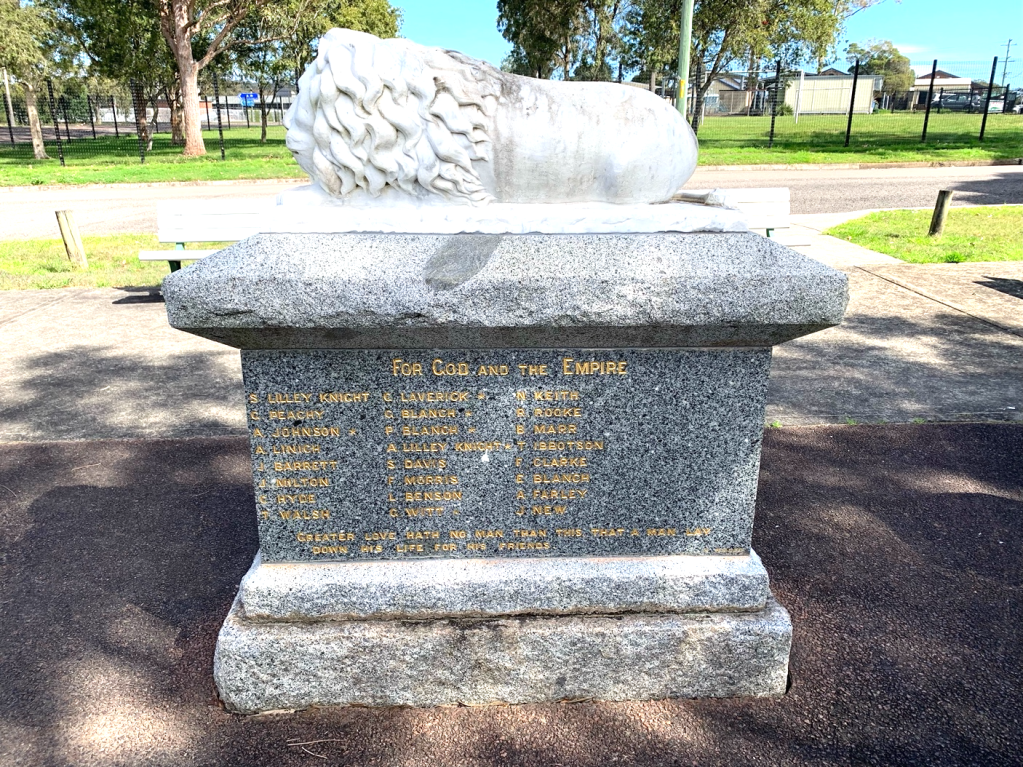
World War One Memorial at Karuah [Author photo]
Unveiling of Karuah War Memorial – 1918
The Dungog Chronicle of 24 December 1918, page 5, reported:
‘Some time ago Mrs. W. Longworth, of ”Glenroy,” took in hand the task of raising funds for the erection of an Honor Roll to perpetuate the memory of the soldiers who left that district to fight in the great war, and on Saturday last, the success of her efforts was crowned by the unveiling of a beautiful memorial, erected on the reserve overlooking the river and bay, at that charming locality.
The Roll of Honor comprises a solid block of granite, mounted on concrete foundations, and surmounted by a recumbent lion. It bore the inscription, “Erected by residents of Karuah and friends, in honour of the brave men who answered their country’s call and fought in the world’s great war, 1914-1918.” “This Roll of Honor was unveiled by Mrs Longworth, 21st December, 1918.” On the reverse side was inscribed in letters of gold, “For God and Empire. S. Lilley Knight *, G. Blanch, G. Peachy, *P. Blanch, *A. Johnson, *A. Lilley Knight, A. Linich, S. Davis, J. Barrett, F. Morris, G. Hyde, L. Benson, J. Milton, *G. Witt, T. Walsh, N. Keith, E. Blanch, R. Rooke, A. Farley, B. Marr, J. New, T. Ibbotson, *G. Laverick, F. Clarke. Greater love hath no man than that he lay down his life for his friends.” * Killed in action.
Mrs Longworth, in unveiling the Roll of Honor, in an eloquent address, paid a high tribute to the valour of the Australian soldiers, whose noble deeds would live as long as history was recorded, and she thanked the local committee and others who had laboured to have the memorial erected. Addresses were delivered by Brigadier-General Meredith, Rev. R. G. Knox, Mr J. Markey, and the Hon. Walter Bennett, M.L.A., who acted as chairman, and the large assemblage joined heartily in singing the National Anthem. Refreshments were provided by the ladies. The memorial was erected by the firm of Meldrum and Markey, Newcastle, and the hon. secretary to the movement, Miss Hagan, of Karuah. Apologies for non-attendance were received from the State Commandant, Brigadier-General Lee, the Bishop of Newcastle and others.’
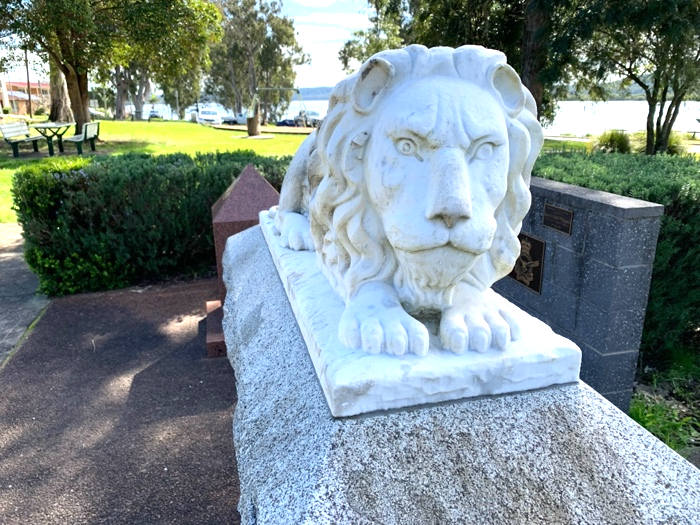
The British lion as aroused by the conflict [Author photo]
Upgrade to War Memorial – 1922
The Newcastle Morning Herald and Miners’ Advocate of 10 May 1922, page 9, reported:
‘A galvanised iron two-bar railing has been placed round the Karuah soldiers’ memorial, which in now set within a square of masonry, 20 feet by 20 feet. The memorial is one of the most attractive in the district, and is greatly admired by visitors. It is located in the area used at present as a park, the monument being surmounted by the figure of a lion recumbent, with its face set to the east.’
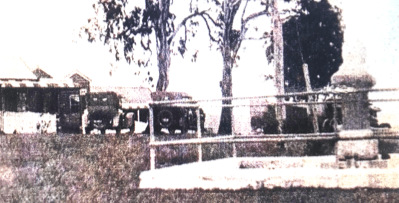
Memorial with the two-bar iron railing and old Post Office in the background.
Renovation of the War Memorial by the Progress Association – 1938
The Newcastle Morning Herald and Miners’ Advocate of 15 October 1938, page 20, reported:
‘Mr. R. D. Browne, of Hamilton, to whom a contract was let for the renovation and alteration of the Soldiers’ Memorial at Karuah, has completed the work. The base of the memorial was raised; the old kerbing being partly cut away. The new base has been built on the old one. The lettering on the honour roll has also been renewed. The owners of Helensvale colliery, Messrs. E. and T. Lewis, and Mr. A. E. Hardes, of Waratah, assisted the Progress Association, for which the contractor carried out the work.’
Proposed Relocation of the War Memorial – 1996
The News of the Area (Nota) of 8 August 1996, page 8, reported that Karuah residents were at odds over the Anzac memorial:
‘A proposal to move an Anzac cenotaph across the Pacific Highway from one park to another has sparked a row that threatens to split Karuah. A resident, Mrs Gloria Davis, said it seemed almost sacrilegious to contemplate such action, let alone carry it out. “I can’t think of any valid reason or rush to now move it,” Mrs Davis said. The names of her husband’s uncles are recorded on the roll of honour on the 78-year-old riverside monument. ‘The cenotaph’s been in Memorial Park since 1918,” she said. “The region’s original surviving Anzacs carefully inspected the whole area before finally choosing this hill location beside the present bridge which, to them, physically and symbolically represented Gallipoli.” She said the Karuah Progress Association and the Karuah Lions Club also opposed the move to Longworth Park. She also criticised the Karuah RSL Sub-branch, which is behind the move, for holding a crucial meeting to vote on the issue at 3.30 pm on July 19. Many people had not been able to attend the meeting, she said.
The president of the Karuah Lions Club, Mr Dick Cressy, said the meeting was a “kangaroo court” to rubber-stamp a decision the sub-branch had apparently already made. “The decision was bulldozed through. I had two unsuccessful tries to have a letter read out recording our opposition,” Mr Cressy said. 25-9 in favour but the president of the Karuah RSL Sub-branch, Mr Ron Anlezark, said the criticism came from a minority. He said the town meeting vote of 25 to 9 in favour of moving the monument spoke for itself and 500 leaflets had been sent out to residents urging that they attend. Mr Anlezara said it was important that all the war memorials be put together. He said Longworth Park’s World War II memorial would soon be joined by Vietnam and Korean monuments. “When the (Anzac) memorial was erected, there was no Karuah bridge, but it could now be in the path of a second (parallel) bridge and be damaged,” he said. Cr Lee Anlezard, from Port Stephens Council, said the matter would be decided by a council vote.’
The debate in the town about the fate of the memorial continued for a while but the memorial remained in its original position and no parallel bridge over the Karuah River was built.
SOLDIERS LISTED ON THE KARUAH ROLL OF HONOR
‘The AIF Project‘ of the University of NSW was utilised to obtain the following details on the Karuah soldiers listed on the Roll of Honor.
1. Name on Memorial: J. Barrett
Name on Enlistment Paper: James Barratt;
Occupation: Labourer;
Address: Cessnock;
Marital status: Single;
Age at embarkation: 36;
Next of kin: Brother, John Barratt, Cessnock;
Enlistment date: 26 February 1916;
Rank on enlistment: Private;
Unit name: 35th Battalion, 1st Reinforcement;
Embarkation details: Unit embarked from Sydney on board HMAT A24 Benalla on 1 May 1916;
Fate: Returned to Australia 12 May 1918. He died during September 1953 at Karuah.
2. Name on Memorial: L. Benson
Name on Enlistment Paper: Renard Charles Benson;
Occupation: Fisherman;
Address: Karuah;
Marital status: Single;
Age at embarkation: 29;
Next of kin: Father, Mr. Mathias Benson, Karuah;
Enlistment date: 25 August 1915;
Rank on enlistment: Private;
Unit name: 2nd Battalion, 13th Reinforcement;
Embarkation details: Unit embarked from Sydney, on board HMAT A6 Aeneas on 20 December 1915;
Fate: Returned to Australia 8 August 1919.
3. Name on Memorial: G. Blanch
Name on Enlistment Paper: George Arthur Blanch;
Occupation: Fisherman;
Address: Karuah;
Marital status: Married;
Age at embarkation: 25;
Next of kin: Wife, Mrs. Violet Jessie Blanch. Twin brother of Peter James Blanch (also listed on Memorial);
Enlistment date: 28 April 1916;
Rank on enlistment: Private;
Unit name: 36th Battalion, 6th Reinforcement;
Embarkation details: Unit embarked from Sydney on board HMAT A72 Beltana on 25 November 1916;
Fate: Killed in action 30 July 1917. No known grave.
4. Name on Memorial: P. Blanch
Name on Enlistment Paper: Peter James Blanch;
Occupation: Oysterman;
Address: Karuah;
Marital status: Single;
Age at embarkation: 25;
Next of kin: Mother, Mrs. Annie Blanch, Karuah;
Enlistment date: 9 May 1916;
Rank on enlistment: Private;
Unit name: 36th Battalion, 4th Regiment;
Embarkation details: Unit embarked from Sydney on board HMAT A30 Borda on 17 October 1916;
Fate: Died of wounds on 19 July 1917 in France. Buried at Trois-Arbres Cemetery (Plot 1, Row T, Grave No. 26), Steenwerck, France.
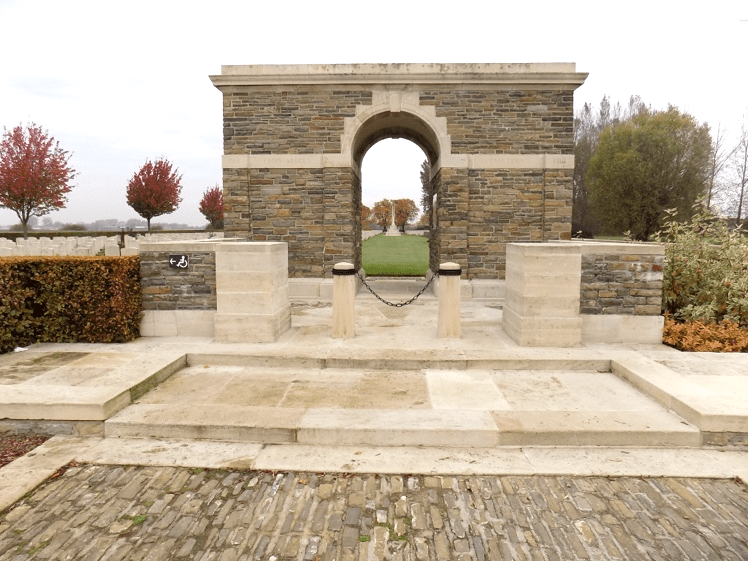
Trois Arbres Cemetery – Steenwerck, France [Commonwealth War Graves Commission]
5. Name on Memorial: E. Blanch
Name on Enlistment Paper: Ernest Blanch;
Occupation: Milk hand;
Address: George Street, Waratah;
Marital status: Single;
Age at embarkation: 23;
Next of kin: Father, A. Blanch, Swan Bay, Karuah;
Enlistment date: 11 January 1918;
Rank on enlistment: Private;
Unit name: Light Horse, February 1918 Reinforcements;
Embarkation details: Unit embarked from Sydney, on board SS Port Darwin on 30 April 1918;
Fate: Returned to Australia 13 March 1919.
6. Name on Memorial: F. Clarke
Name on Enlistment Paper: Frederick Clarke;
Occupation: Fisherman;
Address: Port Stephens;
Marital status: Single;
Age at embarkation: 21;
Next of kin: Mother, Mrs. Jane Clarke, Karuah;
Enlistment date: 31 July 1917;
Rank on enlistment: Private;
Unit name: 55th Battalion, 10th Regiment;
Embarkation details: Unit embarked from Sydney on board HMAT A14 Euripides on 31 October 1917;
Fate: Returned to Australia 16 March 1919.
7. Name on Memorial: S. Davis
Name on Enlistment Paper: George Stanley Davis;
Occupation: Farmer;
Address: Karuah;
Marital status: Single;
Age at embarkation: 24;
Next of kin: Father, George Davis, Karuah;
Enlistment date: 14 March 1916;
Rank on enlistment: Private;
Unit name: 36th Battalion, D Company;
Embarkation details: Unit embarked from Sydney on board HMAT A72 Beltana on 13 May 1916;
Fate: Returned to Australia 16 March 1919.
8. Name on Memorial: A. Farley
Name on Enlistment Paper: Archibald Leslie Farley;
Occupation: Farmer;
Address: Gloucester;
Marital status: Single;
Age at embarkation: 24;
Next of kin: Father, Edward James Farley, Gloucester;
Enlistment date: 10 August 1915;
Rank on enlistment: Private;
Unit name: 6th Light horse Regiment, 11th Reinforcement;
Embarkation details: Unit embarked from Sydney on board HMAT A14 Euripides on 2 November 1915;
Fate: Returned to Australia 3 July 1919.
9. Name on Memorial: C. Hyde
Name on Enlistment Paper: Charles Henry Hyde;
Occupation: Hotel employee;
Address: Toronto;
Marital status: Single;
Age at embarkation: 22;
Next of kin: Father, George Thomas Hyde, Salt Ash;
Enlistment date: 6 April 1916;
Rank on enlistment: Private;
Unit name: 34th Battalion, 3rd Reinforcement;
Embarkation details: Unit embarked from Sydney on board HMAT A68 Anchises on 24 August 1916. Disembarked at Devonport, 11 October 1916. Proceeded to France, 21 November 1916;
Fate: Returned to Australia 15 September 1918.
Other details: Wounded in action (first occasion), 8 March 1917 (gunshot wound, right cheek). Wounded in action (second occasion), 19 March 1817 (multiple gunshot wounds, head and side). Transferred to England, 26 March 1917, and admitted to Tankerton Hospital, 26 March 1917. Transferred to 3rd Auxiliary Hospital, 14 May 1917. Granted furlough, 21 May – 5 June 1917, to report to Training Battalion, Perham Downs. Proceeded overseas to France, 16 July 1917; re-joined unit, 21 August 1917. Wounded in action (third occasion), 8 May 1918 (gunshot would, right leg). Transferred to England, 12 May 1918, and admitted to Central Military Hospital, Winchester. Transferred to 1st Auxiliary Hospital, Harefild, 28 June 1918; to No. 3 Command Depot, Hurdcott, 1 July 1918; to No. 1 Command Depot, Weymouth, 26 August 1918. Commenced return to Australia, 15 September 1918; disembarked Melbourne, 17 November 1918; discharged, 3 December 1918. Died 1 September 1980.
10. Name on Memorial: T. Ibbotson
Name on Enlistment Paper: Thomas John Ibbotson;
Occupation: Painter;
Address: Karuah;
Marital status: Single;
Age at embarkation: 29;
Next of kin: Brother, Francis Charles Ibbotson, Karuah;
Enlistment date: 16 August 1916;
Rank on enlistment: Private;
Unit name:36th Battalion, 5th Reinforcement;
Embarkation details: Unit embarked from Sydney on board HMAT A24 Benalla on 9 November 1916;
Fate: Returned to Australia 12 June 1919.
11. Name on Memorial: A. Johnson
Name on Enlistment Paper: Albert Victor Johnson;
Occupation: Motor Driver;
Address: Karuah;
Marital status: Single;
Age at embarkation: 25;
Next of kin: Father, J. O. Johnson, Karuah;
Enlistment date: 8 December 1915;
Rank on enlistment: Private;
Unit name: 45th Battalion;
Embarkation details: Unit embarked from Sydney on board HMAT A71 Nestor on 9 April 1916;
Fate: Killed in Action 23 February 1917 at Guedecourt, near Bapaume, France. No known grave.
12. Name on Memorial: N. Keith
Name on Enlistment Paper: Neil Keith;
Occupation: Grocer;
Address: McDonald Road, Lakemba;
Marital status: Single;
Age at embarkation: 29;
Next of kin: Mother, Mrs. Maggie Keith, Karuah;
Enlistment date:5 March 1916;
Rank on enlistment: Private;
Unit name: 18th Battalion, 14th Regiment;
Embarkation details: Unit embarked from Sydney on board HMAT A18 Wiltshire on 22 August 1916;
Fate: Returned to Australia 27 July 1917.
13. Name on Memorial: S. Lilley Knight
Name on Enlistment Paper: [Sid] Lilley Knight;
Occupation: Oysterman;
Address: Karuah;
Marital status: Single;
Age at embarkation: 25;
Next of kin: Aunt, Mrs. E. McLean, Rockdale;
Enlistment date: 30 July 1915;
Rank on enlistment: Private;
Unit name: 13th Battalion, 14 Reinforcement;
Embarkation details: Unit embarked from Sydney on board HMAT A70 Ballarat on 16 December 1916;
Fate: Returned to Sydney 16 January 1919
14. Name on Memorial: A. Lilley Knight
Name on Enlistment Paper: Albert Lilly Knight;
Occupation: Fisherman;
Address: Swan Bay, Port Stephens;
Marital status: Single;
Age at embarkation: 18;
Next of kin: Brother, Herb Lilly Knight, Swan Bay, Port Stephens. Parents: Samuel William and Jane Knight; brother of Herbert Lilley Knight, Karuah;
Enlistment date: 8 February 1916;
Rank on enlistment: Private;
Unit name: 35th Battalion, 1st Reinforcement
Embarkation details: Unit embarked from Sydney on board HMAT A24 Benalla on 1 May 1916;
Fate: Killed in Action 27 April 1918. Buried at Daours Communal Cemetery Extension (Plot 111, Row B, Grave No. 27), France.
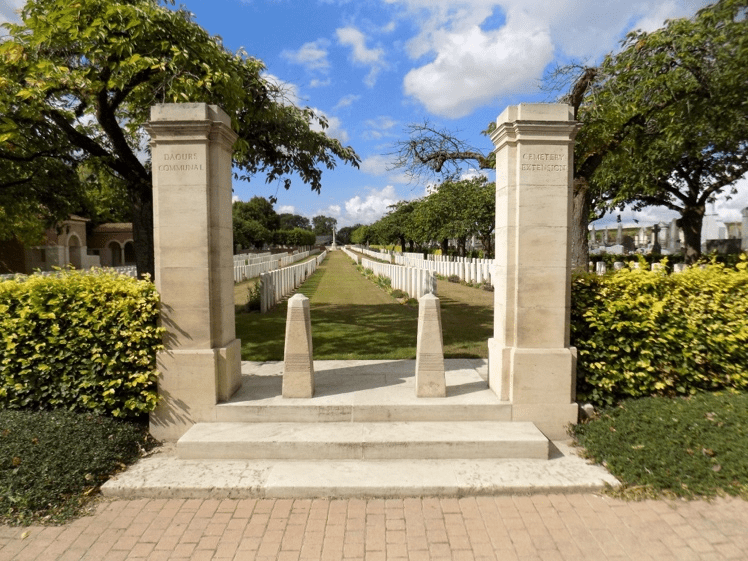
Daours Communal Cemetery, Extension, France [Commonwealth War Graves Commission]
15. Name on Memorial: G. Laverick
Name on Enlistment Paper: George James Laverick;
Occupation: School teacher;
Address: Brown Street, West Wallsend;
Marital status: Married;
Age at embarkation: 24;
Next of kin: Wife, Mrs. Annie Laverick, West Wallsend. Parents: Thomas and Catherine Laverick;
Enlistment date: 11 January 1916;
Embarkation details: unit embarked from Sydney on board HMAT A20 Hororata on 2 May 1916;
Fate: Killed in Action. Buried at Strand Military Cemetery (Plot VIII, Row C, Grave No. 4), Ploegsteert, Belgium.
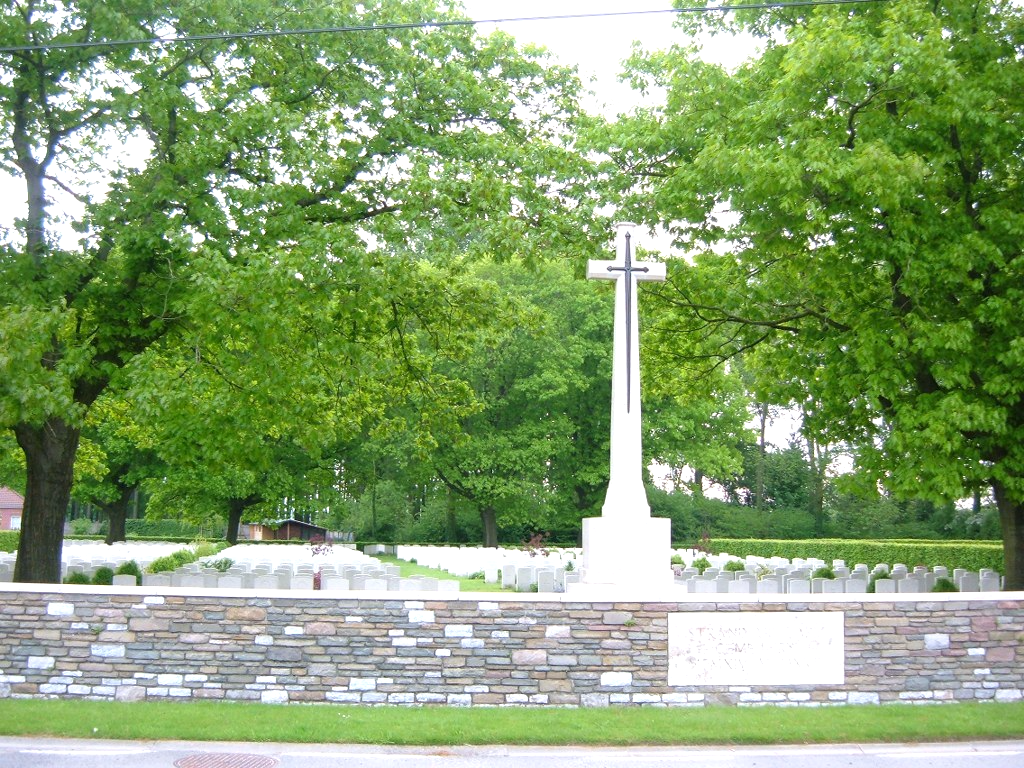
Strand Military Cemetery, Belgium [Commonwealth War Graves Commission]
16. Name on Memorial: A. Linich
Name on Enlistment Paper: Albert William Linich;
Address: Karuah;
Marital status: Single;
Age at embarkation: 20;
Next of kin: Father, Charles Linich, Karuah;
Enlistment date: 23 March 1916;
Rank on enlistment: Private;
Unit name: 34th Battalion, 2nd Reinforcement;
Embarkation details: Unit embarked from Sydney on board HMAT A15 Port Sydney on 4 September 1916.
17. Name on Memorial: B. Marr
Name on Enlistment Paper: Harold Maher;
Occupation: Labourer;
Address: Karuah;
Marital status: Single;
Age at embarkation: 22;
Next of kin: Brother, B. Maher, Port Stephens;
Enlistment date: 6 December 1916;
Rank on enlistment: Private;
Unit name: 20th Battalion, 19th Reinforcement;
Embarkation details: Unit embarked from Sydney on board HMAT A68 Anchises on 24 January 1917;
Fate: Returned to Australia 19 February 1919.
18. Name on Memorial: J. Milton
Name on Enlistment Paper: John Edward Milligan (see separate section on this soldier);
Occupation: Labourer;
Address: Wyong;
Marital status: Married;
Age at embarkation: 36;
Next of kin: Wife, Mrs. E. Milligan, Commonwealth Street, Surry Hills;
Enlistment date: 12 October 1915;
Rank on enlistment: Private;
Unit name: 2nd Battalion, 14th Reinforcement;
Embarkation details: Unit embarked from Sydney on board RMS Osterley on 15 January 1916;
Fate: Returned to Australia 26 September 1917.
19. Name on Memorial: F. Morris
Name on Enlistment Paper: Frederick Morris;
Occupation: Fisherman;
Address: Karuah;
Marital status: Single;
Age at embarkation: 21;
Next of kin: Mother, Mrs. L. Morris, Port Stephens;
Enlistment date: 8 February 1916;
Rank on enlistment: Private;
Unit name: 35th Battalion, 1st Reinforcement;
Embarkation details: Unit embarked from Sydney on board HMAT A24 Benalla on 1 May 1916;
Fate: Returned to Australia 15 January 1919
20. Name on Memorial: J. New
Name on Enlistment Paper: James Edward New;
Occupation: Steel smelter;
Address: Fawcett Street, Mayfield;
Marital status: Single;
Age at embarkation: 24;
Next of kin: Father, James New, 71 Taylor Street, South Shields, England;
Enlistment date: 28 November 1915;
Rank on enlistment: Private;
Unit name: 35th Battalion, D Company;
Embarkation details: Unit embarked from Sydney on board HMAT Benalla on 1 May 1916;
Fate: Effective abroad (still overseas).
21. Name on Memorial: G. Peachy
Name on Enlistment Paper: George Arley Peachey;
Occupation: Farm labourer;
Address: Karuah;
Marital status: Single;
Age at embarkation: 24;
Next of kin: Father, P. Peachey, Karuah;
Enlistment date:15 December 1915;
Rank on enlistment: Private;
Unit name: 19th Battalion, 11tth Regiment;
Embarkation details: Unit embarked from Sydney on board HMAT A71 Nestor on 9 April 1916;
Fate: Returned to Australia 9 July 1919.
22. Name on Memorial: R. Rooke
Name on Enlistment Paper: Leonard Royal Rooke;
Occupation: Oysterman;
Address: Anna Bay;
Marital status: Single;
Age at embarkation: 20;
Next of kin: Father, John Henry Rooke, Anna Bay;
Enlistment date: 11 April 1916;
Rank on enlistment: Private;
Unit name: 34th Battalion, 3rd reinforcement;
Embarkation details: Unit embarked from Sydney on board HMAT A68 Anchises on 24 August 1916;
Fate: Returned to Australia 11 May 1919. Died 28 September 1963.
23. Name on Memorial: T. Walsh
Name on Enlistment Paper: Thomas Augustine Walsh;
Occupation: Oyster lessee;
Address: Karuah;
Marital status: Married;
Age at embarkation: 35;
Next of kin: Wife, Mrs. Evelyn Amelia Walsh, Karuah;
Enlistment date: 22 March 1916;
Rank on enlistment: Private;
Unit name: 34th Battalion, 3rd Regiment;
Embarkation details: Unit embarked from Sydney on board HMAT A68 Anchises on 24 August 1916;
Fate: Returned to Australia 11 May 1919.
24. Name on Memorial: G. Witt
Name on Enlistment Paper: George William Witt;
Occupation: Labourer;
Address: Gloucester;
Marital status: Married;
Age at embarkation: 29;
Next of kin: Wife: Mrs Bertha Olive Witt, Gloucester; Parents: William and Elizabeth Witt;
Enlistment date: 12 May 1916;
Rank on enlistment: Private;
Unit name: 36th Battalion, 4th Reinforcement;
Embarkation details: Unit embarked;
Fate: Died of wounds, 11 September 1918. Buried at Daours Communal Military Cemetery Extension 9, Plot IV, Row E, Grave No. 26), France.
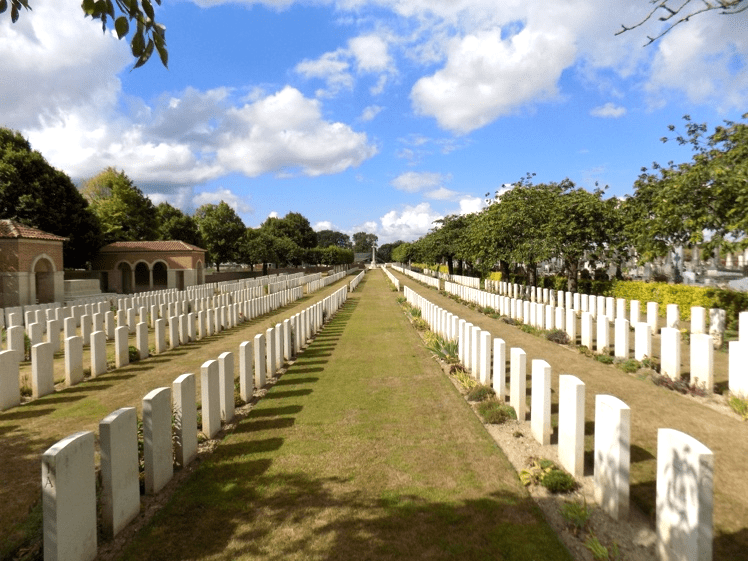
Daours Communal Cemetery, Extension, France [Commonwealth War Graves Commission]
Case of Jack Milton
Jack Milton, who was an aborigine, is listed on the honour roll but his name does not appear in the Military enlistment records. Many references to Jack Milton appear in newspaper articles of the time about him residing at Karuah, and of his military enlistment.
The following letter from Jack Milton published in the Raymond Terrace Examiner and Lower Hunter and Port Stephens Advertiser of 23 March 1923, page 3, gives an insight into his life experiences and beliefs:
‘Sir. — Being a half-cast myself, and a returned soldier, living on a suburban holding at Karuah, I protest very strongly to a letter in the Raymond Terrace “Examiner” concerning the coloured people of Karuah, Port Stephens. I have been a resident here at Karuah for the last 25 years, and not at any time have I witnessed male or female, that have been attacked by any of the coloured people on the settlement and there are no whites that get water from the dam. The person who wrote that letter is a slanderer and back-biter, and one of a few people that has tried every device in their power to down the coloured people.
The person that attacks the coloured people so viciously should stand out in the open, and give a fair fight, and not fight behind a tree. There are a few parasites and bloodsuckers living on the coloured people, that they could well do without, and all the hen picking and haggling that is going on is done by public paid servants. Those who trouble over a few coloured people that are living on a holding alongside the Reserve, are certain persons who have no jurisdiction over them, and as for the writer of that letter knowing a lot about the blacks in their wild state, out in Queensland he must be a stranger here for I never thought anyone about here had been 15 miles passed Raymond Terrace.
The writer referred to the police. Each family of coloured people living on the blocks outside the Reserve are law abiding, and if all the writers, slanderers, and backbiters paid as much attention to their work as the police do, we would not have much to complain about. It is very funny that story about the white girls being attacked by coloured people and making out that the police are not doing their duty. That attack on the coloured people was most cowardly. If there was any truth about it, but there is not. The matter won’t end here for I intend to write to the Minister for Home and Territories and have an inquiry into the whole matter—for I don’t see why the coloured people should he persecuted, for out of this little settlement of collared people here about 40 all told, 5 or 6 went to the war and I think there is a law under the British flag for us. JACK MILTON.’
The identity of Jack Milton was solved during 2020 by a researcher, Benita Parker. On the website, Indigenous Histories, the identity of Jack Milton is proved to be John Edward Milligan. The full justification for the identification is set out therein.
Concluding Comments
As the soldiers from Karuah went to Europe to fight for ‘King and Empire’ it is fitting that the town be commemorated on the Australian War Memorial in London. The Memorial commemorates the service men and women who served in the First World War and Second World War by listing the names of the towns in which they were born.
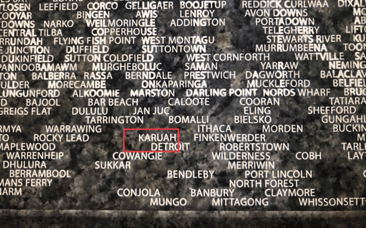
The name of Karuah as displayed on the Australian War Memorial in London.
Information on the First World War Memorials at Nelson Bay is also found on this website at the this link.
Researched and compiled by Kevin McGuinness
August 2022

 Port Stephens - a history exploration