
Introduction
In the early years of twentieth century, prior to the construction of the Pacific Highway along the route serving the mid-north coast of New South Wales, travel to the various coastal destinations, such as Forster was a sea journey.
The North Coast railway line from Sydney to Brisbane opened in stages from 1905 to 1930, but it was an inland route to Gloucester and thence to Taree and further north. Roads did not connect the railway route to all the coastal towns.
The age of tourism to the mid north coastal region had not arrived. That all changed in October 1907, when the New South Wales Government Tourist Bureau launched a new travel route between Newcastle and the mid-north coast, via Port Stephens and the Myall Lakes.
It was known as the Lakes Travel Route. Forster was one of the primary destinations.
The new route basically promoted a five-stage travel itinerary for the following forward and reverse passenger journeys:
- Travel to Newcastle and then a ferry to Stockton;
- Coach travel to Salt Ash connecting with a steamer to Port Stephens, stopping at Tea Gardens;
- Travel by launch from Tea Gardens up the Myall River and Myall Lakes to Bungwahl;
- Coach travel from Bungwahl to Wallis Lake;
- Travel by launch up Wallis Lake to Forster; and then on to Tuncurry and Taree by coach.
There were various combinations thereof offered by four main tourist operators, viz Mr Charles Bowers (Forster), Mr Jas. Goodwin (Bungwahl), Messrs. Thurlow and Co. (Tea Gardens) and Mr Matthewson (Stockton).
Apart from tourism, the Lakes route was also used for personal and commercial travel, by those that did not wish to travel by sea because of the dangers present or due to fears of seasickness. Prior to the launch of the new route, patronage was infrequent and passengers had to make their own arrangements along the way.
The tourist route proved popular for seven years. However, the poor condition of the road between Wallis Lake and Bungwahl was the worst part of the trip and would contribute to the eventual demise of the route for tourism.
The Lakes Route was scenic and safe and provided a wonderful adventure for tourists. Several travel writers published stories of their experiences of the route.
While these tended to be long, they described in detail the terrain and settlements along the route and gave an insight into what tourists could expect to see and experience during their trip.
Lakes Travel Route
The following featured travel articles, in chronological order, from various newspapers of the day tell the story of the Lakes Travel Route:
(1) Wingham to Sydney: Wingham Chronicle and Manning River Observer – 26 October 1907, page 5.
“As a number of our readers have heard about the new route to the metropolis via the beautiful Wallis, Smith, and Myall Lakes, a short resume of the way and mean’s of getting there will no doubt be of interest to those who intend to take this trip. First of all we might say that the whole of the journey by boat is in smooth water, and passes through some of the most beautiful scenery one could imagine.
We left Wingham on Sunday morning at 8 a.m., and arrived at Tuncurry about noon, where host Bower’s, of the Forster Hotel, had a boat waiting to convey us across to Forster in time to have dinner. At 2 p.m. a start was made from Bowers’ wharf in a smart little oil launch. After a run of about 18 miles through the beautiful Wallis Lakes, which are teeming with fish and wild fowl of every description, we landed on the upper side of the lake. The fare is 4/- for this portion of the trip. Here Mr. J. A. Godwin was waiting with a splendid coach and spanking team of horses, to drive us across to Smith’s Lake, around the shores of which we sped for a distance of about seven miles, when we halted at the residence of Mr. Godwin to partake of tea, which was served in A1 style.
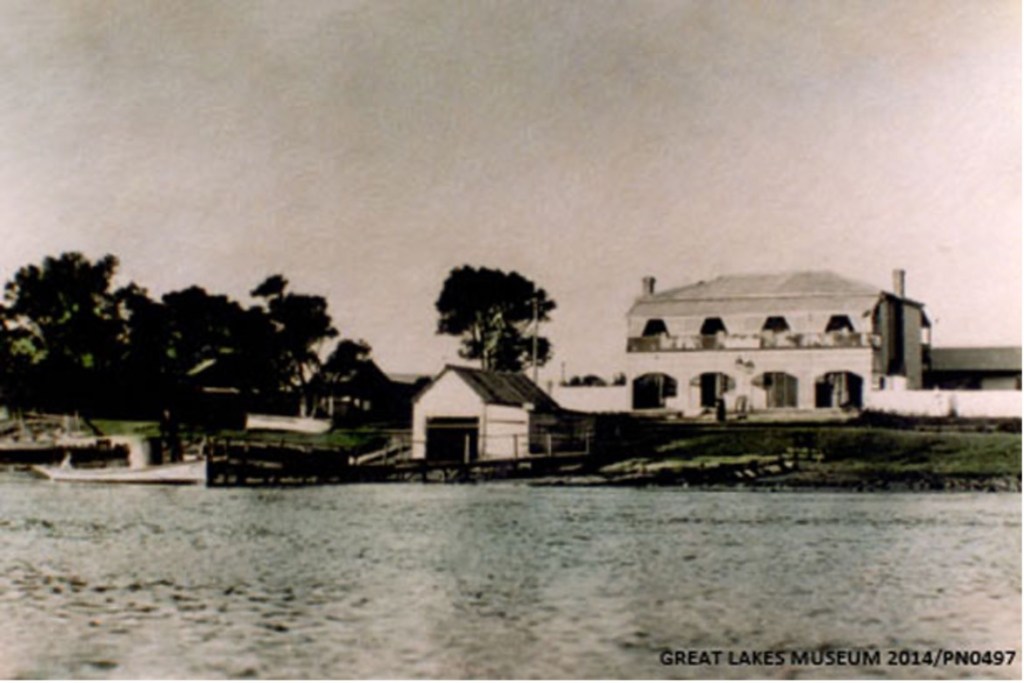
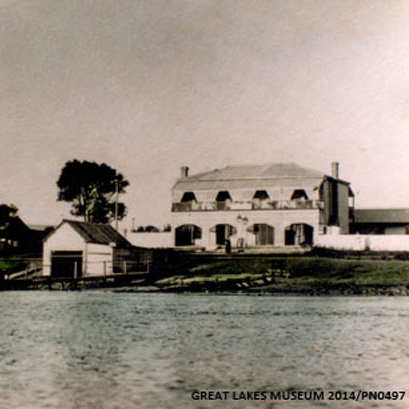
Forster Hotel with wharf in front. [Great Lakes Museum]
After a spell of a couple of hours we proceeded to Bungwahl, a distance of about, one mile. The coach fare is 4/-. …. Messrs. Thurlow and Co. were waiting at the wharf with their smart little steamer Reliance, which is provided with a cabin on the upper deck for ladies, containing about eight berths, and one on the lower deck for gentlemen. As the boat did not start from Bungwahl until 1a.m., we turned in for a few hours. On coming on deck again we found ourselves proceeding through the Myall Lakes, which were alive with wild ducks, swans, and other water fowl. Several stoppages are made on the trip to take on board fish and other produce.
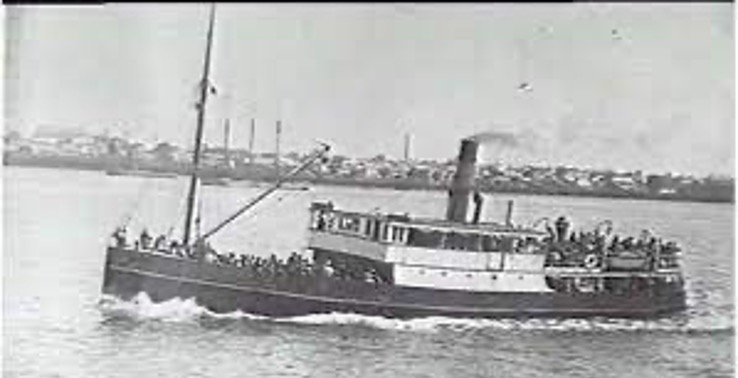
s.s. Reliance owned by Thurlow and Company
We arrived at the Tea Gardens, a distance of about 30 miles, in time for breakfast, which was partaken of at the Port Stephens Hotel, a fine new two-storey building kept in an up-to-date style by Mr. B. J. Doherty.
We then proceeded to Nelson’s Bay, where the steamer Hawke lay at anchor, surrounded by some half-dozen small steamers and launches, and transferred our cargo of fish, etc. … We then proceeded through vast stretches of land-locked water, and arrived at Salt Ash about 2 p.m. The charge for this long steamer trip is only 4/6. We then transferred to a splendid four-in-hand drag [carriage], capable of carrying about 20 passengers with their luggage, which bowls us along one of the most level roads in the State to Stockton ferry, a distance of about 11 miles, arriving at 4p.m., giving those going to Sydney about two hours in Newcastle before the train leaves. The coach fare from Salt Ash to Stockton is 4/-, or a total cost of 16/6 from Forster.
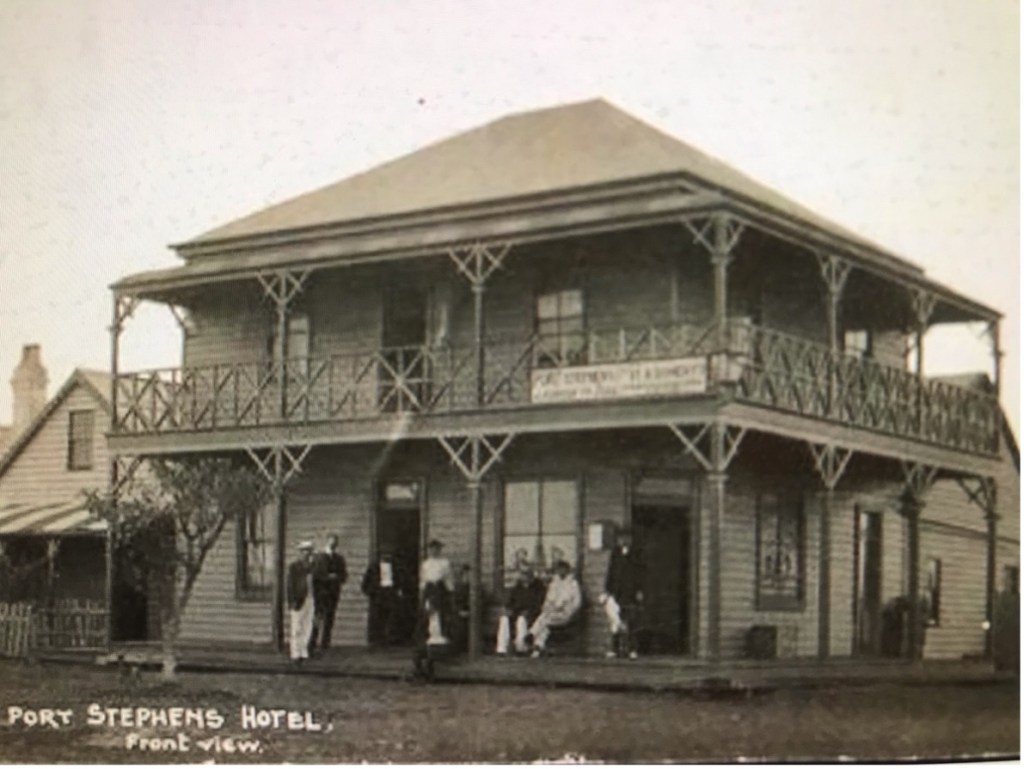
Port Stephens Hotel – Tea Gardens, 1908.
(2) Forster to Sydney: Wingham Chronicle and Manning River – 9 November 1907 pg 3.
“Which of us, and especially,….. has not exclaimed with the scriptural authority “woe is me,” when the necessity arises for taking a trip to or from the Manning via steamboat. The uncertainty of departure, of the weather outside ……. But now as “The Lakes” trip has been opened up and made available all that is changed. The journey is a delight instead of a nightmare, and — which is a great con-sideration—very little difference in price. When I took the trip a week or so ago, host Bowers of Forster had not got his launch completed wherewith to negotiate the Wallis Lake, the first section of the journey, and a hired boat was requisitioned, but since then I expect the new outfit is going strong.
The launch leaves Forster at 2.30 p m., and in about half-an-hour the Wallis lake is entered, and from thence till the journey’s end the scene is an ever changing panorama of beauty. As the boat glides silently over the face of the waters where blue or cloud, sun or stars are reflected in the limpid depths, the quiet impressiveness enwraps ones mind in its peaceful thrall. Passed in turn are sharp treeless spurs outlined against the sky, rounded headlands clothed in spring’s green mantle, and dense scrub, the home of the staghorn and orchid, and we slip by in a silence which is only broken by the plaint of wild bird, or the splash of a leaping fish.
Arrived at the head of Wallis Lake a coach met us, and we were driven for eight miles among a scene of the finest description. On one side the road wound alongside the Smith Lake— famous for such phenomenal hauls of fish — and on the other hand virgin forest rising in gentle undulation till lost in the great green silence. The drive through the clear invigorating air leaves one very glad to fall upon the excellent tea which awaits the passengers of the coach, at the accommodation house at the entrance of the Myall Lakes, and from thence after another drive of a mile or so, the launch which completes the journey to Salt Ash is met. Sleeping accommodation is provided, but to stay on deck and admire the scenery on either side if moonlight is worth the vigil.
The Wallis Lake is beautiful! The Smith lake is beautiful! but the Myall Lakes are the most beautiful of all. They alone are worth the journey to see. After leaving the Lakes we entered the Myall River, a narrow tortuous stream of surprisingly clear water, and at about 8 a.m. Tea Gardens is reached in time for breakfast. …..
After breakfast we boarded the launch again and crossed Nelson’s Bay and entered a creek of most unpronounceable name [Tilligerry Creek] to where at Salt Ash a coach waited to take us to Stockton, where we took the train for the city. The journey had been a most enjoyable one, and had not occupied much more time than going by boat.
Leaving Forster at 2.30 p.m. on, say Wednesday, the traveller is able to catch the afternoon train on the following day from Newcastle to Sydney. Mr. Bowers of Forster leaves nothing, undone which will ensure the comfort of passengers taking this route, which, it is safe to say, has a tremendous future before it. At present the Myall Lakes are crossed at night, but shortly arrangements are to be made by which the entire trip will be taken by daylight. When this has been arranged for, then the journey will be a little bit of heaven stolen from the hereafter.”
(3) Taree to Newcastle: Manning River Times and Advocate -7 December 1907, page 3.
“Public interest having at last been awakened concerning the beauties and the future possibilities of what is known as the lake route from the Manning to Newcastle, the impressions of one who has recently traversed the route both ways may be of interest ….
To give an idea of the extent of the lake country (up till recently almost unknown by the majority of residents in this district, at least) it may be stated that with the exception of an 8-mile coach drive, passengers are conveyed by oil launch and steamer from Forster to within 16 miles of Newcastle — a smooth water trip of about 80 miles. It remained for four enterprising men in the persons, of Mr. C. Bowers (Forster), Mr. Jas. Goodwin (Bungwahl), Messrs. Thurlow and Co. (Tea Gardens), and Mr. Matthewson (Stockton), to open up the route for passenger traffic, and although only a few months have elapsed since the project was initiated, the preliminary difficulties have been, overcome, and a fairly accurate timetable may now be relied upon.
The trip is divided into five easy stages, which prevent any possibility of that tiresome monotony inseparable from long coach or steamer journeys, and when the traveller reaches his destination, he is not fatigued. At present a good deal of time is spent in the handling of cargo on the Myall Lakes and at Port Stephens, but we believe the time is not far distant when a solely passenger service will be inaugurated, which will mean a saving of some hours on the journey.
The First Stage. — Leaving Taree at 8.30 a.m. on. Wednesday (another trip is also ran at the same hour on Sunday) in Mr. Hancock’s comfortable coach, Tuncurry— a distance of 21 miles— is reached about noon, after an interesting drive, the road running for some miles along the bank of the Wallamba River. A launch is in waiting, and the passengers are conveyed across the harbour to Forster, where an excellent lunch is partaken of at the Forster Hotel, and thus the first stage of the journey is completed. The fare by coach from Taree to Forster is 7s 6d.
The Second Stage. — After resting for an hour or two at Forster, an oil launch leaves the hotel wharf about 2.30 p.m. for the 15 mile ran up Wallis Lake. So far Mr. W. Belton’s speedy little launch Orita has been carrying the passengers, with every satisfaction. ……The 15 miles from Forster to the head of the lake, where the coach is boarded for Bungwahl, are covered in slightly under two hours, and the scenery is very pretty, particularly when the wide expanse of water opens out to view shortly after leaving Forster. Wallis Lake is famed as a fishing resort, whilst a small island in the centre is the home of pelicans and black swans— hundreds of the latter floating gracefully on the water at no great distance from the launch. A waiting shed and jetty in Charlotte Creek, at the head of the lake, are conveniences which will shortly be provided. The fare for this portion of the journey is 4/-.
The Third Stage. — The Bungwahl – Forster road runs within a few yards of the spot where passengers are landed by the launch, and Mr. Jim Godwin’s coach and staunch pair of horses are in readiness for the 8-mile drive to Bungwahl. The coach will accommodate 8 passengers, and when necessary extra buggies and sulkies are employed. The drive, as far as scenery is concerned, is most delightful — the road following tar the greater part of the distance the shore of Smith’s Lake, studded with prettily wooded islets, whilst at one point a glimpse of the ocean is obtained between two hills. This lake is separated from the sea by a narrow neck of sand, and literally teams with fish of all descriptions, as many as 800 baskets having a few years ago been netted in one haul. When the writer passed through recently, 100 baskets were penned up by one of the fishermen, and were being used as required. In times of heavy rain the fishermen dig a small channel through the sand bar, and the lake opens out to the sea, but only remains open for a short period. At night time the light from Seal Rocks lighthouse flashing up over the hills affords a pretty sight.
On the way to Bungwahl a halt is made at Mr. J. Godwin’s pleasantly situated accommodation house on the shore of the lake, where a first-class table is kept, and where everything possible is done by Mr. and Mrs. Godwin to make the visitor comfortable until the boat leaves. It may be mentioned that Mr. Godwin was born on the spot where he now resides, and having spent 36 years there, knows every inch of the roads, by night or day. In view of the increasing traffic on this road, however, which is the connecting link between Wallis and Myall Lakes, the Shire Council (Stroud) should give it that attention to which it is now entitled, and carry out some necessary improvements thereon.
The Tourist Department was so impressed with the secluded beauty of Smith Lake, and its fishing and shooting facilities, that Mr. Godwin was requested to build and furnish two cottages there, and a guarantee would be given that the cottage would be occupied six months out of the twelve. It is a capital place for a quiet holiday. After tea, and supper later on, passengers are driven to the Bungwahl wharf, a distance of two miles, and the steamer boarded for the long trip of 70 miles through the Myall Lakes. The coach fare from Wallis Lake to Bungwahl is 4/-.
The Fourth Stage. — The s.s. Reliance— a new steamer of 22 tons, built at The Branch, Karuah River, by Messrs. G. A. Radcliffe & Son, and launched in November, last year— leaves Bungwahl, a small and picturesquely situated village at the head of Myall Lake, about 10’clock on Thursday morning. … The steamer is nicely fitted up with sleeping accommodation for about a dozen or sixteen passengers, no discomfort is felt— the only disadvantage being that before daylight some of the finest scenery on the route is passed through; so that to get an adequate idea of the beauty of the lakes, it is advisable to return from Sydney by the same route, when the passenger is favoured with daylight all the way. The Reliance is a trim, speedy little craft, owned by Messrs. Thurlow & Co. (Messrs. Thurlow and Flannigan), who have spent many years on these waters, and guide their vessel with unerring accuracy through what appears to the landsman to be a labyrinth of lakes, rivers, and bays.
Here and there the steamer enters a prettily wooded arm — a warning blast from the whistle having previously given notice of her approach — a boat shoots out from the shore, a cream can is lowered or taken on board, and away the Reliance goes on her course. At Naranie and other small settlements on the shore of the lake fish are taken on board in large cases — the principal centre bring Tamboi, at the entrance to the Lower Myall River, which is reached about daylight on Thursday morning, after traversing the Myall Lakes and Upper and Lower Boolambayte. For about 18 miles the steamer now passes through a narrow, clear, and shallow stream, mangrove-lined — sharp turns abounding, whilst huge cabbage palms, staghorns and wild flowers grow in profusion along the banks.
Practically no settlement is met with along the river until Tea Gardens is in sight, when on the right hand appears a roomy and comfortable looking brick residence formerly occupied by Mr. J. K. Mackay, and now by a Mr. Brown. Tea Gardens, where a halt is made for breakfast, is a small township boasting, of two hotels (Mr. B. J. Doherty’s new two-storey building, opposite the wharf, being well-appointed in every respect, and the charges very moderate), a post and telephone office, police station, public school, several small stores, a hall, and a few residences. Tea Gardens is a busy little centre, and it is destined, on account of it bring the centre of a large fishing and timber industry, to grow in importance. …. After a stay of about on hour at Tea Gardens for breakfast, the Reliance takes her departure for Salt Ash.
A narrow channel is negotiated for a mile or two, and then the magnificent harbour of Port Stephens opens out to view, with its noble stretch of water extending for many miles. At one spot, known as the Duckhole, the Hawk and Storm King were loading for Newcastle; a large timber boat, the Queen Bee, passed, steaming up the harbour; two sailing vessels were at anchor, awaiting cargoes of timber; Whilst away in one of the distant arms could be discerned H.H.S. Dart. To the eastward the picturesque headlands forming the entrance— Yacaba, 820ft. high, and Tomaree, 440 feet — stand out prominently, …. Steaming across the entrance, Nelson’s Bay wharf is called at, and later on the small settlements of Carrington, Tanilba, and Tahlee are passed, also a number of pretty islands. ….Up the latter creek the steamer winds a sinuous course, until Salt Ash, a small settlement 15 miles from Stockton, ia reached abont 2 p.m., where Mr. Matthewson’s four-horse coach is in waiting. The fourth stage of the journey, from Bungwahl to Saltash— about 70 miles— costs 7s.
The Fifth Stage. — After partaking of a light lunch, for which the modest sum of 9d is charged, passengers are now off once again on the 15 mile drive to Stockton. The coach is licensed to carry 20 persons, and is most comfortable to ride in — the road being level for the main part, and very good, whilst the scenery is interesting. Well-kept dairy farms are on either hand, with neat and nicely painted cottages- The villages of Williamtown and Fullerton Grove are left behind, also the well-known Fern Bay Recreation-Ground, and the long line of ships’ masts at Stockton appears in sight. The coach drives up to the ferry wharf, a fare of 3/6 is paid to the genial driver, and for the small sum of 2d the visitor is taken by the ferry steamer across the harbour to Newcastle, which is reached about 4 p.m., thus allowing ample time to catch the 6 o’clock train for Sydney.
The trip throughout is most enjoyable— occupying very little longer than by the ordinary steamer or coach route — and those who undertake it cannot fail, to be impressed with the great beauty of the scenery.”
(4) Newcastle to Taree with an overland component: Daily Telegraph – 14 October 1908, page 12.
“Those who took part in the tourist trip recently organised by the Government Tourist Bureau through the Lakes district to the Manning River, returned to Sydney on Saturday last, after a splendid week’s programme. The route lay through Newcastle, to which place they travelled by rail, and after crossing in the ferry to Stockton, the party were driven over 15 miles along a beautiful route to Salt Ash, at the head of Tilligerry Creek, Port Stephens. An up-to-date steamer met the party there, and conveyed them via Tilligerry Creek to Port Stephens, visiting Nelson’s Bay en route, and landing at Tea Gardens for the night. Next morning the launch Myall, a fast oil launch, until recently seen in Sydney Harbor, conveyed them via the Lower Myall, Broadwater, and Upper Myall Rivers to Bullahdelah, through banks lined with palms, staghorns, elkhorns, and other native flora.
In the afternoon the party climbed the Alum Mountain. On the Monday morning vehicles were secured, and the overland trip from Bullahdelah to Taree commenced. Taree was reached about 6 o’clock. The whole of the next day was devoted to a launch trip on the Manning River. ….. On the Wednesday the party packed their traps again, and were driven 21 miles along a bush road, the greater portion of the distance towards Tuncurry. At Tuncurry an afternoon’s fishing was indulged in. Next day the launch was again taken from Tuncurry via Wallamba River and Wallis Lake to Wallis Creek, at the head of the lake, where the coach proprietor from Bungwahl met the party and conveyed them along the edge of Smith’s Lake to Bungwahl. A change of conveyance occurred here, the party being taken in another launch via the Great Myall Lake, Upper and Lower Booloombayt, Broadwater, and Myall Rivers, back to Tea Gardens, and the following day they returned by the same route to Newcastle and Sydney. The weather during the whole of the trip was most delightful…… Recently an arrangement has been made, at the instance of the Tourist Bureau, with the Railway Commissioners and the launch proprietors, to issue a combination ticket from Sydney through to Taree and return, which may be obtained at Sydney or Maitland.”
(5) Taree to Newcastle: Macleay Argus – 6 November 1909, page 9.
“Started from Taree punctually at 5 p.m. on Thursday, 21st October, self being the only passenger. Mr. W. Sloman provides a neat turnout—buggy and pair of black ponies— the smallest ones I have ever sat behind, and the way those dwarf quadrupeds got through the twenty one mile drive to Tuncurry was a treat to see. The trip was accomplished in three hours, easily. Bowers’ motor launch was waiting with other passengers, and immediately my dunnage was on board we made tracks for Forster, where we arrived in due course and did full justice to a good tea which was awaiting our arrival. After tea, a pleasant chat and smoke with the hotel proprietor (Mr. C. Bowers) and then to bed, where dreamland occupied the tired and weary body, until the sawmill whistle woke one from slumber by it’s shrill and continued blasts, which almost made one feel inclined to say nasty things or to resort to bad language. However, out of bed was the order, which had to be obeyed, although the first streaks of daylight were just heralding the dawn. …..
After we start and get fairly on our way, a strong wind comes up from the south, which is faced bravely by the little craft, and good work she makes of it, and we are landed only ten minutes behind schedule time, at Charlotte Bay Creek, where a double-seated buggy, with two spirited young horses attached, is waiting to take us on to Bungwahl, and they covered the distance in double-quick time and landed us at the wharf, where the launch “Replica” was waiting to convey us to Tea Gardens. As there was no time to partake of breakfast at J. Godwin’s Accommodation House, which I much regretted, as a good meal is always served there by Mrs. Godwin, we were very kindly provided with a cup of billy tea and biscuits by the launch’s engineer which were very much appreciated. I may mention in passing that since writing my first impressions of the Lakes Trip, the launch “Replica’ ‘ has had many improvements made to her, which greatly adds to the comfort of the passengers.
Upon arrival at Tea Gardens, a hurried lunch is partaken of, and once more the “Replica” is boarded, and the journey continued to Salt Ash. … After passing out of the Myall River, we get into the more expansive waters of Port Stephens, and in the distance can see the ocean through the high headland. The wind freshens up here and soon is blowing in hurricane force, causing the small launch to rock and plunge through the rough water, through which, however, she makes good passage, but, many are the bumps we experience which are taken with philosophy as all on board make merry by singing old familiar songs and choruses, and everybody and everything has the appearance of a holiday party, bent on getting the most enjoyment out of life, for the day, at least. All is laughter, joy and happy faces.
We finally reach Salt Ash in good time, say farewell to the flowers of the bush, and board a well equipped coach and continue the journey in good style to Stockton where we cross to Newcastle by the ferry and board the train for Sydney. The Lakes trip is one that commends itself to the traveller who wishes to enjoy a trip. The promoters deserve every-credit for the way in which they carry out their programme and should receive a very large support from the tourist and general public in furthering this scheme of travelling to the Northern Rivers by a chain of motor boats and coaches, through picturesque country and extensive lake scenery second to nothing in Australia.”
(6) Newcastle to Tuncurry: Daily Telegraph – 23 October 1909, page 15.
“A coach meets the ferry that runs from Newcastle across to Stockton, and this conveyance carries you to Salt Ash, the most southerly point of Port Stephens. During a pleasant drive of 16 miles there is much that is of interest in view. The road for some miles runs close to the banks of the Hunter, and at any time of the year huge sailing ships may be seen discharging ballast preparatory to loading coal. Leaving the water, the road winds its way through many dairy farms, until finally the objective is reached after, a run of a couple of hours along a good road. Salt Ash itself does not present an attractive aspect. There is nothing particularly inspiriting about a mangrove swamp, and the importance of the hamlet lies in the fact that it is the point from which the lake trip starts. At some time or another a Government wharf was constructed, but it is now in a position of isolation, for the banks of the Tilligerry Creek have become silted, and boats cannot get up to it. Further down stream, however, a jetty, more than 100 yards in length, has been fashioned, and at the end of this there is waiting for you either a fair-sized steamer or a 10-knot motor launch. Both are comfortable.
A run along Tilligerry Creek carries you into the Middle Harbor of Port Stephens, a fine expanse of water, with the Heads, two big bluffs, in the eastern distance. Near the Heads is Nelson’s Bay, the only settlement of any importance in Port Stephens proper. It is the general headquarters of fishermen, who get sport both inside and outside, the ocean grounds in particular affording splendid schnapper fishing. Nelson’s Bay is also visited by steamer from Sydney. Traversing Port Stephens, the Tea Gardens are reached. ….. At this point the boat ties up for the night and good accommodation is available, for there are two hotels.
The trip is resumed at half-past 6 next morning, and soon the wide opening of the Myall River is reached. Then follows a run of more than 14 miles along the waters of a narrow river. This watercourse runs parallel with the coast, and along the whole of its length is not distant more than a mile from the ocean. When there is a fresh in the river, the land for half a mile on either side resembles a sponge and is laden with water. On to the edge of the bank ti-trees grow in profusion and they provide a grey fringe to the green foliage of the forest trees behind. Fine palms are seen in profusion, and huge stag and elk horns cling to the tree trunks. Going along the river in the early morning, the scene is a beautiful one. The still water acts like a mirror, the reflection of the growth on the banks being startlingly clear. …. The river winds in and out, and it has numerous offshoots in the shape of creeks. The vegetation is alive with birds, including the flock pigeon. In places there is not too much water, and snags are numerous, but the skipper of the launch knows the channel better than you know King-street, and he is never in trouble. Finally, after a very pleasant run, the river takes a turn at right angles, and without warning you run on to the surface of a lake four miles long by three wide, known as the Broadwater. The outlook is good. Straight ahead of you there is the blue water. Away to the left Bulladelah Peak and Alum Mount overlooking the township, are discerned, while on the right Mungo Brush, a narrow neck be-tween lake and sea. At one spot the distance across is only 200 yds.
To the left Bulladelah River turns to the township. Although a narrow stream, it is in places as deep as it is wide, going down as far as 50ft. On the banks of the Broadwater, near the entrance, there is a swan pen. In the moulting season the swans, of which there are great numbers, cannot rise, and they are caught and kept in the pen until orders are received for them, and then they are sent all over the world in coops, like fowls. After a run of four miles the next lake in the chain is called the Boolombayt, although locally a succession of them are called the Two-mile Lake and Sheep Island Lake. As showing how the water winds in and out, if you, after leaving the Broadwater, were to go ashore and walk across a neck of land a couple of hundred yards wide, you arrive at a spot which involves a trip of 10 miles by water.
After passing through the Boolombayt, the Myall Lake (local name, “the Big Lake”) is entered. This expanse of water is 10 miles long and eight wide. On occasion quite a choppy sea is met with here. ……. The second section of the Lakes trip proper is finished at the top of the Myall Lake, the stopping place being known as Bungwahl. The distance from the Tea Gardens to Bungwahl is 42 miles, and the launch now running on the route takes a few minutes more than four hours to complete it— smart going, indeed. A coach then takes you from Bungwahl to the most southern portion of Wallis Lake. From the point of view of the tourist, this run of eight miles is the only weak link in the chain, for the reason that the road is a very bad one, and if the shire council is alive to the possibilities of the place as a tourist resort, they will take immediate steps to effect an improvement. A Government grant has already been expended, but there still remains much to be done before a comfortable ride can be secured.
Two miles after Bungwahl is left behind, the visitor gets a fine view of Smith’s Lake, for the road for a couple of miles runs along its shores. This lake is separated from the ocean by a sand bar which at intervals is cut. ….. At Wallis Lake another fine launch awaits the traveller, and a splendid run of a couple of hours lands you at Forster, a pretty little township which is on the southern side of the port of Cape Hawke. On the other side of the river, communication being provided by means of a free ferry, Tuncurry is situated.”
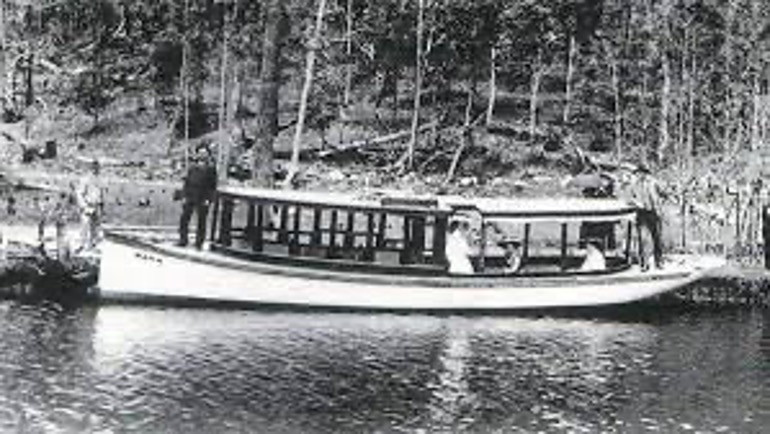
The launch Mona – one of the boats owned by Charles Bowers used to convey tourists on Wallis Lake.
(7) Newcastle to Taree: Australian Town and Country Journal – 29 June 1910, page 21.
“The trip from Sydney to Taree, a prosperous town on the Manning River, is accomplished in two full days, during which the traveller is taken by train, coach, motor-launch, and steamer over a delightful course of mountain roads, winding rivers, and quiet, picturesque lakes, the surroundings always being of a pleasant and varied nature, and such as to never weary the sight-seer with monotonous sameness. It is only within a very recent period that visitors to the northern rivers and residents on the North Coast have begun to recognise the charms this tour has to offer, but it has now established itself as a favourite, and the four trips made regularly every week are now so liberally patronised that the travelling facilities are taxed to the utmost.
FROM STOCKTON TO SALT ASH. Leaving the morning train at Newcastle, the first coach journey is begun at Stockton. The road traverses the banks of the Hunter for some distance, near the entrance of the river to Newcastle Harbor. On the way, numerous sailing vessels may be seen busily discharging their ballast preparatory to taking loads of coal for British or foreign ports. These ships present a curious spectacle as they lie moored up to the wharves, sometimes two abreast, their straight, upright-masts giving the impression of a forest of gigantic trees which have been stripped of all their foliage. At Fullerton Cove, the road leaves the river bank, and winds for several miles through a series of prosperous dairy farms and orchards. Branch roads lead to Hexham, Raymond Terrace, and the small settlement at William Town, which lies about half way between Newcastle and Salt Ash. The main road leads on to Nelson’s Bay, but a short branch road of about a mile brings the tourist to the first sign of the lakes and river travelling. The country at Salt Ash is flat and mangrove-covered, a long wharf stretching out to about midstream being utilised for the passengers to embark in a comfortable and roomy steam launch on Tilligerry Creek.
BY LAUNCH TO NELSON’S BAY. Travelling by launch from Salt Ash the route to Nelson’s Bay traverses Tilligerry Creek, a picturesque and broad but rather shallow sheet of water, which eventually enters Port Stephens. The banks for the most part are low-lying and covered with mangroves, but patches are cultivated by energetic settlers as orchards, or are used for dairy farms. At the mouth of the stream, after rounding Bull’s Island, a magnificent, extensive view shows the Port Stephens Heads in the distance on the east, while a fine view is obtained of a beautiful headland known as Sawyer’s Point [Karuah], which marks the entrance of the Karuah River on the western side of the bay. Nelson’s Bay has much charming beauty. The route to Nelson’s Bay traverses Tilligerry being around Middle Island. Then the fame of the bay as a fishing ground has long been established. Nelson’s Bay is a nicely secluded little settlement, being well protected from strong winds by Flagstaff Hill and the rising ground to the south and west.
A DAY’S TRAVEL ENDED. The next stopping place of any importance on the route is Tea Gardens, where a halt is made for the night. The water passage from Nelson’s Bay to Tea Gardens presents many attractive features. Long narrow sand banks extend far out into the bay, and after passing several wharves, utilised for the dispatch of timber and alum stone from higher up the river, the deserted buildings of Hawk’s Nest suddenly come into sight on the northern bank. It was at this spot that the original settlement was made, but when the timber supply became exhausted a once-flourishing mill closed, the employees de-camped, and nothing now remains but the crumbling ruins of the buildings. Tea Gardens is a prettily-situated little village, and one which is destined to become a rather important commercial centre, for it is here that the bulk of the shipping of the port and lakes is concentrated. Fishing is a favorite sport in this locality, the expansive sheet of water which the township fronts being rich with sport for anglers. A timber mill also flourished in the village a few years back, but here, too, the supply has failed.
ON THE MYALL RIVER. Leaving Tea Gardens the route follows up the wider reaches of the Myall River, until the river narrows, and is only navigable by small, shallow craft. The banks of the stream are literally smothered in a prolific growth of swamp-oak, ti-tree, dense masses of staghorns, and occasional clumps of cabbage-tree palms. After passing Devil’s Elbow, the river broadens at the Glasswater, then alternately narrowing and widening until Nellie’s Bay and Chinamen’s Bay are left behind. Entering the Broadwater at Samboi, the headquarters of several fishermen, a splendid view is obtained of the two streams, which branch off — one to Bulahdelah and the other through Lower Booloombayt or two-mile lake. The course is studded with several picturesque green islets, till the great Myall Lake is reached, and it, too, is dotted with pretty islands, while quite a number of dairy farms line the shores. Neraine and Bungwahl lie on the northern end of Myall Lake, the latter township being the scene of busy saw-milling operations.
A PRETTY DRIVE. Probably one of the most picturesque sections of the route is now entered. Tourists are conveyed by coach for a distance of about eight miles along a bush road, which winds around the shores of Smith’s Lake, this extensive sheet of water presenting one of the finest views along the route. Far out on the horizon the well-known Seal Rocks are to be seen. Wallis Creek is the next “transhipping station,” and after “a pleasant run of about 14 miles over the picturesque Wallis Lake and Wollomba River, the towns of Forster and Tuncurry are come upon.”
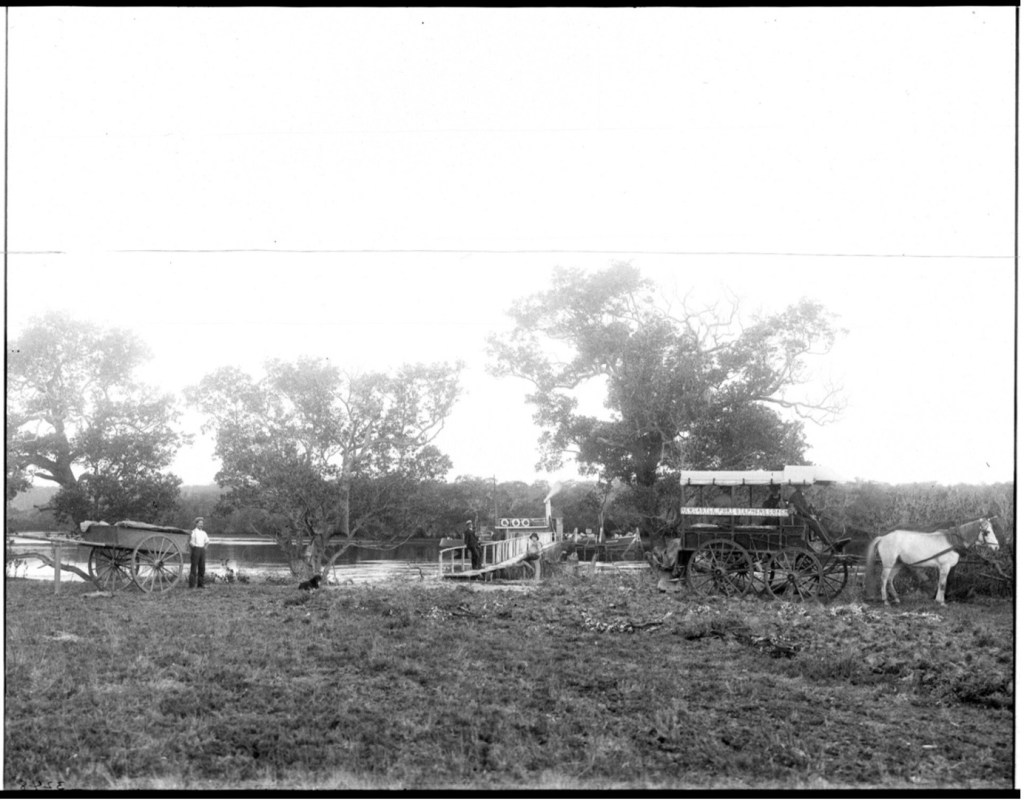
A coach from Stockton delivering travellers to a steam launch at the Salt Ash wharf on Tilligerry Creek, 1907. The sign on the side of the coach reads: Newcastle Port Stephens Coach – Leaves Stockton Wharf Tuesday and Friday.
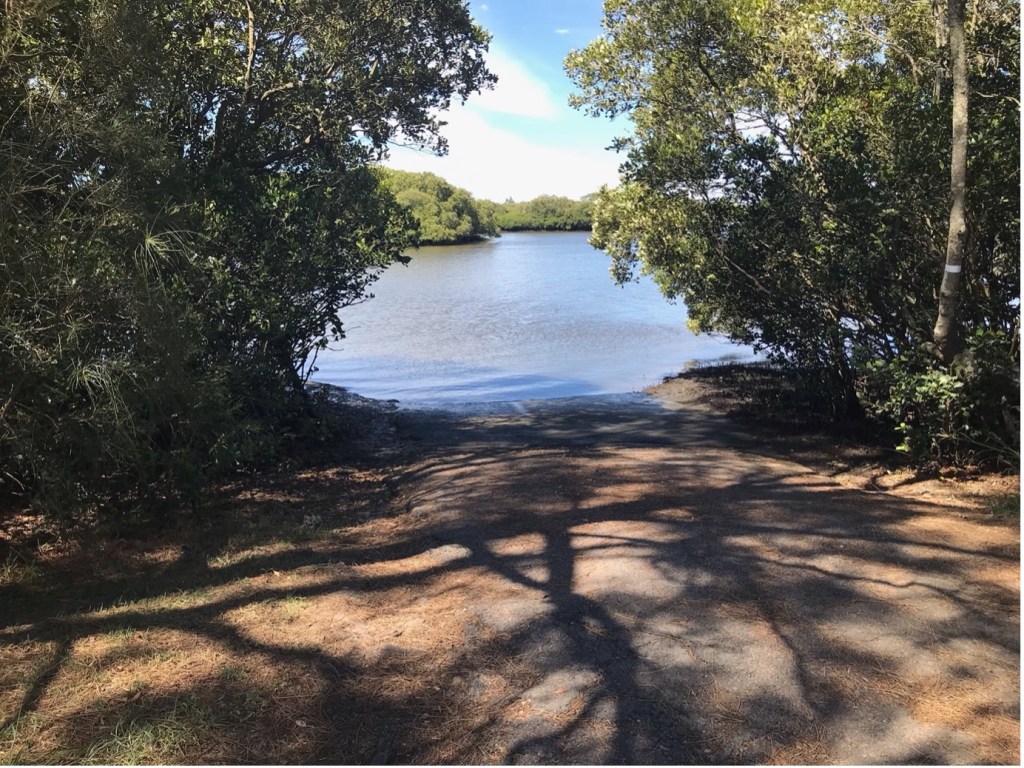
Site of the demolished Salt Ash Wharf located near the intersection of Lemon Tree Passage Road and Rookes Road, Salt Ash [Author Photo]
End of the Lakes Travel Route – 1914
After seven years of operation the Lakes Route was suddenly abandoned by the one of the chief transport providers in January 1914. The Dungog Chronicle: Durham and Gloucester Advertiser of 16 January 1914, page 8, reported:
“Tourists are loud in their complaint of the cessation of the line of coaches from Bungwahl to Forster and Tuncurry, the connecting link of the through route — Stockton to Taree. Messrs Thurlow Bros., pluckily instituted this route by establishing a line of coaches from Stockton to Salt Ash, and then steamer, which travels from that place to Nelson’s Bay, Tea Gardens, up the Myall River, and through the lakes to Bungwahl. Here Mr “Jim” Godwin had a line of coaches to convey tourists to Forster, so as to connect with the Tuncurry-Taree line. Many city folk were in the habit of doing the round trip, returning by train from Taree. The road, however, from Bungwahl to Forster, has been allowed to drift into such a terrible state of disrepair that it is positively unsafe to travel over it, and Mr Godwin has had to cease running his coaches. Tourists will no doubt find plenty of scope in the extensive waters of Port Stephens and Myall Lakes for both shooting and fishing, but the route would be more popular if tourist’s could get to the Manning River from the lakes. Perhaps those interested should make the road to Forster trafficable. The Government are in funds again, now a 3-million loan has been floated, and perhaps Bungwhal may get a bit of it.
Modified Lakes Travel Route reinstated – 1925
In February 1925 , a new modified lakes travel route was launched, utilising a new ferry service from Salt Ash. The new route ended at Bungwahl, but did not include travel over Wallis Lake, thus requiring road travel thereafter to Forster. Tourists would eventually travel to Taree, for a train trip back to Sydney. The new arrangements must not have proved successful, as no further travel reviews were published by tourists, as had occurred with the previous lake route.
The Newcastle Sun of 16 February 1925, page 5, reported:
“The Great Lakes route, are of the finest assets in the State from a tourist point of view, will be an established fact within the next fortnight.
The Killarney of the South offers unique advantages for the visitors under a new scheme, which includes the establishment of a new ferry service from Tilligerry Peninsula to Tea Gardens by a company with a capital of £15,000. The distance between Newcastle and Tea Gardens will be very considerably reduced. The route will be from Tea Gardens, through the magnificent Myall Lakes, by Legge’s Camp to Bungwahl. From this township, the route is through beautiful bush by road to Forster and Cape Hawke, and thence to Taree, where a special connection is made by train for Sydney. The matter is being taken up with enthusiasm by districts concerned. The special advantages of the Great Lakes’ tourist route were explained at a well-attended meeting at Tea Gardens on Saturday night by a party comprising Messrs. J. W. Cox and J. Casey, tourist department, C. R. J. Franklin, Stroud shire, and H. C. Barnett, Newcastle.
Every assistance on the part of the department was promised by Mr. Cox, on behalf of the director of the Bureau, who also gave an assurance that the Railway Department would likewise cooperate in the encouragement of tourist traffic. He said that they must bring increased prosperity to the district, particularly where there was so much to offer. The advantages of Port Stephens were enumerated by Mr. Barnett, who declared it an appalling matter that so much time was now absorbed in travelling. It was absurd, he said, to think that the distance of 25 miles from Newcastle to Tea Gardens should take four and a half hours. Under the new scheme, he predicted a very considerable reduction. Twenty-five hundred people in the residential area demanded better facilities, he said, and this new ferry service would give, what this area was, a natural playground for Newcastle. It was Mr. Barnett’s dream that Port Stephens should be brought within 43 minutes of Newcastle, and this he believes, was not impossible. Tea Gardens was quite alive to the advantages of tourist traffic, declared Mr. C. R. Franklin, who presided, and would do all possible to assist in the movement. The meeting gave the proposal enthusiastic support.”
Concluding Comments
The various travel operators who coordinated their services to provide a seamless method of travel over a series of water and road components, were people of vision. It appears that they were ahead of the Government which was slow in providing adequate roads along the coast for travellers. While travel to parts of the north coast were possible by train, many seaside towns were still cut off by lack of trafficable roads.
Appreciation is due to the many travel writers of the time, some of whom have been featured in this paper, who provided such rich descriptions of the route. When reading these reviews, one feels that they are a participant on a wonderful holiday adventure, over one hundred years ago.
Further information on early travel within the Port Stephens region is published on this website and can be viewed at the following links:
A Four Day Excursion to Port Stephens – Christmas 1906
A Personal Tour of Port Stephens – 1914
Excursion from Newcastle to Port Stephens by Sea
A Journey from Port Stephens Up the Myall Lakes to Forster – 1908
Journey from Maitland to Port Stephens – 1889
An excursion to Port Stephens by Dr Richard Arthur, MLA – 1914
‘Dungog and Round About’ – 1909 and 1910
A Description of Nelson Bay – Port Stephens – 1892
A Vacation Cruise from Sydney to the Myall Lakes – 1892
A Journey Around Port Stephens – 1894
Researched and compiled by Kevin McGuinness
February 2022

 Port Stephens - a history exploration