
Introduction
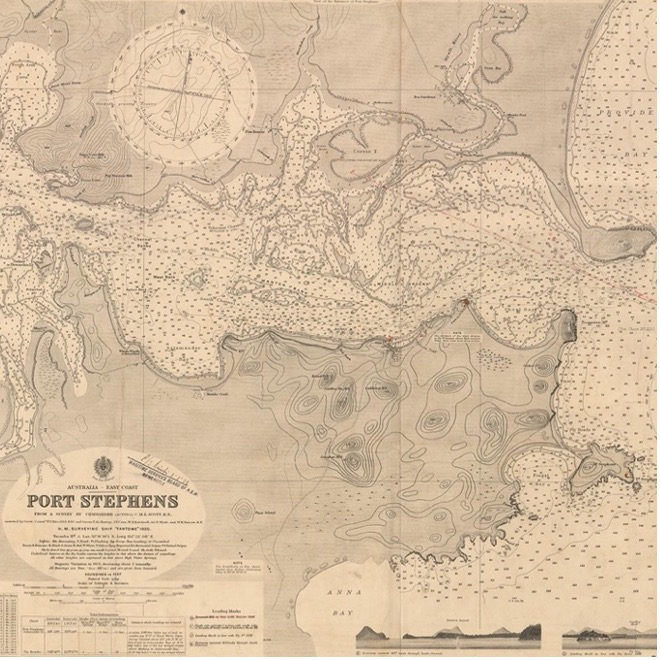
The Port Stephens Survey Map (1920) was published on 3 May 1924 at the Admiralty in London. It was compiled from the survey of Port Stephens undertaken by Commander (Acting) C. M. L. Scott, Royal Navy, from April to August 1920, in H.M. Surveying Ship Fantome.

Port Stephens Survey Map 1920 [National Archives of Australia]
Using the resources of the Australian National Library’s Trove newspaper collection, this paper tells the story of the Map.
PART ONE: HMS Fantome
HMS Fantome was launched on 23 March 1901 at Sheerness, England. She and her sister ship HMS Merlin were built for the Royal Navy Survey Service. The Fantome conducted Royal Naval survey work in Australian waters originally from 1907 -1914.
The ship had an interesting period of service in the years of the First World War (1914-18) and beyond:
- transferred to the Royal Australian Navy (RAN) on 27 November 1914;
- commissioned as HMAS Fantome and sent to New Guinea in December 1914;
- returned to Sydney and decommissioned in February 1915;
- recommissioned on 27 July 1915 as a RAN patrol vessel, having been armed with guns, and sent on patrol duties in various overseas regions;
- decommissioned in Sydney on 14 January 1919 for return to the Royal Navy;
- recommissioned back into the Royal Navy in Sydney in April 1920, after a refit and the removal of her guns, for service again as a survey ship.
One of first tasks of the Fantome was the surveying and charting of Port Stephens in 1920.
The ship served in Australian waters until late 1923. On 9 January 1924, the Fantome returned to Sydney to be decommissioned after completing a survey of the western approaches to Endeavour Strait and the Prince of Wales Channel.
On 17 April 1924, she was sold to William Waugh Ltd of Balmain, Sydney, for breaking up.
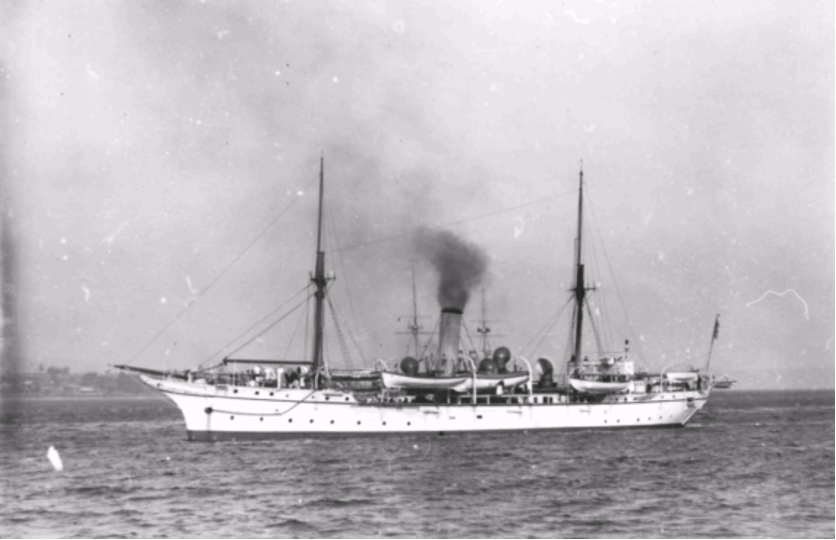
Fantome
HMS Fantome at Port Stephens
The Fantome was engaged in the survey of Port Stephens from April to August 1920. While in the Port, the ship’s crew developed a rapport with the local community as evidenced in the following newspaper reports:
School Visit to Ship
The Raymond Terrace Examiner and Lower Hunter and Port Stephens Advertiser of 23 April 1920, page 3, reported:
‘H.M.S. Fantome is at present in Port Stephens engaged in survey work. On Sunday afternoon last, thanks to the courtesy of Commander Scott the children of the local school were afforded an opportunity of looking over the vessel. In charge of their teachers the pupils were conveyed on board in the ship’s boats, where they were taken in hand by the officers and men and shown all the objects of interest, and their uses and workings explained.
The children evinced the deepest interest in all they saw and looked upon the visit as one of educational value to them. The Commander, officers, and men of the Fantome, spared no effort to entertain the youngsters, who before leaving the ship, were treated, by the ships company to afternoon tea, when they were regaled with good things of descriptions too various to mention.
The juveniles are loud in their praise of the kindly reception accorded them, and the treatment they received, and pronounce the visit as the best ever. Commander Scott R. N. explained to the teacher, many matters of interest which will be made the subject of future lessons in connections with the school work. On the whole the visit was greatly enjoyed by all, and the teachers and pupils desire to express to the Commander, officers, and men their highest appreciation of the courtesy and kindness extended to them.’
‘The Fantomes’
The Raymond Terrace Examiner and Lower Hunter and Port Stephens Advertiser of 13 August 1920, page 3, reported:
‘One of the most successful social functions held locally for some time was the concert and dance arranged by the Sport’s Club of H. M.S. “Fantome,” in aid of the Public School Fund held on Friday evening 30th July. The attendance was large and appreciative and included Captain Scott and Mrs. Scott, and several officers and men from the survey ship, as well as visitors from Tea Gardens and Anna Bay.
A fine vocal and instrumental programme was rendered by “The Fantomes,” assisted by ladies from Tea Gardens and Nelson’s Bay, and the local school pupils. The arrangements were made by the Fantome Sports Club, and carried through under the able directorship of Mr. E. R. Holman, sport’s secretary. Refreshments were supplied by the ladies of the P. and C. Association. In addition to being a great social success, the school fund will materially benefit as a result of the entertainment.
Before the conclusion of the programme, Mr. Greentree, local teacher, thanked the officers and men. of the Fantome for their generosity in arranging the entertainment, to which Mr. Holman replied, and expressed the pleasure it gave the ship’s company to assist a worthy cause. At the conclusion of the concert programme, a few hours were spent in dancing, and a very successful and enjoyable evening concluded with the singing of Auld Lang Syne.’
Mishap to a Boat Belonging to Fantome.
The Raymond Terrace Examiner and Lower Hunter and Port Stephens Advertiser of 20 August 1920, page 3, reported:
‘During the recent westerly gales, several boating accidents have occurred locally, fortunately without serious results. ….. Monday 6th inst, was the worst day experienced for many years. A boat belonging to H.M.S Fantome, working outside the heads was unable to make the harbor, and the occupants had an unenviable experience, being out all night at the mercy of the elements. They were rescued early on the following morning, none the worse for their enforced absence. The survey ship ‘H.M.S Fantome’ will shortly be leaving Port Stephens for Thursday Island, the work here being satisfactorily completed, During their stay in this Port the ‘Fantomes,’ have become very popular, and regret is expressed at their projected departure especially by some of the ‘fair sex,’ who have a tender spot for the blue jackets.’
The Fantome’s log states that the steam whaler unable to make the harbour was named the Herald. Another steam whaler named Alert, belonging to the Fantome, went in search of the Herald and found it within lee [shelter] of Tomaree Head. Both of these small whalers used for survey work were stowed on board the Fantome.
Fantome Leaves the Port
The Raymond Terrace Examiner and Lower Hunter and Port Stephens Advertiser of 27 August 1920, page 3, reported:
‘H. M.S. Fantome left this port on Friday night last [20 August, 1920], having completed the survey of Port Stephens for the Imperial Navy. It is rumoured that a gang of men will shortly be employed at the Naval Base, and further developments are awaited, and expected as a result of the activity being displayed’.
The log of the Fantome recorded the following entries on its last day in the Port:
5.00am: Lit fires in Alert.
6.00am: Hands employed cleaning ship.
7.00am: Lieutenants Hervey and Cary left ship on surveying duties.
7.10am: Ship weighed and proceeded as required.
8.30am: Anchored to draw sketch of leading line.
8.30am: Lieutenants Bardwell and Farrow left ship on surveying duties.
9.05am: Hands employed cleaning mess deck.
10.00am: Weighed and proceeded as required [The ship moved from Salamander Bay to Nelson Bay].
10.55am: Anchored as required.
10.55am: Lieutenant Farrow and Bardwell returned on board.
11.15am: Hoisted first whaler.
Noon: Draught leaving: forward 10 [feet] 3 [inches], aft 11 [feet] 6 [inches].
1.05pm: Weighed and proceeded as required.
1.10pm: Hands employed as required.
3.45pm: Lieutenants Hervey and Cary returned on board.
3.45pm: Came to with Port anchor and veered to 2½ shackles in 7 fathoms water, Nelson Bay.
7.15pm: Hoisted Alert.
9.20pm: Weighed and proceeded out of harbour. Courses and speed as requisite.
9.45pm: Passed Heads.
10.10pm: [Point] Stephens Light bearing West true. Set course 214°. Set patent log 0. 135 revolutions.
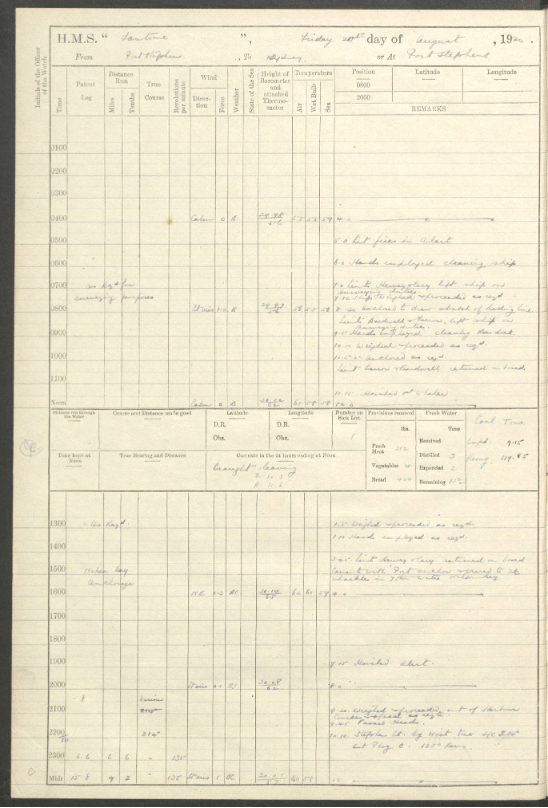
Log of the Fantome of 20 August 1920
PART TWO: Items of Historical Interest on the Survey Map
An examination of the 1920 Survey Map shows the following points of historical interest:
Ending of Nelson Bay Road at Salt Ash
The Survey Map features an insert map which shows that in 1920, Nelson Bay Road as a trafficable road did not exist past Salt Ash. To reach Nelsons Bay and various parts of Port Stephens, travellers were required to take a steam launch from Salt Ash along the Tilligerry Creek and then into Port Stephens.
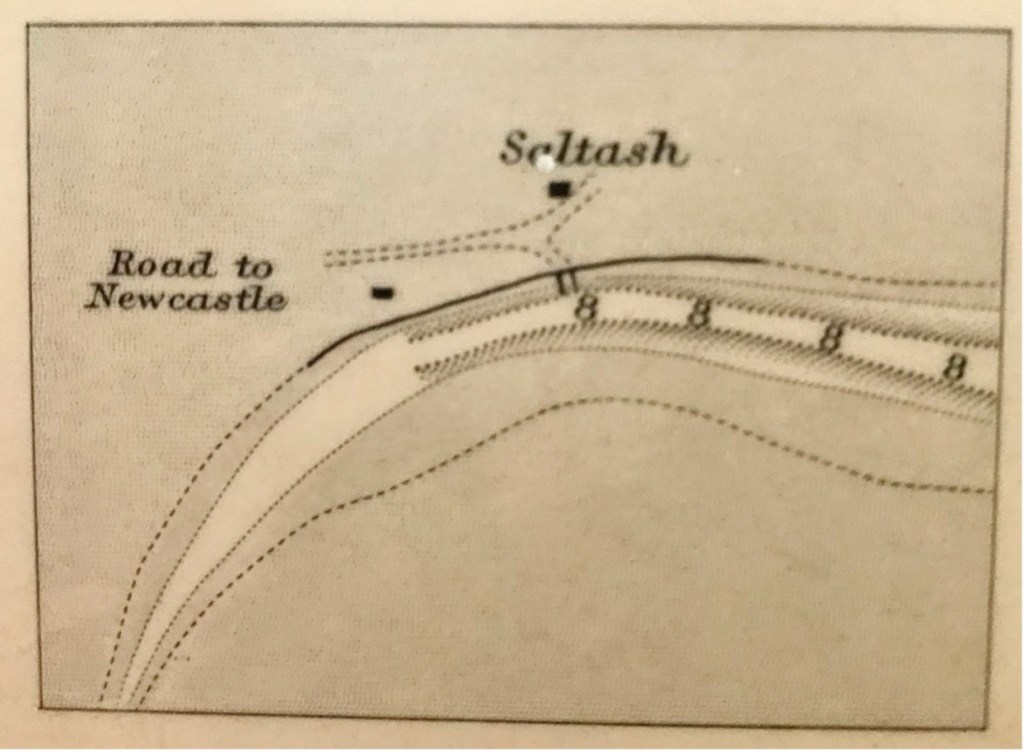
Insert Map showing Nelson Bay Road to Salt Ash circa 1920
The Vanishing Myall Point
In a recently published book, “Past Port” (2020), Mike Scanlon featured Myall Point, (Page 1). This was a vegetated peninsula that stretched from the western tip of Winda Woppa running parallel to and below Corrie Island near the mouth of the Myall River. It appears on maps of Port Stephens from 1845.
The following section of the 1920 survey map, as below, shows Myall Point, where it is described as a ‘low sand point covered with small scrub’.
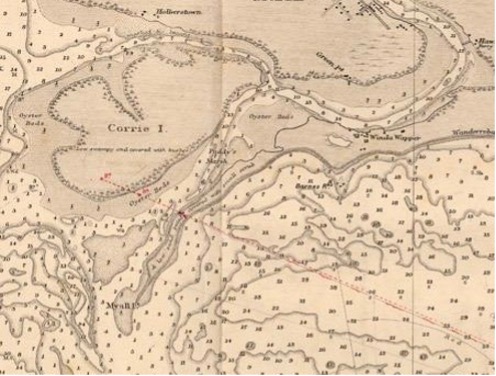
Area of 1920 survey map showing Myall Point (centre) [National Archives of Australia]
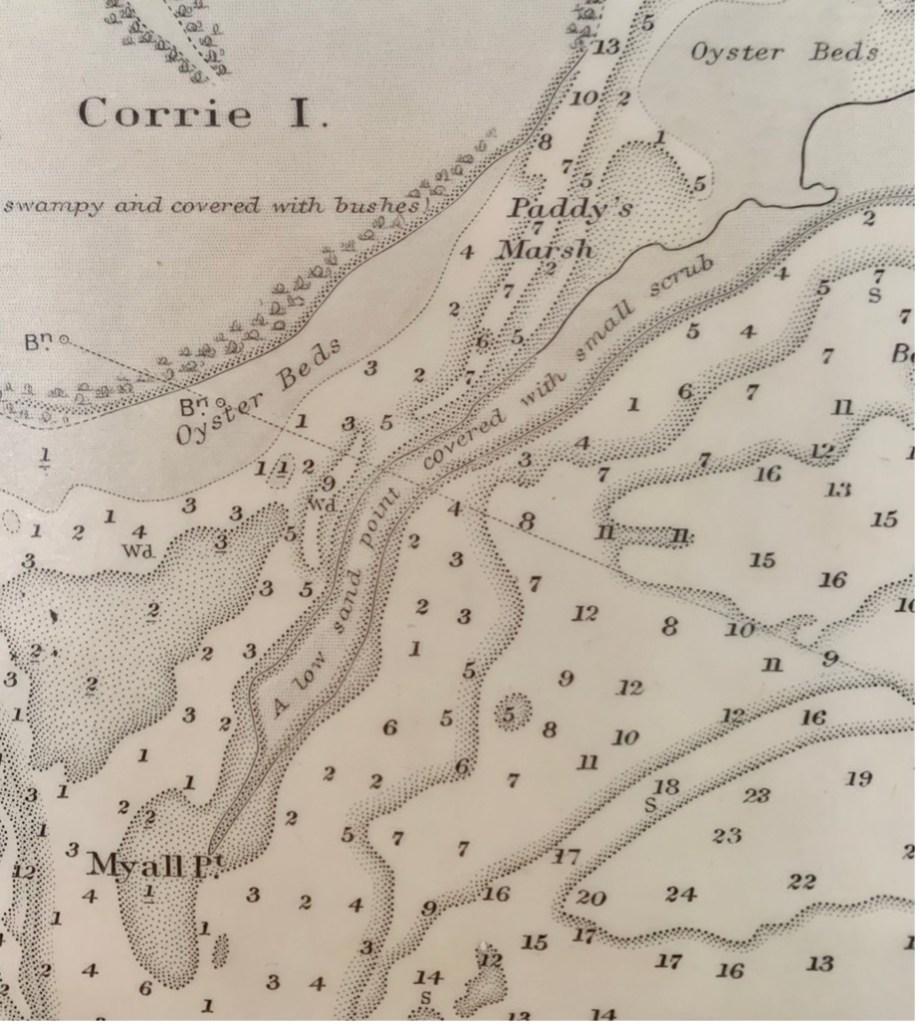
…and the area as inscribed on the Survey Map
Today Myall Point as a land feature has vanished, having succumbed to dredging, a change in tidal patterns and a ferocious storm in 1927. It is marked on maritime maps as a ‘sandy shoal’ named Paddy Marr’s Bar (formerly Paddy’s Marsh). It is hazardous to boating.
Site of Proposed Naval Base
In the decade of 1910-1920, there was serious discussion by government authorities concerning the establishment of a Naval Base at Salamander Bay in Port Stephens.
In 1913, the Commonwealth Government resumed land and in 1916 gazetted the area for the purpose of constructing a submarine base.
Some preliminary work was commenced around Wanda Wanda Headland with the construction of access roads, drainage ditches and a wooden jetty, using a labour force of 250 unemployed miners from Newcastle.
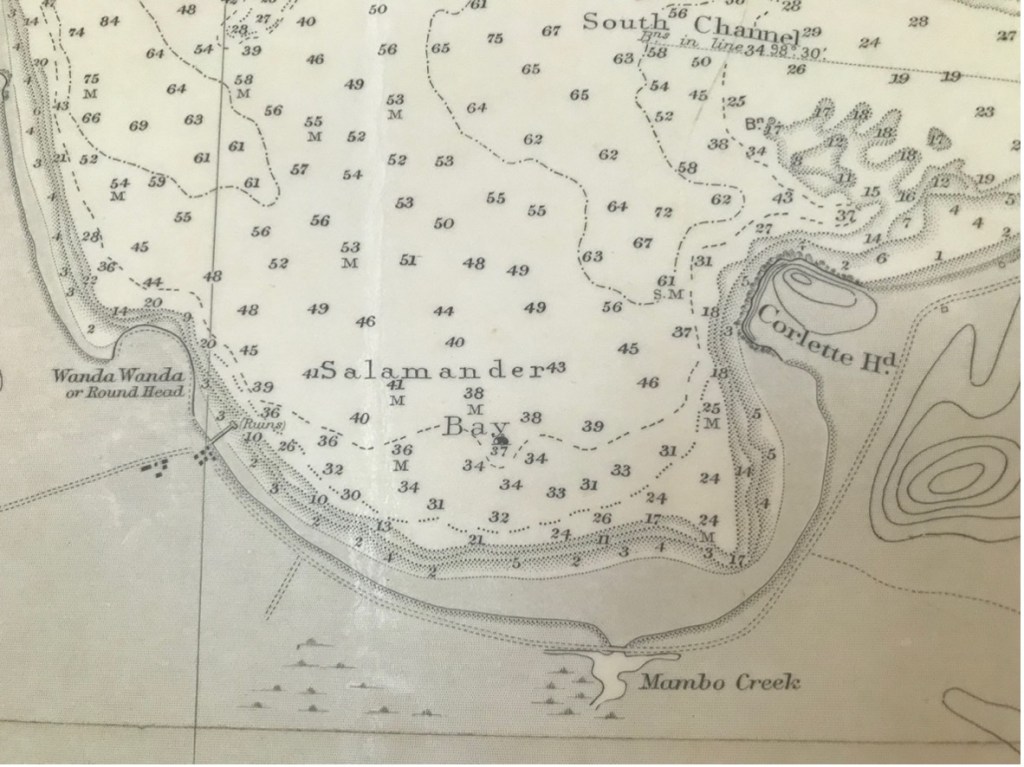
Area of Map showing site of proposed Naval Base at Salamander Bay
Little progress was made during the years of the First World War. However, on his visit to Australia in 1919, Lord Jellicoe, Admiral of the British Fleet, still envisaged Port Stephens as the site of a major Naval Base.
This did not eventuate and construction works had ceased by 1922.
Marsh lands in Nelson Bay township and public well at Fly Point.
The survey map shows a section of the current Nelson Bay Central Business District near the corner of Magnus Street and Yacaaba Street, that was marsh land at the time of the survey.
The Raymond Terrace Examiner and Lower Hunter and Port Stephens Advertiser of 10 October 1935, page 2, reported that the Port Stephens Shire Council had arranged for the splitting of 750 slabs of wood for the reclamation of the Nelson Bay foreshore.
A public water well is also shown at Fly Point, adjacent to the present-day Victoria Parade around the site of the stage in Neil Carroll Rotary Park. This was an important source of fresh water for holiday campers in the area.
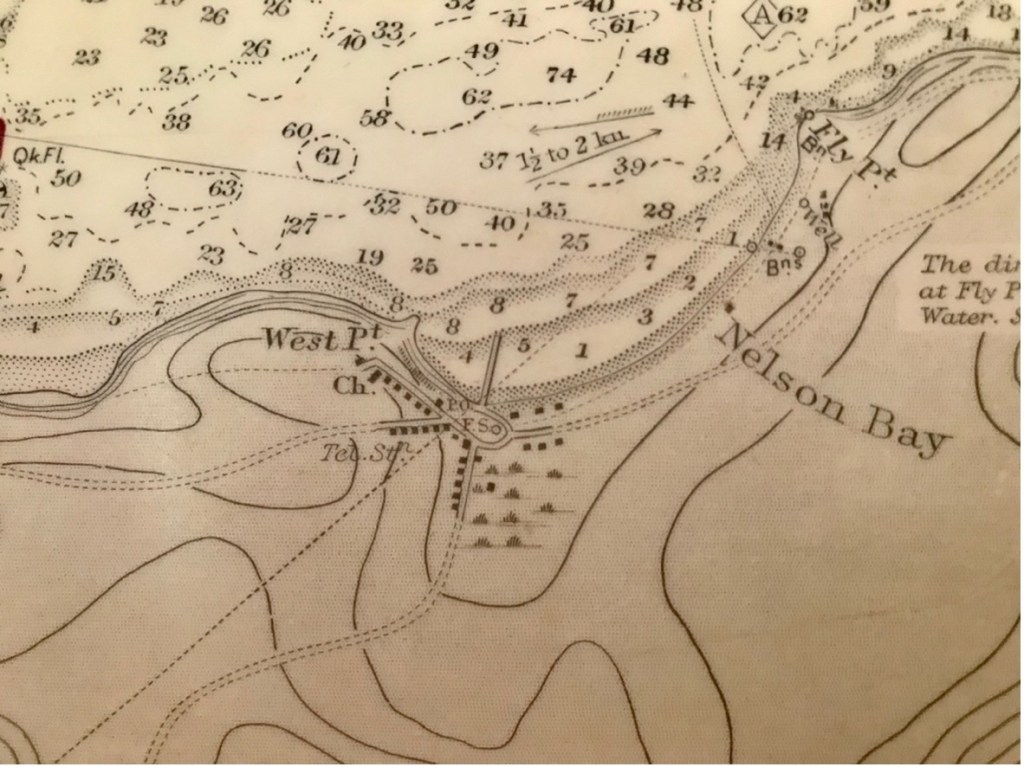
Area of Map showing the sites of marsh land and public well in Nelson Bay.
Concluding Comments
The Evening News of 30 April 1924, page 5, reported on the Fantome, that was currently idle in Sydney:
‘The departure from Sydney today of Commander Maxwell, R.N., Paymaster Lieutenant-Commander Humphreys, R.N., and six ratings of H.M.S. Fantome closes the career of that survey ship in Australian waters under the Royal Navy’s colours.
The Fantome enjoys the distinction of having had the longest service in Australian waters of any vessel of the Royal Navy. She is now an idle ship lying at the back of Garden Island. Originally a sloop of 1070 tons, the Fantome was built at Sheerness in 1901, and had her first commission in 1902. She came to Sydney five years after and has been in these waters ever since. In 1920 she was returned to the Royal Navy, under Acting-Commander Scott, and in March 1921, Commander F. S. B. Maxwell took her, remaining on the ship until this month, when H. M. S. Herald arrived to take her place. Today the Fantome was paid off. Some fine surveying work stands to the credit of the Fantome, notably the discovery of the Fantome Rock, near the Cumberland Islands, on the Queensland coast. The Herald, under Commander Harvey, a noted hydrographer, was one of the last of the war sloops, and is admirably adapted to survey work.’
Researched and compiled by Kevin McGuinness
March 2022

 Port Stephens - a history exploration